

Fitz Lee (June 1866 – September 14, 1899) was an African American soldier from Dinwiddie County, Virginia, who served with Troop M, 10th United States Cavalry—one of the famed Buffalo Soldier regiments of the post–Civil War Army. His service reflects the presence and contributions of Black Virginians in the regular U.S. Army at the close of the 19th century.

American soldier and Medal of Honor recipient Fitz Lee.
Image courtesy of Wikimedia Commons (Public Domain).
Lee enlisted in December 1889 and served during a period when African American troops were routinely assigned to demanding and dangerous duties while receiving limited public recognition. His identity as a Buffalo Soldier places him within a nationally significant military tradition tied to western frontier service and overseas conflict.
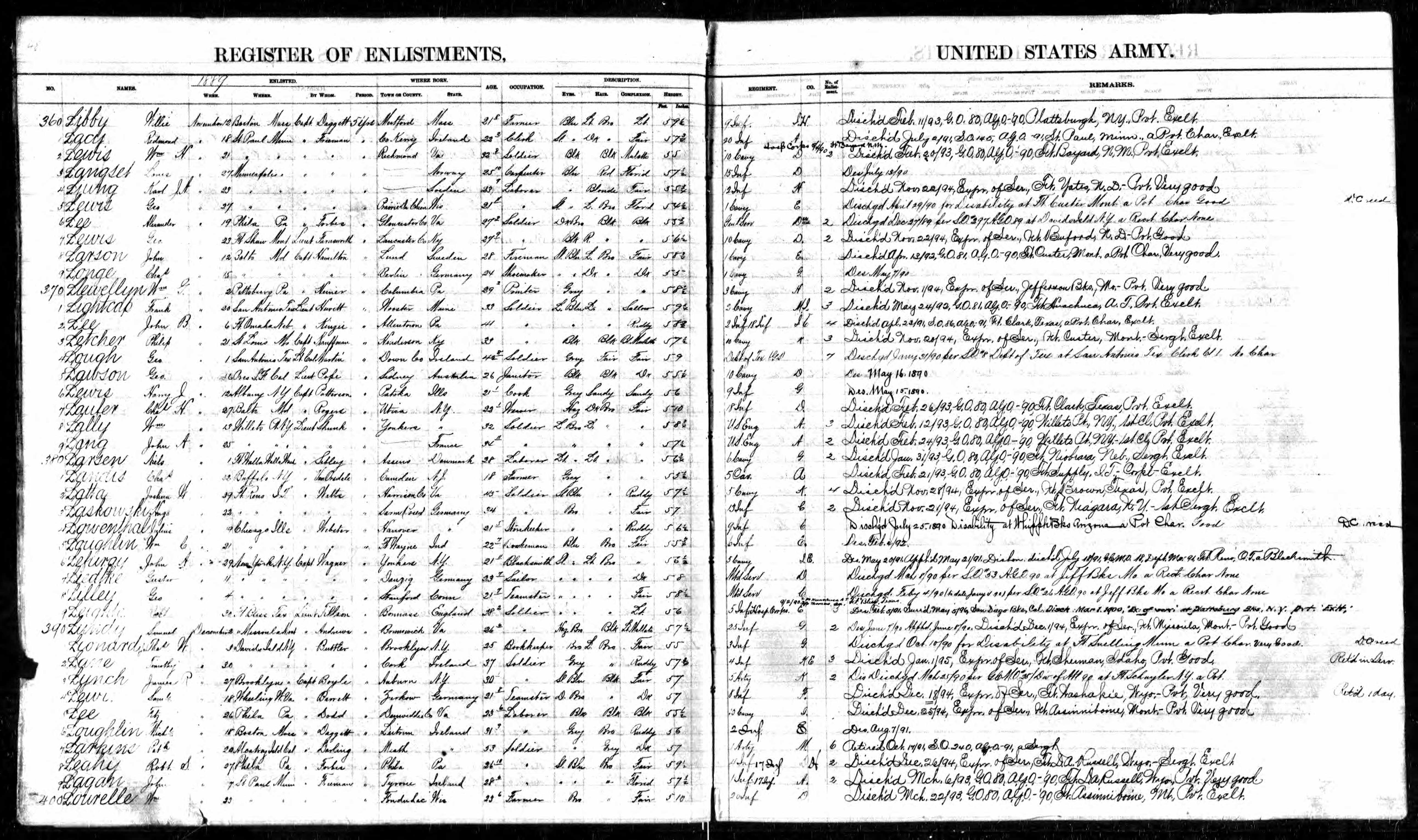
Click image to enlarge.
Enlistment record for Fitz Lee from the U.S. Army Register of Enlistments.
Line 395 of image references Fitz Lee.
Source:
Ancestry.com. U.S., Army, Register of Enlistments, 1798–1914 [database on-line]. Lehi, UT, USA: Ancestry.com Operations Inc., 2007.
Additional historical context regarding Fitz Lee and the 2025 renaming of Fort Lee may be found in the archived article, The Army Made a Blind Black Soldier a Surrogate for Robert E. Lee .
Biographical information concerning Fitz Lee’s Medal of Honor service also appears in Charles W. Hanna’s African American Recipients of the Medal of Honor: A Biographical Dictionary, Civil War Through Vietnam War (Jefferson, North Carolina: McFarland, 2002), pages 114–115. A digitized version is available through the Internet Archive .
The United States Army’s official announcement concerning the renaming of Fort Lee in honor of Fitz Lee is available at Army.mil .
Burial information for Fitz Lee is documented through Find A Grave Memorial #12020 , which identifies his burial location as Fort Leavenworth National Cemetery, Section G, Site 3183, in Leavenworth County, Kansas. The memorial also includes an image of the tombstone.
If you have questions, contributions, or problems with this site, email:
Coordinator - Ed Olsen
State Coordinator - Jeff Kemp
If you have questions or problems with this site, email the County Coordinator.
Please do not ask for specific research on your family. I am unable to do personal research.