
by: Ed Olsen, 2026 Dinwiddie County, Virginia USGenWeb coordinator
Robert Clark was a successful African American businessman in Petersburg, Virginia, whose life illustrates both the opportunities and challenges faced by free Black residents in the decades before and after the Civil War. Born enslaved in Virginia about 1825 or 1826, Clark gained his freedom in 1849 and built a prosperous livery stable business that made him one of Petersburg's most successful free Black entrepreneurs.
The story of Robert Clark survives only in scattered records. A brief mention in a twentieth-century historical article, a recollection written by a Petersburg physician, census records, a deed of emancipation, birth registers, and cemetery records together allow us to reconstruct portions of his life. Although many questions remain unanswered, these sources reveal the remarkable journey of a man who rose from slavery to become one of Petersburg's most prosperous African American businessmen before and after the Civil War.
What follows is an examination of those records and what they tell us about Robert Clark, his family, and his business career in Petersburg, Virginia.
Seagrave's post appears to have been based largely on Luther P. Jackson's article "Free Negroes of Petersburg, Virginia," originally published in The Journal of Negro History in 1927.
Jackson wrote:
"Others acquired their freedom only in the immediate decades preceding the Civil War. One of this class was Robert Clark, who worked as a slave at a hotel in Petersburg and later bought his freedom. Immediately afterwards he opened a livery stable on Lombard Street and did exceedingly well. During the decade of the 1850's there was hardly a free Negro in Petersburg who excelled Clark in business prosperity. By 1860 his real estate and personal estate amounted to $9,000. He had continually on hand for hire horses, buggies and carriages, open or close."
Jackson's source for this statement was John Herbert Claiborne's Seventy-Five Years in Old Virginia. Claiborne recalled that "Bob Clark" worked in the dining room at Powell's Hotel in Petersburg and, through careful saving, accumulated enough money to purchase his freedom and establish a livery stable on Lombard Street.
Although Claiborne referred to the establishment simply as "Powell's," the hotel had a long history in Petersburg. Edward Pollock, writing in Historical and Industrial Guide to Petersburg, Virginia (1885), noted that the Powell's Hotel Company was incorporated in 1843 after the earlier Powell's Tavern had been destroyed by fire. Pollock wrote that the new hotel stood on the same site as the earlier tavern, on the location later occupied by Petersburg's Iron Front Building. The company was capitalized by several prominent Petersburg businessmen, including A. G. McIlwaine, D'Arcy Paul, George W. Bolling, William Talley, and William Brownly. If Claiborne's recollection is accurate, Robert Clark would have worked at one of Petersburg's leading hotels during a period when the city was experiencing significant commercial growth.
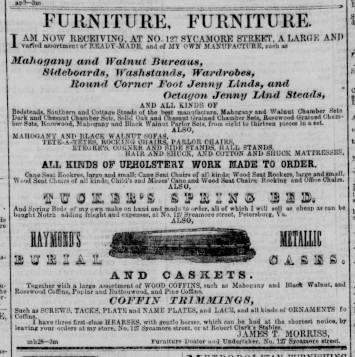
Additional evidence of Robert Clark's prominence appears in an advertisement published by Petersburg furniture dealer and undertaker James T. Morris in the Petersburg Index on 18 May 1866. Advertising his undertaking services, Morris instructed customers to leave orders either at his store on Sycamore Street "or at Robert Clark's Stables." This reference indicates that Clark's establishment was well known within the community and trusted as a place where business could be conducted. It also suggests that Clark's livery stable may have played a role in Petersburg's transportation and funeral services network.
By 1860, census records demonstrate just how successful Clark had become.
Confirmation in the 1860 Census
Seagrave also cited the 1860 United States Census for Petersburg. The census provides independent evidence supporting the accounts of both Jackson and Claiborne.
In Petersburg's East Ward, Robert Clarke was enumerated as:
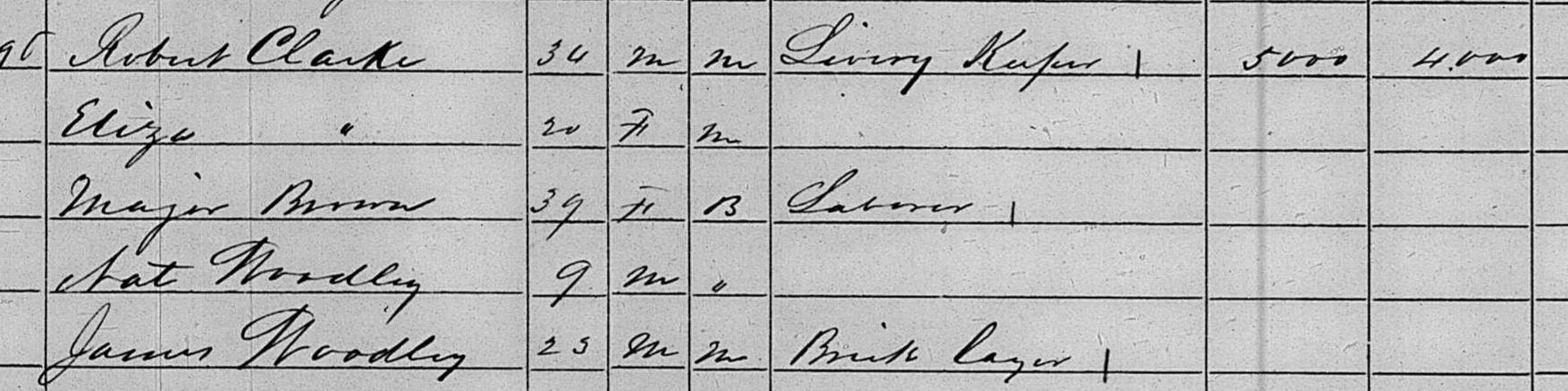
Also residing in the household was Eliza Clark, age 20, identified as mulatto and born in Virginia.
The combined value of Robert's real and personal property totaled $9,000, exactly matching the amount cited by Jackson. The census confirms that by 1860 Clark had achieved a remarkable level of economic success.
Eliza Clark's presence in the household raises interesting questions. Because she appears in the 1860 census as a free person of color, she was almost certainly free before emancipation became universal in Virginia. Whether she was Robert's wife, sister, or another relative remained unclear in 1860 because that census did not record relationships between household members.
While researching Robert Clark on Ancestry and other genealogy websites, I located a deed of emancipation recorded in Petersburg in 1849.
The document was executed by Richard N. Thweatt of Chesterfield County and formally proved before the Petersburg Hustings Court on April 19, 1849. In the deed, Thweatt emancipated:
"...my negro slave called Robert Clark..."
and explained that the action was taken in appreciation of the:
"...extraordinary merit and fidelity..."
of Robert Clark, then described as approximately twenty-three or twenty-four years old.
The age given in the deed places his birth about 1825 or 1826, precisely matching the age reported in the 1860 census. The emancipation was recorded in Petersburg, where Robert later operated his business.
Although additional evidence would strengthen the identification, the age, location, and timing strongly suggest that the Robert Clark freed by Richard N. Thweatt in 1849 is the same Robert Clark who became the prosperous Petersburg livery stable owner.
Additional evidence of Robert Clark's business activities survives in a notice published in the Daily Express on 21 February 1866. In the advertisement, Clark offered a reward for the recovery of a horse allegedly stolen by John Bolling. The notice identifies Bolling as a formerly enslaved man from Prince George County and provides a detailed physical description in hopes of securing his capture. Beyond the circumstances of the theft, the advertisement confirms that Clark was actively engaged in the livery business during the early years of Reconstruction and maintained horses as part of his operation. The notice helps bridge the documentary gap between the 1860 and 1870 censuses and demonstrates that Clark's business remained active following the Civil War.
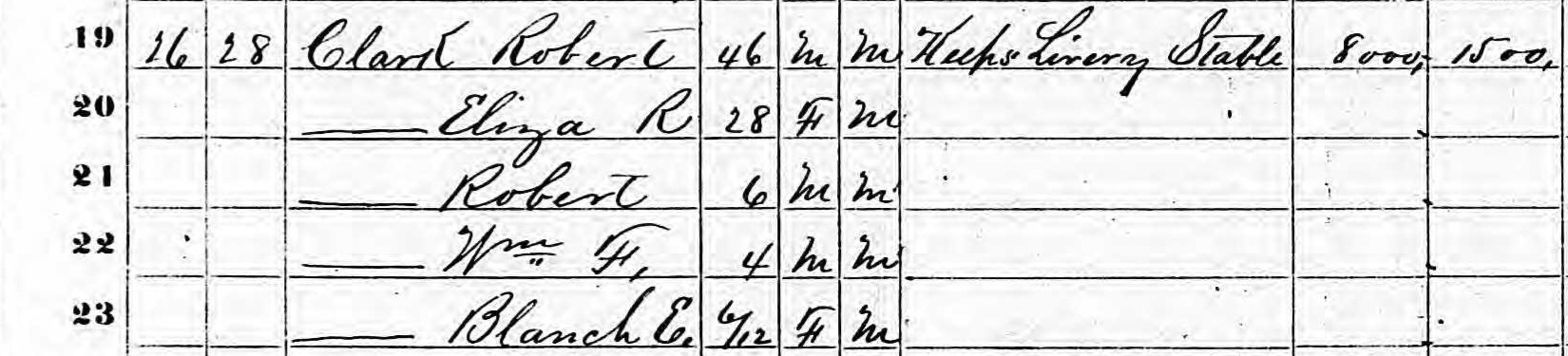
The 1870 census provides additional clues regarding Robert's family.
In Petersburg's Second Ward, Robert Clark was enumerated as:
Also in the household were:
Although the 1870 census did not record family relationships, the presence of Eliza and three young children strongly suggests that Eliza was Robert's wife.
Virginia birth records further support this conclusion. William F. Clark was born on March 20, 1866, and Blanche E. Clark was born on December 27, 1869. In both records, Robert Clark was identified as a stable keeper in Petersburg.
When searching for the family in 1880, Robert Clark could not be located. However, his apparent widow and children were found in the household of Thomas B. Elebeck in Petersburg.
The household included:
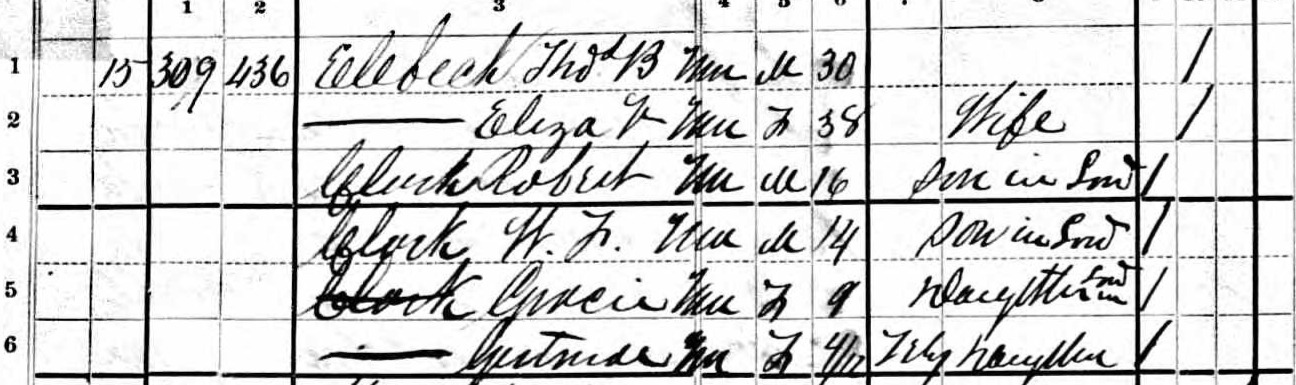
The ages of Robert and William correspond closely with the children found in the 1870 census, suggesting this is the same family. The evidence indicates that Eliza likely remarried sometime during the 1870s following Robert Clark's death.
A Find a Grave memorial for Robert W. Clarke records his death on April 12, 1875, and identifies his wife as Eliza Farley Elebeck. The memorial also names William Franklin Clarke as a son. While additional documentation is desirable, the evidence strongly suggests that this memorial commemorates Petersburg businessman Robert Clark.
An attempt to locate Robert's death record in Petersburg's 1875 death register revealed that the page on which his entry would likely appear is missing from the currently available online images. Further research may reveal whether a surviving copy exists elsewhere.
When searching for the family in 1880, Robert Clark could not be located. However, his apparent widow and children were found in the household of Thomas B. Elebeck in Petersburg. The ages of the children closely match those found in the 1870 census, suggesting this is the same family.
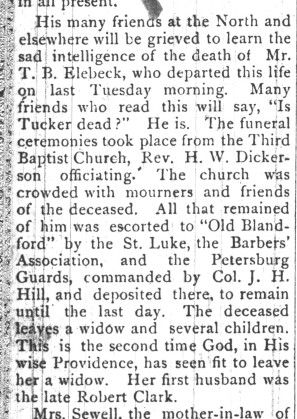
Confirmation of the relationship appears in an obituary for Thomas B. Elebeck published in the Lancet in November 1882. Referring to Elebeck's widow, Eliza, the article noted:
"Her first husband was the late Robert Clark."
This statement establishes that Eliza Clark, wife of Robert Clark in the 1870 census, later married Thomas B. Elebeck after Robert's death.
Robert Clark's life demonstrates the determination, business skill, and perseverance of Petersburg's free African American community. Beginning life in slavery, he secured his freedom, established a successful transportation business, accumulated substantial wealth, and became one of the city's most prosperous Black businessmen before and after the Civil War.
His story survives through census records, emancipation papers, birth registers, cemetery records, and the writings of contemporaries who remembered his success. Together, these sources preserve the legacy of a man who transformed his circumstances and left a lasting mark on Petersburg's history.
I recently came across a blog called Dinwiddie County History, written by Ronald Seagrave. Although the blog remains available online at https://dinwiddiecountyhistory.blogspot.com/, it has been inactive since 2014. After finding Mr. Seagrave's obituary and learning that he passed away in 2024, I became concerned that this valuable local history resource might eventually disappear from the internet. As a result, I began reviewing the site for material that might be of interest to the Dinwiddie County, Virginia USGenWeb Project and worth preserving for future researchers.
One post immediately caught my attention: "Robert Clark, Slave to Livery Stable Owner," published on January 25, 2008. The original post can be found at https://dinwiddiecountyhistory.blogspot.com/2008/01/robert-clark-slave-to-livery-stable.html. Recognizing that websites and blogs can disappear without warning, I was pleased to discover that the Internet Archive's Wayback Machine had preserved a copy of the page at https://web.archive.org/web/20231124204014/https://dinwiddiecountyhistory.blogspot.com/2008/01/robert-clark-slave-to-livery-stable.html.
The article itself was brief but included a fascinating story and a cryptic source citation. Curious to learn more about the man behind the story, I began researching Robert Clark through census records, emancipation records, birth registers, cemetery records, and historical publications. The result is the biographical sketch presented here, which expands upon Seagrave's original post and documents what is currently known about Robert Clark, a formerly enslaved man who became one of Petersburg's most successful African American businessmen.
One intriguing detail appears in a reward notice published by Robert Clarke in the Daily Express on 21 February 1866. The notice identified the alleged horse thief as John Bolling, a formerly enslaved man from Prince George County.
The name is noteworthy because John Herbert Claiborne, in his recollections of Powell's Hotel, remembered two enslaved workers there named John Bolling and Sam Bolling. Claiborne also specifically mentioned "Bob Clark" as one of the hotel's employees.
Whether the John Bolling named in the 1866 newspaper notice is the same individual remembered by Claiborne is presently unknown. However, the coincidence of names, location, and association with Robert Clark makes the connection worthy of further investigation.
I used ChatGPT as a research assistant to help organize information, suggest avenues for further investigation, review transcriptions, and improve readability. However, all research was conducted by me, all cited sources were personally reviewed, and all conclusions expressed in this article are my own. Genealogical research is an ongoing process, and I welcome corrections, additional documentation, and alternative interpretations supported by historical evidence.
If you have any additional information, historical documents, or photos related to Robert Clark or his family, please contact the site coordinator.
Your contributions help preserve this vital piece of Petersburg's history for future researchers!
1860 U.S. Census, Petersburg, Virginia, East Ward, page 199, dwelling 1323, Robert Clarke household. FamilySearch. https://www.familysearch.org/ark:/61903/3:1:33SQ-GBSF-9TCM
1870 U.S. Census, Petersburg, Virginia, Second Ward, dwelling 26, Robert Clark household. https://www.ancestrylibrary.com/search/collections/7163/records/37592696
1880 U.S. Census, Petersburg, Virginia, Third Ward, Thomas B. Elebeck household. https://www.ancestrylibrary.com/search/collections/6742/records/42682882
Claiborne, John Herbert. Seventy-Five Years in Old Virginia. Richmond: The Bell Book and Stationery Company, 1904. Available online: https://hdl.handle.net/2027/uva.x000179402
"Death of T. B. Elebeck," Lancet (Petersburg, Virginia), Vol. 1, No. 17, 11 November 1882, p. 1, col. 1. Accessed through Virginia Chronicle: https://www.virginiachronicle.com/?a=d&d=TLA18821111.1.4
Find a Grave Memorial #75152179, Robert W. Clarke (1824–1875). https://www.findagrave.com/memorial/75152179/robert_w-clarke
Find a Grave Memorial #75152197, Eliza Farley Elebeck (1840–1932). https://www.findagrave.com/memorial/75152197/eliza-elebeck
Jackson, Luther P. "Free Negroes of Petersburg, Virginia." The Journal of Negro History 12, no. 3 (1927): 364–389. Available online: https://www.journals.uchicago.edu/doi/pdf/10.2307/2714105
Morris, James T. Advertisement. Petersburg Index (Petersburg, Virginia), Vol. 2, No. 119, 18 May 1866, p. 4. Accessed through Virginia Chronicle: https://www.virginiachronicle.com/?a=d&d=TPN18660518.1.4
Petersburg (Va.) Enslaved and Free Records, 1787–1865. "Robert Clark: Deed of Emancipation, 1849." Virginia Untold: The African American Narrative Digital Collection, Library of Virginia. https://rosetta.virginiamemory.com/delivery/DeliveryManagerServlet?dps_pid=IE3667636
Pollock, Edward. Historical and Industrial Guide to Petersburg, Virginia. Petersburg, Virginia: T. S. Beckwith & Co., 1884, p. 36. Available online through the Library of Congress: https://www.loc.gov/item/rc01002915/
Robert Clarke, "$25 Reward—Stolen," Daily Express (Petersburg, Virginia), Vol. 16, No. 44, 21 February 1866, p. 2, col. 6. Available through Virginia Chronicle. https://www.virginiachronicle.com/?a=d&d=TDE18660221
Seagrave, Ronald. "Robert Clark, Slave to Livery Stable Owner." Dinwiddie County History (January 25, 2008). Archived at: https://web.archive.org/web/20231124204014/https://dinwiddiecountyhistory.blogspot.com/2008/01/robert-clark-slave-to-livery-stable.html
Virginia Birth Registers, William F. Clark, born 20 March 1866. https://www.ancestrylibrary.com/search/collections/62153/records/16109180
Virginia Birth Registers, Blanche E. Clark, born 27 December 1869. https://www.ancestrylibrary.com/search/collections/62153/records/16110219
Last updated June 5, 2026
If you have questions, contributions, or problems with this site, email:
Coordinator - Ed Olsen
State Coordinator - Jeff Kemp
If you have questions or problems with this site, email the County Coordinator.
Please do not ask for specific research on your family. I am unable to do personal research.