

Waldo County
MEGenWeb


Please share your Family Group Sheet information, Descendents Chart, Photos, etc. of a Waldo County ancestor. Simply email your contribution to the County Coordinator.
By Joan Brown
Edward Burgess, son of Edward and Sarah “Sally”
(Philbrook) Burgess was born 1816 in Vinalhaven, Knox, Maine. He moved with his
parents to Montville, Waldo, Maine in the fall of 1817. Edward died 22 April
1878 in Searsmont, Waldo, Maine and is buried in lot #86 in Oak Grove Cemetery,
Searsmont.
Edward married (1st) Eliza Hall, daughter of George Washington
Hall and Elizabeth (Burgess) Hall, born 31 May 1821 on Matinicus Island, Knox,
Maine. She died 16 May 1867 and is buried in Pine Grove Cemetery, Appleton, with
her parents.
Edward and Eliza lived in “Magog” near the
Appleton/Searsmont town line. He owned a small quarry and lime kiln there. He is
thought to be responsible for the opening of a canal to the St. George’s River
to facilitate the transport of his lime to ships in coastal Maine. Edward and
Eliza lived on the banks of the George’s River and had cranberry bogs on their
property. In later years, Edward’s grandson Bradford Burgess and his wife Eva
would fish there on the river bank. Edward was a Justice of the Peace and
performed the marriages of most, if not all, of his 17 children.
Eliza
was an “herb doctor” traveling from house to house on horseback with her herb
remedies. Having been born on the isolated island of Matinicus, nearly
twenty-five miles off the coast of Maine, this doctoring was probably instilled
in her by necessity.
Edward married (2nd) Mary Ann Richards, daughter of
Thomas L. and Charlotte (House) Richards, born 12 March 1833; she died in
September 1934 in Searsmont and is buried in lot #86, Oak Grove Cemetery, with
Edward.
After ten years of marriage to Mary Ann, Edward suffered an
accident which led to ill health and his subsequent death. A sudden storm arose
one night and he hurried to cover the lime that he had burned that day. In the
darkness, he lost his footing and fell into the quarry.
Edward, soon
after, sold the quarry and kiln and built a new house on a lot adjacent to, and
now part of, the Ben Ames Williams property on route #131. This route runs from
Searsmont to Union and the property is located on the hill just beyond the
village of Searsmont. All that remains of Edward’s house is an overgrown cellar
hole in a thick stand of trees. The house was written into one of Ben Ames
Williams’ short stories called “Partridge” for the Saturday Evening Post.
Edward’s grandson, James Franklin Burgess planted the stately maples at the
front of the property.
Edward was very proud of his apple orchard and
told Mary that she must take good care of the orchard after he was gone. It is
said that for many years after he died, she left a candle burning in a window
facing the orchard to light his way should he return to check on his orchard.
Written and contributed 25 Nov 2006 by Joan (Burgess) Brown
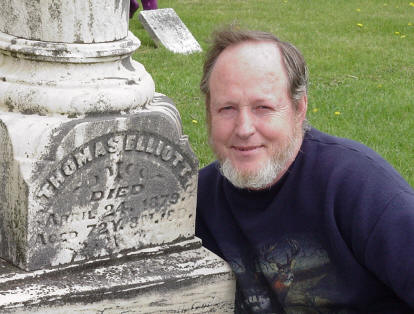 Born 1 Dec 1940 Boston, Suffolk
County, Massachusetts
Born 1 Dec 1940 Boston, Suffolk
County, Massachusetts
Do you remember the character "Owl", in Winnie the
Pooh? He's a loquacious old bird, who enjoys retelling the tales of generations
past, his Great-Uncle so-and-so and the Great Storm of such-and-such a year. If
you know about Owl, then I think you might know about my father. The only
difference between the two is that the stories my father tells are real stories
about real people, real storms, and things that really did happen. Well, and the
feathers (Of which he has none).
His name is Thomas Edward Elliott (named
after his oldest brother's two imaginary friends), though if you know him from
childhood, you might call him "Tommy". He was born in Waterville, Maine, to
Norman and Edna Elliott and grew up in the nearby town of Freedom. Those parents
seem to have passed a few hobbies on to him including the constant pursuit of
all things genealogical (his, my mother's, yours, mine, it doesn't seem to
matter) and seeking out the history of small-town "Mainers". But that's not all
that his parents passed on to him. Fifteen or twenty thousand 3" x 5" cards
indexing Waldo County cemeteries were inherited by him, which wait to be
alphabetized and ever-so-slowly (we like to call it "methodically") entered into
these pages.
He doesn't have an aunt who laid a seagull's egg by mistake,
like Owl does, but he does have a pretty good story about being "chased" by a
cow. He also has no portrait of an Uncle Robert hanging over his fireplace, but
rather his Great Uncle Jim and Great Aunt Kitty look down from above the
computer, where he spends so many hours maintaining this site. His Aunt Minnie
played the "bones", and his mother played piano during silent movies at the
Grange Hall. His grandmother had hair that was so long it piled on the floor
when she took it down, and every night she got down on her knees and prayed
before going to sleep, despite the fact that she couldn't get back up on her
own. I've heard she made some pretty good molasses cookies, too. He once shot
his brother in the behind with a BB gun (not exactly on purpose) and I'm sure
his brother paid him back more than once (or was this payback for something
else?... who's counting?).
And those are only among the stories that I
can recall. There are so many more that I hear anew each time I see him. I tease
him for repeating a few, but I don't really mind. His rocking chair squeaks and
so does the grand-baby that lays against his chest while he carries on about the
people and town he loves so very much. That town of Freedom, Maine.
Rebecca Elliott-Akens
Proud daughter of a
born and raised Mainiac
"I am sad to report that Tom Elliott has passed
away after a bout with cancer. He was an avid supporter of Waldo County
genealogy for many years. He will be missed by his family and his many Waldo
County supporters." --Bill Wing
Died 12 Dec 2012 in Lewiston,
Androscoggin County, Maine, aged 72
USN Vietnam
Maine Veterans Memorial
Cemetery, in Augusta, Kennebec County, Section A, Row 29, Site 3
Thomas
E. Elliott Jr., 72, of West Bath died Friday, December 14, 2012 at Central Maine
Medical Center in Lewiston.
He was born in Boston, MA on December 1,
1940, a son of Thomas E. Sr. and Gloria Martin Elliott. He grew up in Portland
and attended St. Dominic's Sacred Heart School and Cheverus High School, where
he was a member of the Swim Team.
Thomas joined the U.S. Navy at age 16,
by telling them he was 17 at the time so he could enlist. He served in the Navy
for 24 years, with 2 tours in Vietnam and retired on December 31, 1982. He was
awarded the Purple Heart as well as other medals and commendations. After
retiring he worked for the Town of Brunswick for 20 years.
Tommy
dedicated his time and talents to the Disabled American Veterans working at the
VA Hospital and transporting veterans to and from their medical appointments. He
worked tirelessly helping veterans receive their benefits and helping to raise
funds to purchase a van to transport veterans.
He was a member of the
Disabled American Veterans; Veteran Affairs Voluntary Service at Togus; Purple
Heart Association; American Legion Post 4 in Gardiner; Veterans of Foreign Wars;
Fleet Reserve Association; Knights of Columbus in Brunswick; and was a member
and Past Exalted Ruler at Brunswick Lodge of Elks and spent many hours
collecting money and toys for the Santa Claus Fund on their behalf. He also
dressed up as Santa Claus for many of these occasions to bring joy to the
children. Thomas also participated in the Toy Run for the Polar Express.
He is predeceased by two sisters, Gloria Honey (Elliott) Berry and Ann Marie
(Elliott) Haley.
Burial will be at Maine Veterans Memorial Cemetery,
Augusta.
The trials and tribulations of Jane (Shepherd) Heal
May she rest in peace.
by Isabel Morse Maresh
Sometime before 1993, my friend, Betsy, found a
divorce case in the Waldo County Court records at the State Archives in Augusta.
At that time I had written some of this story in the 'Out of The Past' column in
The Republican Journal. The story was intriguing and haunting. The divorce
took place in May 1853, one hundred fifty-seven years ago. The facts and
depositions about events that had happened, sworn to by family, neighbors, and
friends, totaled more than fifty pages.
The divorce was being sought by
forty-six year-old Jane (Shepherd) Heal, who had come from Jefferson, Me. where
she had married Gorham Heal of Lincolnville. She has supposed that she would
'live happily ever after', never once suspecting what would lay ahead of her in
life.
Gorham and Jane had five children who lived to adulthood, Augustus,
Roxey Jane, Lucian, Amanda and Roscoe. Jane stated in a deposition that she "had
always conducted herself as a faithful, chaste, kind and affectionate wife."
But, she soon found that her husband was very demanding and abusive. He beat her
so badly when Augustus was but a few months old, that she was bedridden for some
time. Gorham was claimed to be a powerful man. Roxey made a deposition that she
remembered her father beating her mother one time while she was in bed, pounding
her head upon the bedstead until she bled from her nose and ears. He beat her
unmercifully, and at one time she miscarried the child she was carrying after a
severe beating, which left her unable to get out of bed for almost a month. He
grabbed her stomach in his fist, twisted and threatened to "Send her to hell".
At this time, a doctor came a couple of times to tend to Jane, until Gorham told
him not to come again. Jane's mother and sisters brought provisions and
medicines for her. Much of this time she was confined to her bed, and could not
even get up. At those times he would command her to get out of bed to do this or
that for him, and even dragged her out of bed. Gorham had often beat her with
his fists in her side and stomach, as well as kicking her. Times like these, she
and the children feared even going to sleep in the house.
Gorham kept the
food and provisions, including tea, coffee, candles and house staples locked in
a chest. This fact was testified to by neighbors and family. He kept a lock on
the pork barrel and the cellar door, as well as nailing the flour barrel tight.
He kept the keys with him at all times. When he was leaving for the day, he
would unlock the chest, taking out the vittles that he wanted for a meal or for
the day, locking it up again when he left. Neighbors testified at seeing him
take out his vittles for a meal, perhaps share a little with the children, and
refuse Jane a mouthful.
Jane's mother testified that her daughter had
written her after the birth of one of the children, asking for help. Jane wrote
her mother that she and the children were starving. The family and neighbors
would bring in food when they knew that Gorham was not at home. Jane's mother
also testified that Gorham had threatened Jane in her presence, also threatened
Jane's sister, Rosalinda, with a horse whip. Rosalinda stepped between him and
his wife, and he backed off, threatening to punish her after they left. He said
that he did not fear God, man or the devil.
When Jane complained, asking
for food for herself and the children, summer or winter, Gorham would have the
boys bring in buckets of cold water from the well, which he would throw over
her. Jane testified that this had happened over thirty times. Several local
people had seen this happen and testified to it.
At one time Gorham's
father, Peter Heal, lived in part of the house. When Gorham's brother, George,
married, Gorham unlocked the chest, and prepared a feast for his guests to be
eaten in his father's room. When young Augustus asked what he, and his siblings
would eat, Jane replied, "Indian bread and tea." Gorham overheard the remark,
stepped to coals of the open fire in the fireplace, grabbed the teapot, and
threw the boiling tea on Jane, scalding her head. Both Roxey and Amanda
testified that she was blistered, and lost most of her hair. While she was still
bedridden from this incident, Gorham beat her badly one night as she was in bed,
then he stood outside of the bedroom window all night, threatening Roxey and
Amanda that he would tie them to a post in the kitchen and beat them to death,
if they helped her, even though they could hear their mother begging them for
help. They never once doubted that he would beat them. There were testimonies of
other atrocities and depravations that he had committed against Jane and the
children.
George would have been Roscoe's, see below, uncle, and
they both died in the Civil War. Roscoe was only sixteen years old when he
entered the Service, and died two or three months later. George Heald was a
brother to Gorham Heal. I do not have pictures of Gorham nor of Jane. She
undoubtedly died before photography was so popular, which came into popularity
during the Civil War and after. There is confusion in the spelling of the name.
The descendants of Gorham Heal spelled their names Heald, but the divorce
records were Heal.
Moses Young, overseer of the Poor, and Selectman
of Lincolnville testified that Gorham had a well-stocked farm of seventy-five to
a hundred acres, always taxed to him, had a good pair of oxen, a fine mare and a
two-year old colt, a few cows, and a number of pairs of steers, a decent flock
of sheep, at that time all valued about $1500, a fine sum and farm for that
time.
In May of 1853, Jane's brother, Lorenzo H. D. Shepherd, brought
suit against Gorham for the following goods: Nov. 1850, one black Alpaca dress
for Gorham's wife, provisions, boarding, flannel under shirts, three pairs
stockings, for money lent to Jane in 1849, 1850, 1851 and 1852, for boarding
Jane, and to obtain necessities for herself and Gorham and Jane's family of
minor children. This was posted in 'The Republican Journal' of 5 May 1853. Jane
had testified to the court that she had fled to the neighbors on several
occasions in fear for her life, and Gorham had threatened 'to drop her dead with
the first blow', at which time she told the children that if she was found dead,
to tell what had happened to her.
After the testimonies of her children,
mother, friends and neighbors, in May 1853, Jane was granted a divorce from
Gorham Heal, at which time she was awarded $300 a month, as part of her dowry.
It is doubtful that she ever received a cent. About that time, Gorham and son
Augustus left for the 'Gold Rush' in California. Gorham returned to marry a much
younger woman, Eleanor Wadsworth, by whom he had eight more children. He
reported that Augustus had died in California in 1853. There is much in this
story that has to be imagined or to read between the lines. What happened to
Augustus?
After the divorce, Jane was forced to live
off relatives, friends and neighbors. She died in Camden, Me., aged fifty-three
years, having been bedridden and feeble most of her life, probably from the
severe beatings, abuse and malnutrition.
Roxey Jane married and lived in
Camden. Augustus was aged about eighteen years when he had died in California.
Lucian went to sea.
Roscoe joined the Army during the Civil War, on Sept.
20, 1862. He died of fever aboard ship, aged sixteen years. His Pension files
give some interesting information. Capt. Ansel Wadsworth [who later became
Sheriff of Waldo County] made a sworn statement that Roscoe had "taken a severe
cold which prostrated him so that he was treated in the regimental hospital, but
appeared sufficiently well enough to embark on the Steamer, Matazas. He was very
anxious to go with the company. The first day at sea, Roscoe was sick with
typhoid fever and grew worse until the seventh of December 1862, just three
months from enlistment, at which time he died, and was buried at sea."
Now the story gets interesting. Gorham Heal swore to the following on July 18,
1883, "I have lived on the farm I do now twenty-seven years. In 1862, my family
consisted of my wife, named Jane Shepard Heal who died in June 1862, Augustus
Heal, Roxie Jane, Lucian, Amanda, who is a widow in Boston, Mass., and Roscoe.
An infant died in 1862." Gorham had remarried in 1857.
Gorham stated that
he never had owned any real estate and never disposed of any before or since his
son's death. His neighbors, the same neighbors who made sworn statements thirty
years earlier in Jane's defense, swore that Gorham Heal was old and feeble,
walking with a cane. What Gorham did not report in his first applications for a
pension from Roscoe's death, was that he was married in 1857 to Eleanor, a woman
thirty years younger than he, and that he fathered eight children by Eleanor, in
addition to the six by his former wife, Jane.
In the several statements
that he gave proof of his marriage to Jane, he neglected to state that he and
Jane divorced in 1853, and that she had died in Camden, not in his home, and
they were not man and wife. Nor did he make a statement that when he and
Augustus went to California, that he had given his household and farm goods to a
neighbor, while he was physically and mentally abusing his first wife.
Eventually Gorham did mention that he had remarried in his affidavits.
The Pension Records at the National Archives in Washington, D. C. contain a
wealth of information. Roscoe's pension file did reveal that Gorham Heal
received a pension of $8 a month, commencing when he first filed in 1882. If
Roscoe's mother has lived, this pension should have gone to her. In 1882, the
date that he applied to the War Department for a pension, the ages of his
children by his second wife ranged from six years to twenty-four years.
My father once told a tale that his father had told him. I do not know how old
my grandfather was when this event happened, or whether he was alone or with his
father. He told of passing the Heal home in the morning with a horse and wagon
on the way to Camden or Rockland. A large tree stood just beside the house near
the road. As my grandfather came along, a woman was hanging from the tree. She
apparently had tied bed sheets together, and tied them to a limb outside the
bedroom window. Who was this woman?
What happened to Gorham Heal? Neither
a death date nor a grave site has not been found for him. If a man is to be
remembered for the good he has done in the world, then if he has done no good,
then he should be remembered as evil, or perhaps not remembered at all.
Author's note: I noticed that I have Heal and Heald spelled both ways. In the
divorce, the name was spelled Heal. The sons of Gorham Heald spelled their name
Heald, and that is what I had put on the pictures. It is confusing, but it
happened in those days.
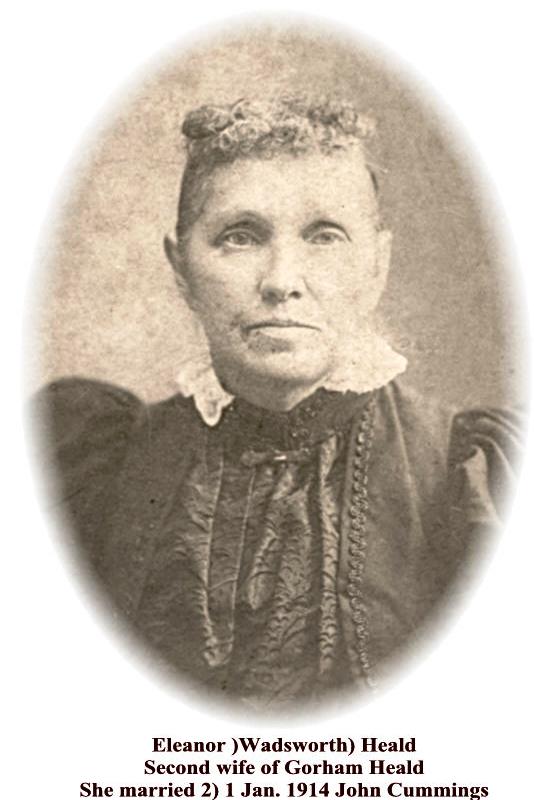
Eleanor (WADSWORTH) HEALD
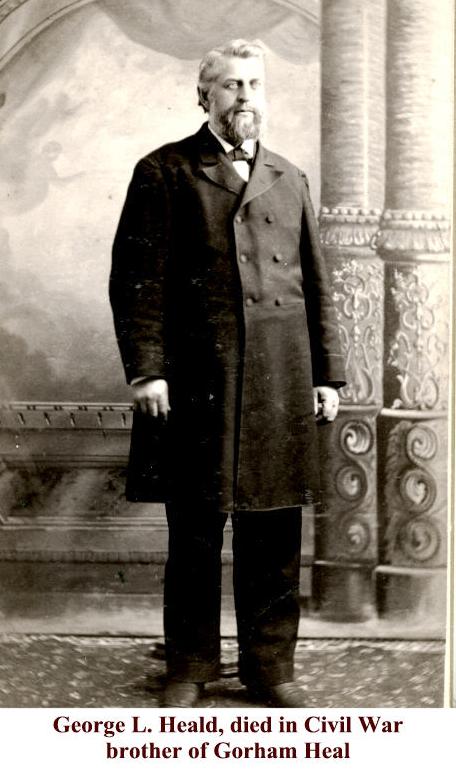
George L. HEALD
died in Civil War
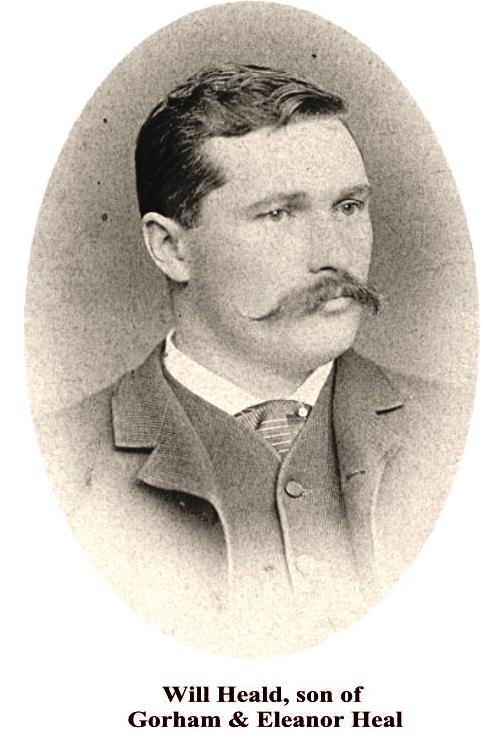
Will P. HEALD
son of Gorham
Contributed 20 July 2010 by Isabel Morse Maresh
by Larry Knight, courtesy of Georgia Southern University
Adelbert Knight was one of nine children born to Abner and Julia Ann Fletcher
Knight in Lincolnville, Maine on January 16, 1841. Unfortunately, four of
Adelbert’s siblings died at or under the age of 21. One of his two older
brothers, Jonathan (a Private with the 4th Maine Volunteer Regiment) died at age
23 after being captured during the Battle of First Bull Run (a.k.a., First
Manassas), only 34 days after enlisting. He was imprisoned at several locations
in Virginia, Alabama and North Carolina, for a total of about 312 days. Ten days
after being paroled due to illness, he lost his personal battle with scurvy at
City Hospital on Blackwell Island (now Roosevelt Island) in the East River of
New York City on July 6, 1862. He was buried in Cypress Hills National Cemetery
in Brooklyn, NY, with a memorial to him on the back of his parents’ gravestone
in Lincolnville, Maine. His oldest brother, Augustus, lived in Montana, where he
was mining for gold, and avoided the war. At this time, there has been no
indication (back in 1862 or now) whether any of the Knight family knew of
Jonathan’s ordeals, as the Adjunct General’s Reports noted that Jonathan was
killed during the First Battle of Bull Run.
Adelbert enlisted in
Portland, Maine at age 21 on March 26, 1862, as a Private in the 11th US
Infantry, Co. F, 1st Battalion (approximately 2 months before his brother’s
death). However, he only started writing in his diary on December 11, 1862. In
April 1864, he was promoted to Color Guard for his Regiment. During this time of
the War and where his Regiment was located, there were few battles and Adelbert
found the time (in addition to writing letters) to transcribe his first diary
into a second one, allowing him to send the first diary home (with a letter
written in the diary) to his mother, in addition to other personal items not
required (e.g., winter clothes), as well as other things (aka, “trinkets”,
“souvenirs”, etc.) that he found after the battles in which he had been engaged.
From online records, the 11th US infantry fought in about 20 major
battles, and Adelbert fought in 17 of them, including, Second Bull Run,
Antietam, Fredericksburg, Chancellorsville, Gettysburg and Wilderness, before
being captured during the Battle of Cold Harbor, outside Richmond, VA on June 2,
1864.
He notes that approximately 45 men from his regiment were
captured, with a total capture of 600 Union soldiers that day. Adelbert entered
and was detained in Libby Prison in Richmond on June 3, 1864. He was confined in
a tobacco warehouse that held 250 prisoners on the floor he was assigned. He
left Libby Prison six days later by train on June 8th and headed south to
Georgia.
On June 14, 1864, Adelbert arrived in a small community
(approximately 600 miles south of Richmond, VA and 125 miles south of Atlanta)
called Andersonville, GA, where Camp Sumter (aka, Andersonville Prison) was
located. The following day, after a relatively short walk, he entered the
prison’s stockade area of approximately 16.5 acres. Food and consumable water
were scarce and, to survive, decided to sell his ink and pen for bread, only ten
days after arriving at Andersonville. It appears that he tried using other ink
products (“homemade” possibly), but decided to use lead (from pencils or bullet
shrapnel), as the ink(s) he tried using soaked through the pages of his diary.
He continued to keep writing in his diary until his last entry on February 20,
1865. Over the years, the lead-written writing became difficult to read at
times. This became a challenge when I transcribed the diary in 1970 for a high
school class project.
His daily diary entries were short but to the
point. He describes the weather, the rations he received, the soldiers who were
severely ill or died; and the "news" (i.e. rumors usually) going around about
the war as well as the prison he was in, some true and some false. With rations
being minimal, there was food available for a price, such as molasses
($12.00/gallon), eggs ($1.00 each), potatoes ($1.50/dozen) and onions
($0.25-$1.25/each).
During his incarceration, Adelbert worked on
expanding the stockade area from 16 acres to 26.5 acres. When he arrived on June
15th, there was a ratio of one (1) acre for every 1,255 prisoners. As he left on
September 28, 1864 for Savannah, the ratio decreased to 386 prisoners to every
acre inside the stockade. This was due in part to the increased stockade area,
but also from prisoner movement to other prisons (for exchange or
hospitalization), prisoners changing their allegiance to the Confederate side,
as well from death due to sickness and disease. Such deaths were caused by
conditions such as lack of acceptable shelter (if any) during the hot and cold
weather months, poor health and hygiene, and malnutrition. The National Park
Service identified some of the reasons for the high death rate at Andersonville
to be from abscess, anasarca, ascites, asphyxia, catarrh, constipation,
diarrhea, diphtheria, dysentery, enteritis, erysipelas, gastritis, hemorrhoids,
hepatitis, hydrocele, icterus, laryngitis, nephritis, pleurisy, rubeola
(measles), scurvy, smallpox, tonsillitis, typhoid and ulcus.
On September
28, 1864, after imprisoned for 106 days in Andersonville, Adelbert left by
railcar for Savannah, where he stayed for 14 days. He entered Camp Lawton in
Millen, GA on October 13, 1864, which was approximately 83 miles northwest of
Savannah. He wrote in his diary the day he arrived:
“Wether fine left Savanah this morning at 7a.m. and arrived at Millen 1 p.m. and we belong to the 3 Det, 6 Div. and 2nd hundred and 3d squad and No. 19 our Camp is 5 ms from Millen on the Augusta R.R. and 83 ms from Savanah. Rations. 1 pt. of Meel and one Pt. Beans. Beef. Salt”.
The prisoners used railroad spikes to split logs for shanties (and
were possibly used for constructing the stockade walls as well). Within
a few days of arriving at Camp Lawton, several soldiers of his regiment
died (some due to scurvy, which Adelbert started to contract due to poor
rations probably). Rumors continued to spread about possible exchange,
but it never occurred until the following year for him.
On the
second day at Camp Lawton he mentioned "The stockade has 40 men in it"
and the third day noted "building ovens inside the stockade to do our
backing" (i.e. baking).
Adelbert did considerable manual labor,
as his diary mentions for October 16, 1864:
"Wether fine. Have been to work to day hard. Cutting logs and luging them to build our tent with. I can not do any more now in A day then I could at home in two hours."
There was considerable “chatter” about exchanges of prisoners, but
more and more prisoners were arriving at the same time (with no shelter
for them, but plenty of money for gambling).
There was an
Election on November 8, with Abe Seincock getting the majority of the
votes (834). The following day prisoners were inspected to determine the
most in need of clothing. Per Adelbert’s diary, on November 14th,
doctors inspected the sick for potential of a future exchange. At this
time food could be purchased, such as $0.25 per Qt. of Meel or Beens,
$0.25 per pint of rice, $2.00 per quart; and one bushel of sweet
potatoes for $40.00 in Confederate money or $8.00 in Green Backs.
Rations that day consisted of one gill (half cup) of rice, about one
quart of sweet potatoes and 5 oz. of Beef and salt.
Adelbert
notes in his diary for November 20, 1684 that all prisoners captured in
1863 (as well as those who were sick) were to be exchanged. On November
22, 1864, Adelbert once again was brought to Savannah prior to entering
a stockade in Florence, SC on November 27, 1864. On November 29, nine
hundred prisoners came into camp, leading to a total of 11,000 prisoners
in camp. However, 1,100 sick prisoners were taken out the day before.
The weather was abnormally cold for that year and the prisoners had to
build shanties (similar to Andersonville) to keep warm and dry.
It appears from his diary that he left Camp Florence on February 17,
1865 (although his diary mentions leaving Millen) with a final entry on
February 20, 1865 in Wilmington, noting possible exchange. Military
records show that Adelbert was paroled on February 27 or 28, 1865 in
South Carolina and discharged May 2, 1865 in Maryland. He was a prisoner
for about 270 days.
As noted above, Adelbert’s diary was lost
around February 1865, but found by a fellow Andersonville prisoner from
Illinois named Noah Potts (it did not appear that they knew each other),
who used the diary on occasion (for minor personal entries) for almost
two years until he sent the diary back to Adelbert (unsure how) with a
brief note written in the diary to Adelbert dated November 15, 1867:
"Mr. Knight, I found this book at Willington, SC. Thought it might be of some use to you. Please write me a line when you receive this if you please. Noah Potts, Herman Knox Co., Ills."
Adelbert returned to Lincolnville, Maine to work the family farm and marry Sarah Avesta Whitmore (a neighbor who wrote during his time in the service) in December 1865. He became a member of the Grand Army of the Republic (GAR) Post 42 in Belfast. His mother sold the farm in 1873, and purchased a house in Belfast (approximately 15 miles northeast of their Lincolnville farm) where Adelbert became a skilled craftsman. His mother passed away in 1886 and was buried with her husband and other children in Fletcher Cemetery in Lincolnville. Adelbert and Sarah had 5 children, one being my grandfather, Burt Leroy Knight. Adelbert passed away in 1913 and Sarah in 1916. Both are buried together in Grove Cemetery in Belfast with some of his children and grandchildren.
Contributed 25 May 2026
By Isabel Morse Maresh
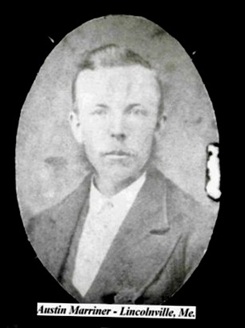
Austin MARRINER
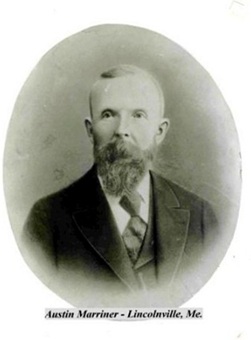
Austin MARRINER
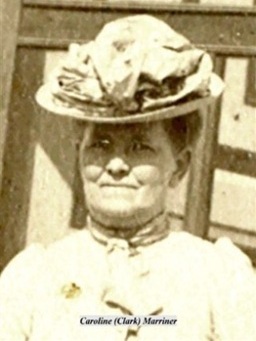
Caroline (CLARK) MARRINER
"Callie" (1854-1905)
Austin Marriner lived a
simple life on the hill in Millertown. He was born in 1846 in the house built by
his grandfather, Joseph Mariner. The land was homesteaded before the
incorporation of the Town of Lincolnville in 1802. It was then called New
Canaan. The Bible describes the Land of Canaan, as a good land, a land of
plenty, of grain, fruit and honey. The old farm had provided a good living for
the generations who had lived there. The Mariners [as it had been spelled in the
old days] had come up from Bath [now Maine] about 1777. Naler, Austin’s
great-grandfather, with his sons, Jonathan and Philip, settled on adjoining
lands. Philip left his homestead early, moving to Searsmont.
Naler had
built a log cabin behind the present house. The indentation was still visible in
the ground. The property passed from Naler and Ruth Mariner to their son Joseph
Mariner, who in turn passed it on the William and Sarah (Jackson) Marriner.
Austin had inherited it from his father, William, intending to pass it on to a
son, but that was not to be.
Though the house was situated on a hill, the
farm land and fields were flat. Over the years, clearing the fields of rock, to
plant crops, the long stone walls had evolved.
Many of the neighbors were
related, all descendants of the early settlers of the town. Austin brought his
bride, Callie Clark, from down on Clark’s Corner to the farm in 1873, after
being married [1 Mar 1873] by J. D. Tucker, Esq. It was nine years before their only child,
Annie Maria was born. Austin enjoyed teasing Annie, calling her “Annie ‘Ria”.
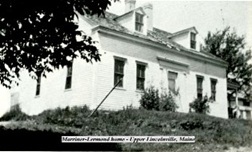
MARRINER Home
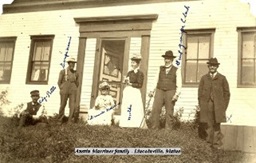
MARRINER Family
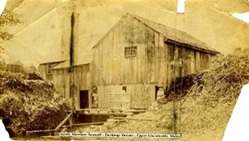
Barn
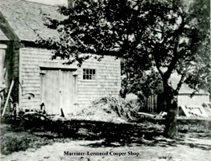
Cooper Shop
Austin was an active farmer, planting crops as well as many kinds of apple
and pear trees, which he took great pride in. He made barrels in his cooper
shop, on rainy days, and in cold, wintry weather. He shipped his apples and farm
produce on the Boston Steamers for Massachusetts markets in his well-made
barrels. He also made casks for the lime industry and his own cider-vinegar
production. Austin himself was a temperance man, who did not indulge in alcohol.
Austin was known as being a strong-willed and stubborn man. His son-in-law,
Rich, told the story of Austin and his horse Bill. Rich said that Austin led the
horse from his stall in the barn to the watering trough twice a day. If Bill did
not drink, he would not have water for the rest of the day. It seems that Bill
was as ornery as Austin. When Bill refused to drink, Austin pushed his head into
the trough. Bill still didn’t drink, so Austin held his head down until he did
drink. Rich said that the old saying, “You can lead a horse to water but you
can’t make him drink” wasn’t so. Austin proved that “you can make him drink”.
Austin had a sawmill in the former Farmer’s Pride District, now called the
Grange. He sawed out long lumber, staves and barrel headings, employing several
local men. He later sold his mill to Gould, who had settled in the area.
Austin had heard about a movement that started in the mid-western part of the
country, by an activist, Oliver Hudson Kelley, called The Grange. The theory of
Kelley was that farmers, scattered across the Nation, needed a national
organization to represent them at State and local levels. Farmers were the
backbone of the country, and were being taken advantage of by merchants, who
would buy their goods, and in turn sold them supplies to keep their farms
running smoothly. The shipping companies also took advantage of the farmers.
Kelley and friends organized a fraternal group called the Order of Patrons
of Husbandry, commonly called ‘The Grange‘, taken from a Latin word meaning
grain or granary. Austin was a enterprising, progressive farmer who believed in
the tenets of the fledgling secret society.

Tranquility Grange Hall #1 burning
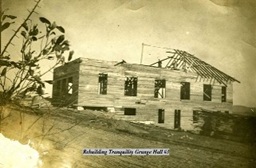
Tranquility Grange Hall #3 under construction
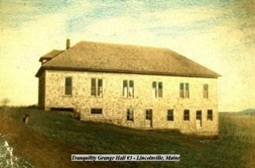
Tranquility Grange Hall #3
The Granges began organizing
in Maine, about 1874. Mystic Grange in Belmont organized and built a large hall
and Grange store in 1876. Farmer’s Pride Grange in upper Lincolnville organized
about the same time, near the Northport town line. Austin had attended the local
Granges. Farmer’s Pride Grange had an active membership, but had the misfortune
to have their hall burn in 1901. Many of their members came from Northport,
making it more convenient for them to join and attend the Grange in that town.
Twenty-seven of Austin’s neighbors and friends met in the Old Town House on
April 28th 1898 for the purpose of organizing a Grange to be called Tranquility,
the 344th Grange in the State of Maine. Austin was installed as the first Master
of the Grange, an office which he held in 1898, 1899 and 1900. Annie kept the
log book. A few of former Farmer’s Pride members joined with them.
About
a years after organization, Tranquility felt the need to have a hall of their
own. John C. and Eva J. Dean, who lived down the road from Austin, owned a piece
of property about a mile from the Centre. They offered it to the Grange for $50.
The group raised money, working and saving until they had enough to start their
own building in 1903. It was a large Gabriel-roofed building, which the members
were extremely proud of.
The beautiful large hall was completed in the
late summer of 1904, having volunteer material and labor, as well as paid
carpenters, with J. S. Miller as the foreman. David McCobb served as Master.
But their joy was short-lived. The building burned nearly to the ground.
Arne Knight, who lived close to the hall, raced up bareback on his horse. Others
gathered at the scene. Because the windows had only been pegged in, the men
braved the heat, pulling out windows, chairs, tables and benches. The Grange
members were just thankful that no one had been seriously hurt in the
conflagration.
The hardy group again met at the Town House, where their
meager building materials were stored. Some wanted to give up the idea of having
their own hall. Austin was among those who vowed to press forward.
Once
again, after cleaning up the debris, the stout-hearted group hired carpenters
and workers, as well as volunteering as much of their time as could be spared
from the home farms. The women kept the food coming, with encouraging words.
Austin, Caroline, Annie and her husband, Rich Lermond put in as much time as
possible It was late Spring, and there was much to do at home on the farm.
The second building was smaller than the first. The farmers could not spare
a lot of their hard-earned profits to put back into the building. The hall was
nearly ready for the plasterers to finish the inside, when the unspeakable
happened. On the 25th day of May, 1908, came the word, the Grange is burning.
Tranquility was not all tranquil. Austin and Callie drove down to the spot where
they had all worked so hard for so long, now just a pile of burning embers.
Austin’s heart was breaking, Callie held back the tears. Their daughter, Annie
with her husband Richard, and three little girls, Mildred, Callie and Mary drove
in behind them in their buggy. Annie wept openly. It had all seemed so
fruitless.
This time the fire was obviously of a suspicious origin. All
of the evidence pointed to one of their neighbors, and a relative of Callie’s.
Surely, no one could dislike the group that much. The case was taken to court,
but apparently nothing came of the accusations.
In the early Fall of
1908, the disheartening task of rebuilding Tranquility Grange Hall commenced.
The carpenters and volunteer builders worked through the fall and winter. In
January of 1909, the beautiful new edifice was ready for the hardy group to
settle into. Instead of plastered walls and ceilings, the group had installed
lovely pressed metal. The ceiling was domed with a striking metal design which
had been tastefully painted with multiple colors.
Austin was a member of
the famed Lincolnville Band, founded by Dr. B. F. Young, who had been selling
organs at the time. Young, while traveling about the countryside in his
business, had happened upon some old brass instruments. Dr. Young was very
talented, teaching the young men in his Youngtown neighborhood to play, many of
whom were Youngs and Heals.
Austin’s grandmother was Abigail Heal. He,
too, inherited some of the musical ability. In 1879, they organized as a band
with fifteen members. As the little band grew, they were called upon to play for
dances, political rallies, and boating excursions. They decided that it was time
for them to have uniforms. Around town, many of the old Civil War veterans had
uniforms which they no longer needed or wanted. They were modified to fit the
members. Now when they played, they were all clad in classy royal-blue uniforms.
The Band was well received everywhere, but never more so, as when they
headed up a Grand Army delegation, playing at the Encampment in Boston around
1890. Amasa Heal later wrote abut the event, refreshing the memories of those
who attended. They were the only band that sang as they played and marched,
receiving encore after encore. There were eighty bands present, some very large.
Lincolnville Band had seventeen members attending that day.
When they
stopped before the President’s stand and sang, “The Vacant Chair”, the ovation
rang through the rafters, stealing the show, and bringing them praise in the
Boston newspapers. Relatives and friends from the Boston Area kept sending them
newspaper clippings about the Lincolnville Band.
Austin had joined and
was a member in good standing of the Mt. Battie Lodge, I. O. O. F. in Camden, as
well as his Grange membership. Austin’s cousin, Allen Miller, and he were both
active Democrats, attending the State Convention in Augusta together. They also
attended meetings of the State Grange there.
In the Spring of 1915,
Austin came down sick with the influenza, from which he never fully recovered.
Effie Dickey reported in her newspaper column in 1916, “Like a bolt from a clear
sky came the news over the phone on Wednesday, Feb. 9th, announcing the death of
Mr. Austin Marriner, who sustained a shock on that morning from which he never
rallied. His attending physician, Dr. E. F. Gould, when called said that death
was but a matter of a few hours, and he died at noon.”
She also reported,
“He was an honest and upright citizen, strong in his ideas and convictions, and
no member of the community could be more widely missed. He was deeply interested
in all public and town affairs, and in politics was a staunch Democrat.”
Austin’s funeral was held in the home where he had been born, lived his entire
life, and died. The funeral was well attended with a display of beautiful floral
tributes. Rev. Sylvanus E. Frohock officiated at the funeral. Austin was laid to
rest in the Union Cemetery, where his parents, grand and great-grandparents
rested, beside his beloved Callie, who had died in 1905, at the age of fifty-one
years. He was sixty-nine years of age, living life to the fullest and making a
difference in the town settled by his forefathers.
Written and
contributed 28 Nov 2006 by Isabel Morse Maresh
Joseph P. Martin was one of the original settlers. He was the son of a minister of Berkshire County, Mass. He was born November 21, 1760. He died May 2, 1850, and is buried at the Sandy Point Cemetery. At the age of sixteen, he enlisted in the Revolutionary army, in 1776, and served until the close of the war. He was present at the surrender of Cornwallis. He was listed as a settler in the Wast Book in 1774, but old records say that he built his cabin in 1784 on the land now owned by Harold McKenney. Mr. Martin served for twenty-five years as town clerk of Prospect. He was a poet, a writer, and an artist. He wrote the book, Life of a Revolutionary Soldier, also several poems and songs. In September 1836, The Light Infantry marched from Belfast to Buckstown on an excursion. In passing through Prospect, now Stockton Springs, they honored Mr. Martin, hero of the Revolution, by firing a salute in front of his house. --Alice V. Ellis, 1955 The Story of Stockton Springs, Maine, page 21.
The future was less kind to Joseph Plumb Martin. Having served in the army through the entire war, Martin took up land in Maine near the mouth of the Penobscot River in what became the town of Prospect. By 1818, at age fifty-nine, Martin was destitute, his total property assessed at fifty-two dollars. Age and infirmities left him barely able to support himself, his sickly wife, and five children. Martin scraped out an existence from his veteran's pension of ninety-six dollars a year and from whatever else he could earn as a town official and an occasional laborer. --James E. Leamon, 1993 Revolution Downeast: The War for American Independence in Maine, page 192.
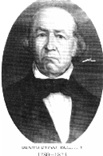
born Sept. 26, 1780, Stonington, Connecticut
died Feb. 27, 1873, Searsport, Maine
Image from Searsport Sea Captains, page 181

DELANO Farm
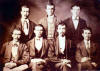
JACKSON Brothers
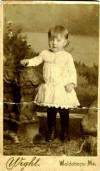
Unknown MORSE
Sara HAWES
Asa SYLVESTER AKA Deacon Asa SYLVESTER
Birth: 16 Jul 1786 in Palermo
Marriage: 03 Sep 1807 to Sarah WORTHEN
Death: 16 Jul 1843 in Caribou, Aroostook County, Maine
Burial: Hutchins Cemetery, Freedom
Father: Ebenezer SYLVESTER b: 6 Jun 1745 in Marshfield, Plymouth County, Massachusetts; married 13 Jul 1772, in Pownalborough, Lincoln, MA to Ann HUTCHINS; d. Jun 1834, in Freedom
Mother: Ann Hannah HUTCHINS b: 13 Jun 1752 in Harvard, Worcester County, Massachusetts; d. 9 Apr 1841, in Freedom
Spouse: Sarah WORTHEN, b: 25 Mar 1787 in Palermo; d. 27 Jun 1857 in Freedom
Children:
1. Enoch SYLVESTER b. 14 Aug 1808, in Albion, Kennebec County, Maine; m. 21 Jan 1833, in Montville, to Francis WHITTEN (1811-1892); d. 23 Apr 1869, in Freedom
2. Simon SYLVESTER b. about 1811
3. Moses Daniel SYLVESTER b. 6 Jan 1812 in Palermo; m. 11 Aug 1840, in Freedom, to Louisa STROUT (1819-1896); d. 6 Oct 1887, in Freedom
4. Sarah SYLVESTER b. about 1813
5. Joel SYLVESTER b. 14 May 1815; m. 1844, to Sarah H. LONGFELLOW (1814-1900); d. 26 May 1889, in Waldo County, ME
6. Mahitable SYLVESTER b. ABT 1817 in Maine; m. Benjamin BRIGGS (1810-1890); d. 1888, in Morrison County, Minnesota
7. Hiram SYLVESTER b. 26 Apr 1818 in Freedom; m. 5 Oct 1845, in Freedom, to Pamela Tilton DRAKE (1817-1877); d. 17 Mar 1881, Hampden, Penobscot County, Maine
8. Malaha SYLVESTER b. 27 Mar 1820, in Warren, Knox County, Maine; m. 2 Nov 1842, to Wellington Gay YOUNG; d. 8 Jan 1900, in Winterport
9. Asa SYLVESTER b. about 1822 in Maine; m. Martha; d. 6 Aug 1897, in Sedgwick, Hancock County, Maine
10. Judith W. SYLVESTER b. 5 Feb 1824 in Montville; m. 13 Sep 1845, in Waldoboro, Lincoln County, Maine, to Daniel YOUNG (1824-1874); d. 14 Feb 1880, in Knox County, Maine
11. Emily SYLVESTER b. 9 Jan 1826 in Maine; m. John P. McDONALD (1822-1899); d. 27 Dec 1908, in Westford, Middlesex County, Massachusetts
12. Nathan SYLVESTER b. about 1828 in Freedom; m. 22 Oct 1854, in Freedom, to Emily H. GORDON (1822-1908); d. 6 Nov 1899, in Freedom
Cora had a story to tell, yet it had been locked up in her memories for many
years, as when it had happened when she was twelve years old, living with her
grandparents, John M. and Selena (Beal) McFarland.
Cora had been born in
Montville, Me. in 1866, the daughter of Henry C. and Abigail (Bailey) McFarland.
Cora remembered her father, and that sometimes he could be withdrawn and quiet,
keeping to himself. Yet, he was a kind and loving father.
One Sunday
morning when she was eight years of age, Henry told Abbie, Cora and his parents
to go on to church without him, as he had some work to do. The family attended
the North Montville Meeting House. Henry had a sister, Eliza, who had married
Hollis T. Gowin. Eliza had died four years previously from complications of
childbirth. She was thirty-six years old. Henry had been depressed, among other
things, at the loss of his sister and her baby.
When the family returned
from church, Henry could not be found. The neighbors came out to aid in the
search for him. They found thirty-three-year-old Henry in the meadow behind the
farm buildings, where he had tied his feet together, and drowned in six inches
of water.
Cora and her mother, Abbie, lived on with his parents in North
Montville, about three miles from Freedom, near Halldale. The old farm house was
on one side of the road, while the barn was across the road.
When Cora
was ten years old, her mother, Abigail, married a big robust man by the name of
George W. Rowell, who came to live in Grampa and Gramma McFarland’s home. George
had spent seventeen years in California, allegedly amassing some money for
himself. He had returned to his hometown of Montville. He, at first, helped with
the farm work, being quite affable. The next February, George and Abbie had a
baby daughter, whom they named Alice. Alice was a joy in the household. Cora
willingly tended her baby sister, who was a happy child, and making the days
cheery, even for her grandparents.
But, even young Cora noticed a
difference in George. He paid a lot of attention to both Cora and baby Alice. It
was attention that made Cora uncomfortable at times, and was noticed by her
grandparents.
George spent a lot of time away from home, and when he was
home, he was sullen, moody and even threatening at times. He often smelled of
alcohol, which was offensive to Cora, as her grandparents, and her father did
not drink alcoholic beverages. Cora had been taught at church about the evils of
alcohol. Cora could sense tenseness in the household, but nothing prepared her
for what finally happened.
Cora grew up, attending Freedom Academy. She
married Charlie Vose, a very gentle man in Knox, Me. Though they had no children
of their own, they adopted a son, named after her father, Henry.
Charlie
owned a very large farm in Knox on the Hoxie Road, where they lived a peaceful
life, though the work was hard. They had a small herd of cows, a flock of
chickens, some sheep and annually raised a hog or two for the meat, lard and
salt pork.
Charlie was a prosperous farmer and a highly respected citizen
of Knox, Me. where he had spent his entire life. He had been a teacher,
supervisor of the schools, and had served as Treasurer and Town Clerk of the
Town of Knox. When Charlie was twenty-two years old, before he married Cora, he
was converted to a belief in Jesus Christ as Savior in a revival by Rev. James
Washburn at the North Montville Meeting house. He was one of twenty-four
converts who were baptized on July 3, 1887, and who joined the Free Will Baptist
Church in North Montville. Charlie and Cora were always active members in the
church and community. Charlie died in Dec. 1910, being attended by Dr. C.
M.Whitney, having a lung affliction. He was forty-three years of age.
Cora continued on the farm, hiring help and having boarders to help with farm
chores, haying, gardening and all that goes with running a farm. She lived as a
widow for twelve years. Each spring, Cora hired help to ‘press’ hay in the barn,
done with an invention called a ‘hay press’. For several years she had hired
John W. Morse of Belmont, Me. to bring his ‘hay press’ to her farm. John came
with his crew, which included his young son, Amon Morse, and his son-in-law,
Jephtha Buck.
While the crew was working at the farm, Cora boarded and
fed them. Her large open chamber long ago became a bunk-house to put up workers.
One evening after supper, Amon asked Cora about where she had been born and
raised. Cora told of events in her life, her father’s suicide when she was
young, and how, at age twelve, she had been present when her grandparents were
murdered. She had been a witness at the informal inquest as to the events that
happened on the cold snowy night about 7 p.m. on Saturday, Jan. 25, 1879.
Amon was totally mesmerized as Cora related the following story. Her
step-father, George Rowell, had been away for some time. George told the family
that he’d been in Belfast for a bottle of rum for his cold. He was seen driving
his horse at a break-neck speed. When he arrived in Belfast, the horse was
over-heated with foam at its mouth from the trip. George had spent three nights
in Belfast, two nights of which were spent at a relative‘s home, returning home
on Friday. Grampa and Gramma were very concerned. That night, Grampa had asked
neighbor, Alonzo Raynes, to stay the night with them.
Mr. Raynes left in
the morning, sending his young hired hand, Fred Bennett, back to the McFarland
home to spent the day and night. The family was growing increasingly afraid of
George. When evening came, he was difficult and surly, saying that he wanted his
little girl, Cora, and his “angel baby” Alice in his room.
George grabbed
Cora and baby Alice, taking them into the front parlor and closed the door. Fred
left the house to get Mr. Raynes. When Grampa and Gramma came into the parlor to
get the girls, George knocked both of them to the floor, pounding them with his
fists. Cora was frightened, and the baby was crying. George drove the elder
couple from the house, then he went upstairs, apparently to get his gun, which
was later described to be a “King’s Arm“, with the barrel running the whole
length of the gun. While George was out of sight, Cora took the baby and went to
the barn across the road.
Cora’s mother, Abbie, had gone down the road to
get Oscar Evans. Mr. Raynes, who lived about a quarter mile away, was coming up
the road, where he met everyone, who were telling him of their fright. Grampa
attempted to go back to the house with Mr. Raynes. George was standing in the
doorway with his gun, which he fired toward them. They heard the bullet go by
them. Cora came out of the barn with the baby, which Mr. Raynes grabbed, telling
Fred Bennett to get Cora down to the Raynes’ house. They all passed the elder
McFarlands, who were slower than they, after having been pushed around by
George.
They did not realize that George was following them with his gun.
He overtook Grampa just a short way from the Raynes’ house, hitting him so hard
with his gun that he probably was killed instantly, smashing the gun stock at
the time. He then caught up with Gramma, beating her about the head and face
with the gun barrel. Grampa and Gramma had been small in stature, no match for
the larger George.
Cora was the last one to get into the Raynes’ house.
She had heard George beating her grandmother, and heard her moan. George arrived
at the house, where occupants were shaking with fear. They had armed themselves
with sticks of firewood, even though they knew it was no protection from his
long-barreled gun. George began beating out the panels of the door with his gun
barrel. Thinking that they all would be killed, Mrs. Raynes said, “Get your gun
from the bedroom, Alonzo! Shoot him before he kills us all!” With that Mr.
Raynes, a small man, shot through the door, shooting low to wound and stop
George, who fell backwards into the snow, with his gun barrel by his side.
Fred Bennett came back to the house, telling them that the neighbors were
coming down the road. The men tied George up with a rope. They left with a
lantern to check on Grampa and Gramma, giving the rope to Cora to hold. She was
so scared, but George who was face down in the snow never moved. The Halls came
with other neighbors, and discovered Grampa and Gramma McFarland dead in the
blood-stained snow.
George’s horse was harnessed, taking the three dead,
victims and perpetrator, to the McFarland home, where they were laid out.
On Monday, a reporter from The Republican Journal came out from Belfast on
the train to Thorndike. He hired a sleigh and driver, who came down seven miles
over what he termed the ‘worst roads in Waldo County’. He spent the night at Mr.
and Mrs. Raynes’ home.
The Sheriff and Dr. A. J. Billings came out to
perform their official duties. During the next few days, many neighbors and
onlookers came on their sleighs to view the site where the carnage had occurred.
Thankfully, a snow storm overnight had covered any traces of the beatings.
The bodies of the McFarlands were taken to the Church where they were laid
out for their funerals, held on Wednesday forenoon, with Rev. J. Small of the
Freewill Baptist Church of North Montville conducting the services. Both Grampa
and Gramma looked very peaceful, if no one had known of the tragic night’s
events. They had been married forty-seven years, and died together, trying to
protect Cora and baby Alice.
The Town Officials took charge of George’s
body. They are all buried in the Halldale Cemetery, where Charlie Vose is also
buried.
Cora’s faith in God helped her to cope with all that she had
witnessed as a child. Her mother, Abbie, married as her third husband, in 1881,
when Cora was fifteen years old, to Charles McCorrison, who was always very good
to Cora and Alice. Abbie and Charles had a baby son, Henry C. McCorrison, also
named after Cora’s father. Cora was always close to all her family, especially
her half-sister and brother.
Cora was surprised, even at herself, at
being able to tell the whole story to Amon. She hadn’t even thought of some of
the details of that night long ago until now. Amon never forgot the story,
telling it to his daughter, Isabel, in his latter years.
Cora and Charlie
had been members of the Grange in Knox. She had many friends in her adopted
town, having lived there for over seventy years of her life.
Cora married
John W. Morse of Belmont in 1922. They lived on, for twenty-nine years together,
at the farm on the Morse Road, formerly called the Hoxie Road. John died there
in 1951. He was buried in East Searsmont in the Marriner Cemetery with his first
two wives, who had died very young.
Cora proudly held the gold-headed
cane, having the distinction of being the oldest resident in the Town of Knox.
Cora (McFarland) Vose-Morse 1956 - Age 90 years
Cora died in Dec.
1960, aged ninety-four years, having lived through some terrifying events in her
lifetime. Amon’s wife, Mary, recorded that there was a bad snow storm on the day
of Cora’s funeral. It was fitting that there was a snow storm, as on the night
that her beloved Grampa and Gramma died, protecting Cora and her baby sister.
Cora is buried with her beloved Charlie in the Halldale Cemetery, where Grampa
and Gramma McFarland are also at peace and rest.
Contributor's name and six photos have been lost.
Copyright © 1996- The USGenWeb® Project, MEGenWeb, Waldo County

This page was last updated
07/12/2026