

Waldo County
MEGenWeb

Waldo County was erected 3 July, 1827 (Public Laws, chs.354,362), by setting
off all of Hancock County lying west of Penobscot Bay and River, taking from
Lincoln County the towns of Camden, Hope, Liberty, Montville, and Palermo, and
Appleton Plantation, and from Kennebec County the towns of Freedom, Unity,
Montgomery, and Burnham. The northern boundary of the county was formed by the
south lines of Penobscot and Somerset Counties and has remained unaltered.
In 1836, one estate was annexed to Camden from Warren on Lincoln County
(ch.17)
The town of Vinalhaven was annexed from Hancock County, March 15,
1838 (ch. 451)
Three homesteads were set off from the Town of Palermo to
the town of Washington in Lincoln County, April 11 1854 ( (Public Laws, Chapter
327)
The towns of Appleton, Camden, Hope, North Haven, and
Vinalhaven were set off to form part of the new county of Knox, April 1, 1860
(Public Laws, ch. 146)
In 1873 part of Clinton Gore Plantation in
Kennebec County was annexed to Burnham (ch. 384).
The present boundaries
of Waldo County include 26 towns and 1 city: the city of Belfast and the towns
of Belmont, Brooks, Burnham, Frankfort, Freedom, Islesborough, Jackson, Knox,
Liberty, Lincolnville, Monroe, Montville, Morrill, Northport, Palermo, Prospect,
Searsmont, Searsport, Stockton Springs, Swanville, Thorndike, Troy, Unity, Waldo
and Winterport.
Source: taken from a Publication of the Maine State
Archives named Counties, Cities, Towns and Plantations of Maine; A handbook of
Incorporations, Dissolutions and Boundary Changes. Prepared by The Maine
Historical Records Survey Project. Division of Professional and Service Projects
Works Projects Administration, Portland, Maine. The Maine Historical Records
Survey Project, 1940
During the French and Indian wars there were very few settlements east of Pemaquid except for those of fishermen on Monhegan and Matinicus. However, after the fall of Quebec in 1759 and the construction of Fort Pownal at Fort Point on the Penobscot River in the same year, settlers moved in rapidly. In 1761 the population of Maine was about 17,500. In 1764 it was 24,000 and in 1790, 96,000. The following chronology, while far from complete, suggests how quickly the Penobscot Bay region was populated.
Extracted from 1992 Coastal Maine, a Maritime History by Duncan, Roger F., pages 190-191.
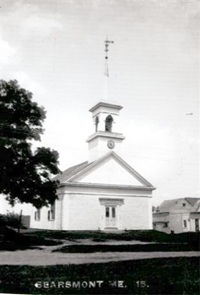 First Baptist church. The Baptist Society in Searsmont, Maine was the first
organized, 1827. Meetings were held in the Town House, or in private residences.
Occasionally they were held in the School houses. The First Baptist Church was
built in 1845. The contract required that the foundation be laid by June first
of that year. The specifications were drawn up by Sumner Pattee, B. F. Whitten
and R. L. Sweetland contracted to built the meeting house. The Church was
dedicated on January 13, 1846. The Church was destroyed by fire in 1888. [To
date, 2006, no photo has been found of the First Baptist Church of Searsmont,
Maine. The building was on the site of the present Town Pump.]
First Baptist church. The Baptist Society in Searsmont, Maine was the first
organized, 1827. Meetings were held in the Town House, or in private residences.
Occasionally they were held in the School houses. The First Baptist Church was
built in 1845. The contract required that the foundation be laid by June first
of that year. The specifications were drawn up by Sumner Pattee, B. F. Whitten
and R. L. Sweetland contracted to built the meeting house. The Church was
dedicated on January 13, 1846. The Church was destroyed by fire in 1888. [To
date, 2006, no photo has been found of the First Baptist Church of Searsmont,
Maine. The building was on the site of the present Town Pump.]
Searsmont
was named in honor of David Sears of Boston, one of the proprietors out of whose
lands the estates of the town were carved. His son, David Sears, Jr., in a
letter dated Oct. 14, 1845, presented to the Town of Searsmont a clock to put in
the tower of the Methodist Church, and a bell, to put in the tower of the
Baptist Church. If at any time the societies ceased to exist, the clock and bell
were to revert to the Town to be used in other ways. The gifts were accepted in
a Town Meeting, October 20, 1845.
[The story is told that after the
Baptist Church burned, the bell was damaged, melted or destroyed. The remains of
the bell were melted down and cast into smaller bells with a handle, likened to
a Teacher’s school bell, in at least two sizes. A bell of one of the sizes was
then given to members of the Church, according to how much money the family had
invested in the Church. There are two known bells in existence, one small bell
owned by the George Gove family, in the Searsmont Historical Society, and a
larger bell, belonging to the Samuel Fowles family, having been donated to the
Lincolnville Historical Society.]
Article reconstructed by Isabel Morse Maresh.
Establishment of the Town of Morrill, Maine
Excerpted from “The
History and Genealogy of the Town of Morrill, Maine” by Robinson, Morse, and
White with permission of the Morrill Historical Society.
Petition for a
New Town – 1854
For a long time there was a variance between the north
part of Belmont and the south part, each accusing the other of unfairness in
apportioning the town officers, and in assessing and collecting the taxes, and
appropriations of the expenses, etc. In 1854 a movement was made by the north
part of the town to be set off from Belmont and incorporate a new town. A
petition was drawn up and signed by most of the voters of North Belmont. A list
of petitioners and signers is given on page 23 and 24 of the above referenced
book.
Petition Submitted – 1855
The petition was presented to the
Legislature at its 1855 session, and taken under consideration, and finally the
north part of Belmont was set off and incorporated into a new town by the name
of Morrill.
The various sections of the Legislative Act to incorporate
the new town of Morrill are given on pages 25 and 26 of the above mentioned
book.
Homes of Morrill, Maine
The Morrill Historical Society
published in 1987, a 92 page booklet, “Homes of Morrill, Maine”. The booklet
contains many pictures of the old homes of Morrill. The booklet also tries to
list the builder and the families who have lived there as best as can be
determined.
The 1805 Smith House
Excerpted from a write-up of the
Smith House provided by and posted with the permission of the Morrill Historical
Society.
The Smith House, built in 1805, is currently owned by the
Morrill Historical Society and used as their museum.
This little house
has stood in the middle of Morrill, Maine for over 200 years but not always at
the same location. It was built by Matthew T. Merriam for his father-in-law,
Benjamin Smith.
Benjamin and Elsey (Woodman) Smith were amongst the
earliest settlers of Greene Plantation, later Morrill named for Governor Anson
P. Morrill in 1855, after a petition was signed to separate the town from
Belmont. Belmont gained its name being halfway between Belfast and Montville.
In 1801, Benjamin Smith built a saw mill on the stream and a wooden dam.
This dam blew out, carried away a large bank, and made a new channel forming the
island below the mills. He later built a grist mill on this source of water
power. While the wilderness was being settled, his wife, Elsey and daughter,
Abby struggled to help by cooking for the crew and tending to necessary, tedious
chores of those days.
According to the History of Morrill, Elsey
encountered a bear while riding horseback to the settlement with provisions but
she was a brave, stalwart woman and managed to frighten the bear away. The
pioneer ladies were made of fine mettle.
The original buildings were
situated on “Smith Pond” known now as the Morrill Mill Pond, but the present
maps in Maine Atlas and Gazetteer lists it by its original name. The Smith House
was moved from its first site on the bank of the pond because the road was made
wider and in order to save it from demolition, Charles White had it moved.
Mr. White, who was instrumental in researching the genealogical history of
Morrill along with Mrs. White, was a descendant of the early settlers and during
his lifetime a charter member of the Morrill Society.
About 1918, Mr.
White hired Sam Heal to move the house onto his land where it stood for many
years until he gave the building to the Morrill Society. Mr. Heal with a 800-900
pound driving horse with planks, rolls, tackle blocks undertook the job and so
the story goes, for the paltry sum of $25 moved it. It took a week traveling
along the side of the road so as not to hold up traffic.
It was then
moved again in 1981, just a few feet onto land owned by the Society. This time
members under the supervision of Harold Hayward who provided tackle blocks,
jacks and his expertise accomplished the move in one day. We hope it is on its
final resting place!
The picture of the original set of buildings with
ell, shed and barn is hung over the mantel in the house. It shows that the
family had comfortable quarters and that they were able to raise ten children
here in this first framed house in the town. History records that Mr. Smith was
a fine artisan doing about all the plastering and laid large chimneys in those
early times.
Mr. Smith opened his house for the first school which was
taught by Ezra Woodman and Mary Lesan in 1808. Any mail that was sent to early
families was left at the Smith House and church meetings were held here too.
This was the hub of the “Smith’s Mills” as this settlement was known by that for
many years. He also gave land for the town for a cemetery when the first death
occurred, namely Eliphalet Brown who was killed in 1804 at the early age of 18 years.
By Isabel Morse Maresh
Eunice busied herself preparing for church this
Sabbath morning, the thirteenth of April 1873. She thought to herself, “It's odd
that mother is not up getting ready for church.”
Mother was Elizabeth
Hannah (Raynes) Morse, born in New Gloucester, Maine in 1783. She was called
both Betsey and Hannah. Betsey had married John Lane Morse of Chester, N. H. in
1804. After their marriage John and Betsey had removed to the fledgling town of
Montville, then in the Commonwealth of Massachusetts, where they built a log
home. It was where their daughter, Eunice had been born and where the remainder
of their large family been born and raised.
Mother was ninety-one years
of age. She had not missed a Sabbath day’s meeting in all of the sixty plus
years of Eunice’s life. Eunice stepped into her mother’s room and realized that
Mother would be in the Presence of the Lord this morning, singing with the
angels.
Eunice recalled the many tales Mother had told her from her
youth. Her youngest brother, Moses, who had settled in Belmont, tended out on
Mother, preparing her a garden, keeping the old home in some sort of repair,
preparing it for winter, harvesting the garden, getting in and splitting
firewood, and the many chores to keep a home warm and secure during the long
Maine winters. Her sister, Betsey had married Hiram Weymouth, and resided in
China, Maine. Her older brothers, Ezekiel and Kendrick had removed to Detroit,
Maine.
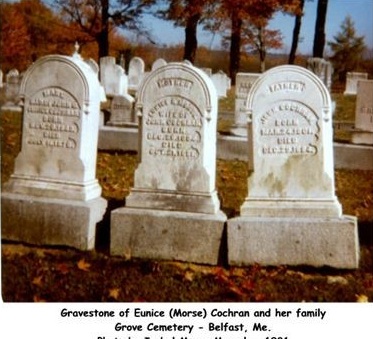
When Mother became aged, and unable to stay in her home, Eunice,
who had married John Cochran, took Mother to live with them in Belfast. Mother
would not be in the family pew in the First Baptist Church in Belfast this
morning, with Eunice, John, their daughters, Mary Ann and Lucy.
Father,
John L. Morse, had been active in Montville as a “surveyor of lumber” in 1822
and 1823, a “Fence viewer” in 1829. Father had tragically died of a fever in
February 1830 in Montville. He was only forty-six years of age.
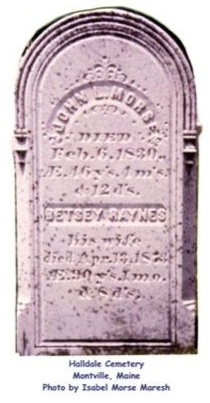
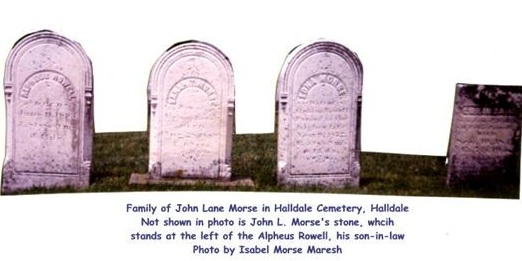
Mother would be buried beside her beloved husband, John, who had been buried with other
members of the family in the little Halldale Cemetery, in Montville, the
gravesite marked by a row of white gravestones. Mother’s death was duly recorded
in the Belfast Baptist Church, a fitting tribute to the life of faith that she
had lived in her lifetime.
Mother had told Eunice of their church life in
Montville. The first church in Montville was organized 17 July 1807 in an old
schoolhouse in the Frye district. In Aug. of 1807, Elder Job Cushman was
installed as the Pastor. A great reformation followed. Elder Cushman was
promised $1 a week, but times were hard. Often the pay didn’t come. To raise
money for the Church, the men paid a poll tax of twenty-five cents. The women
were to pay twelve and a half cents. Other money received was from a tax of the
men, according to their property tax, assessed according to their tax paid to
the Town. If a man refused to pay the tax, his family could not participate in
Church fellowship. Being deeply religious, it would be a disgrace not to be able
to meet with other believers. If a family was too poor to pay, his tax was
abated and taken from the pastor’s pay.
A two-story brick edifice was
built in 1829. The membership of the church rose and waned. At times there was
much dissent among the membership. Mother did not seem to recall what had
happened to the brick building.
When Mother and Father first came to
Montville, Elder John Colby, a traveling minister, unknown to the local people,
came to town preaching the Gospel. Wherever he preached, people were converted
to Christ. Elder Colby preached in the Schoolhouses, in private homes, in barns,
as well as on the highways, days and evenings, not just on Sundays. In about ten
weeks eighty people were converted to a belief in Christ, in the Kingdom, in
South Montville, North Montville, as well as in neighboring towns. People were
being baptized several times a week. Elder Colby cut the ice on pleasant days,
to baptize the eager converts. Elder Moses McFarland and Elder Ebenezer Knowlton
were also baptizing converts. One hundred and twelve converts were added to the
Church with well over one hundred twenty baptized. Among the converts who were
baptized were Father and Mother, John L. & Betsey Morse, and their children.
In the early days, traveling ministers arrived on horseback, from the
Quarter Meetings of the Freewill Baptist Churches. Among those preachers was
Rev. Jason Mariner of Lincolnville, often bringing his brother, William. William
courted and married Sarah Maria Jackson, daughter of William and Sarah Jackson,
all active members of the North Montville Meeting house.
The members of
the new congregation were required to join the Temperance movement, promising to
abstain from drinking alcohol of any form. Also, they were to pray for the
abolition of Slavery, a topic which often caused dissent in the congregation,
causing one church to disband.
Mother recalled that the North Montville
church recorded that they were united with the Quarter Meetings in Aug. 1818.
The North Ridge Church went through another reformation in the year before
Father died, in 1829, adding many more members to the Church, which had a small,
drafty log meetinghouse. At that time there was such a large crowd attending
meetings, that they were divided, Elder Pratt preaching at the meetinghouse,
Elder Thorn of Lewiston preaching at the Schoolhouse, while Elder Knowlton
preached at Father and Mother’s home.
About 1855, Asa Hall deeded a
parcel of land in North Montville to the members of the North Montville
Meetinghouse Corporation, their heirs and assigns forever, for the purpose of
building a meetinghouse for its members. Eunice and John came out from Belfast
to attend the dedication. Even her brother, Moses and his wife, Susan of
Belmont, attended the dedication of the Church in Jan. 1856. The Church was
faithfully attended every Sunday by Mother and her children who lived locally,
owning a pew in the Church. The church later became known as the North Montville
Baptist Church.
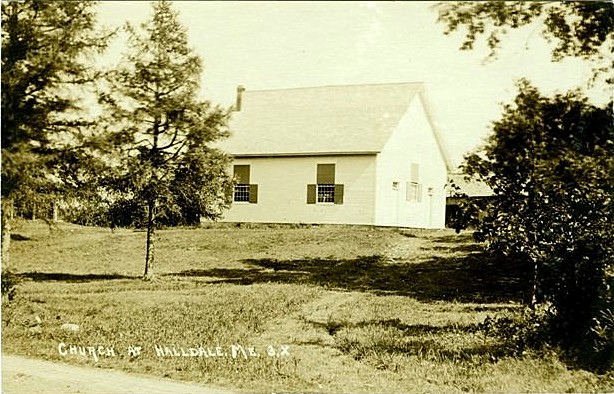 John and Betsey Morse long ago went to Heaven to sing
with the angels, but the Meetinghouse that the family had loved so dearly, is
still in existence in the Halldale section of North Montville. It has gone
through its ups and downs. During World War II, attendance waned to the point of
being closed for some time. The last recorded meeting was in January 1971.
John and Betsey Morse long ago went to Heaven to sing
with the angels, but the Meetinghouse that the family had loved so dearly, is
still in existence in the Halldale section of North Montville. It has gone
through its ups and downs. During World War II, attendance waned to the point of
being closed for some time. The last recorded meeting was in January 1971.
In early 2005, it was noticed that the Church had been closed for years. The
Maine Historic Preservation Commission in Augusta, Maine, issued a judgment that
the old meeting house was eligible for nomination to the National Register of
Historic Places. Only a handful of the members of the old church survive.
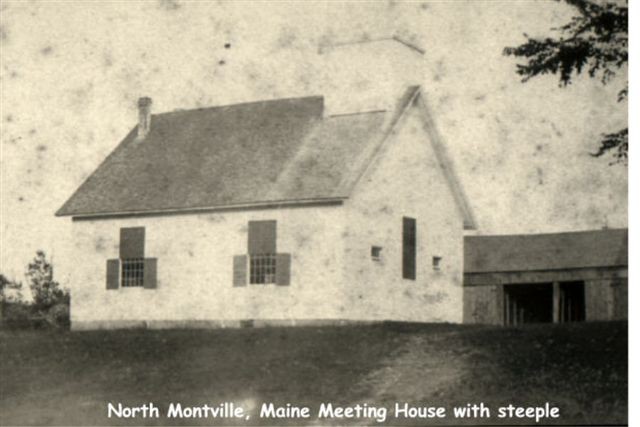
The future of the old meetinghouse and its five old records books, back to
the beginning of the religious movements in Montville, is in question. As of
2006, the church is not on the records of the Baptist Churches in Maine, nor on
record as a Non-Profit entity with the I.R.S. The meetinghouse has been in good
condition for its age.
I would like to think that the dream that recently
woke me, with a still small voice saying, “Don’t let our beloved church be
lost,” have been a voice from the beyond.
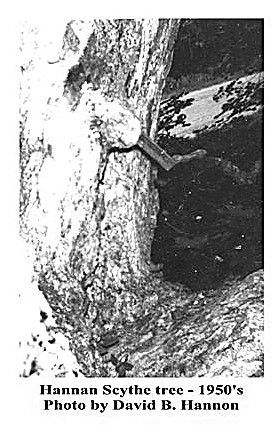
Scythe Tree 1950s
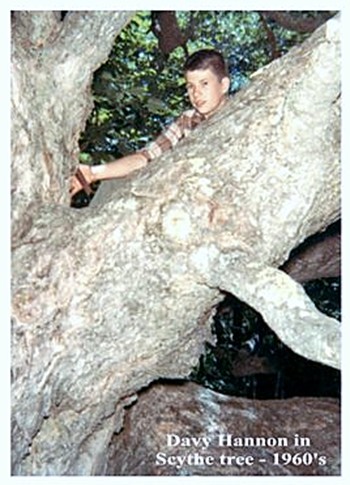
Scythe Tree 1960s
Davy Hannon
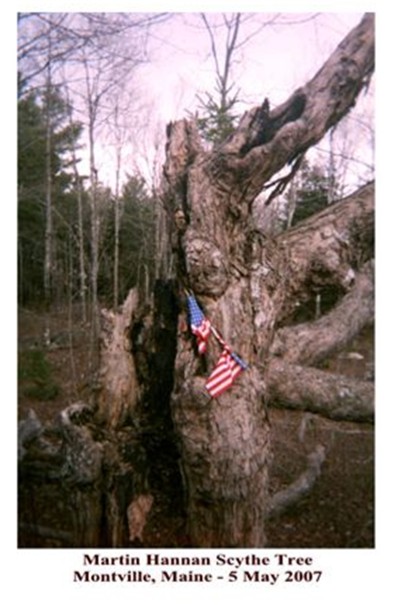
Scythe Tree 2007
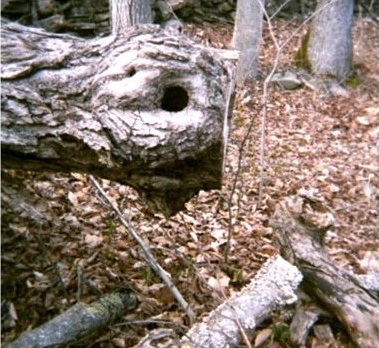
Scythe Tree Limb 2007
Written by Isabel Morse Maresh
This has not been a good year for old family landmarks. Early this Spring, Bob and
I were coming home from Freedom through Montville. We chanced to come by the old tree
that Martin Hannan hung his scythe in as he was mowing in the then field for
Levi Bartlett on a hot July day in 1862, with his brother Horace and Bartlett’s
haying crew.
Martin had been a rugged young man, able to do a good day’s
work for a day’s pay. As they mowed in rhythm up to the road, an Army Recruiter
happened by, looking for volunteers to sign on to fight in a war that few were
aware of until that time.
On that day, Martin Hannan and his brother,
Horace, decided to follow the Recruiter to sign on as soldiers in the Union
Army, a decision which affected their future and their health for the rest of
their lives.
The young maple tree where Martin hung his scythe was a
landmark for the people of Montville for over a century.
Many years ago,
Elden Rowell asked Bob and I if we would like to see the legacy, left by Martin
Hannan, Bob’s great-grandfather. It became a ritual to ride to Montville each
Fall to gather a box of colored leaves from the old tree. Just like our old
bodies, and our old dog, the tree annually showed signs of age and decay. The
piece of the scythe blade that was left became smaller and smaller until one day
it was gone.
The leaves were pressed, sometimes dated, and put into a
box. I even shellacked some, making greeting cards, including the tale of Martin
Hannan and the old tree.
Martin Hannan died in 1904, still the tree stood
tall and proud, living on. The legend was perpetuated by myself and others. A
short history of Montville, supposedly written by students in the 1940’s said
that Martin had died in the Army. That story was not true. Martin was
injured in Dec. 1862 at Bell Plains, Virginia, where he stepped into a hole on
uneven ground while carrying a heavy log to build a ‘corduroy’ road. Dr.
Billings diagnosed him with a ruptured groin.
In June of 1863, on a march
near a place called Dumfries, Va., the day was intensely hot. It was so hot that
Martin passed out, and was unconscious for a length of time. When he came to, he
crawled under the bushes. Israel Cross, a soldier from Lincolnville, stayed with
him until nightfall when he was able to walk. They caught up with an Army
hospital wagon. Martin had suffered heat-stroke, the effects of which troubled
him for the rest of his life. On another hot day, he was with his company in a
battle at Gettysburg, Pa., where he had never seen so many men in one place in
his life. As men fell to the left, right, front and back of him, Martin felt the
pain of being hit by a shell fragment in his left hip.
Martin Hannan
eventually returned to Montville where he married Melinda Herrick. The two of
them raised a family of eight children. He was the progenitor of a large number
of descendants, many living in the Montville-Liberty area, though many have
moved to far-away places.
Occasionally someone would mention to Martin
that the tree had grown around his scythe. After his death in 1904, the tales
persisted about the scythe in the tree, though it was not the only such tree in
the area.
On that Spring day of 2007, Bob and I stopped to visit the old
decaying tree. The branch that had held the remains of the scythe had broken off
and was laying on the ground. The crotch of the tree had been cut with a modern
saw.
I was very sad as we drove away. Several times since the story of
the old tree and Martin Hannan came to my mind. I told Bob, who sometimes thinks
that I’m nuts anyway, that we should hold a Memorial for the old tree and what
it has meant to many over the years.
And while we’re about it, we should
give a salute to Martin Hannan, his brothers, and the many veterans who have
left family and all to fight for what they believe is right. Not everyone has a
legacy and the posterity that Martin Hannan has, to be remembered by. But each
and every veteran did what they felt that they were needed to do. May God bless
America, and bless our Veterans of all wars.
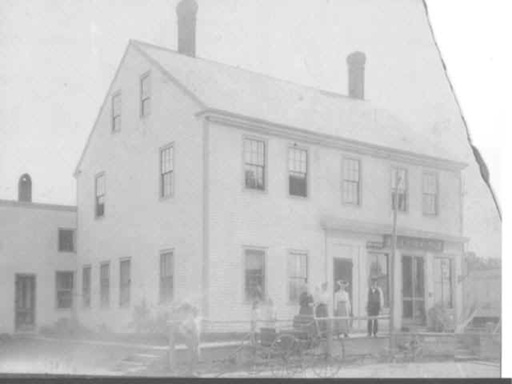
Simmons Store and Post Office
Searsmont, Maine
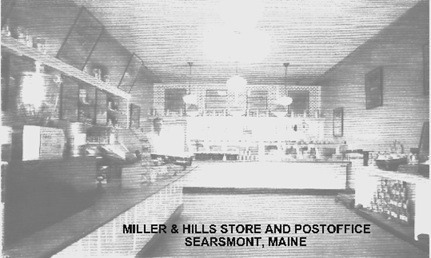
Miller & Hills General Store and Post Office
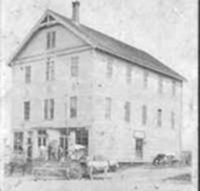
Old Grange Building
The person in the photograph is Fred Royce MILLER, who was born in Searsmont, Maine, 15 Feb 1901; he died in Falmouth, Maine, 15 Nov 1982. Fred Royce Miller was a grandfather of Linda Miller Clark, who contributed these three photos of the building in Searsmont.
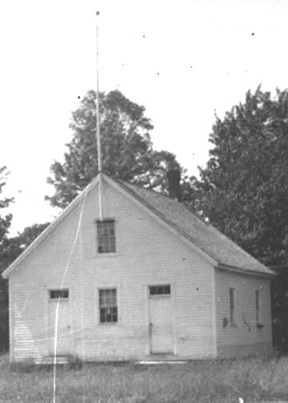
Swanville School
courtesy of Lisa Nugent
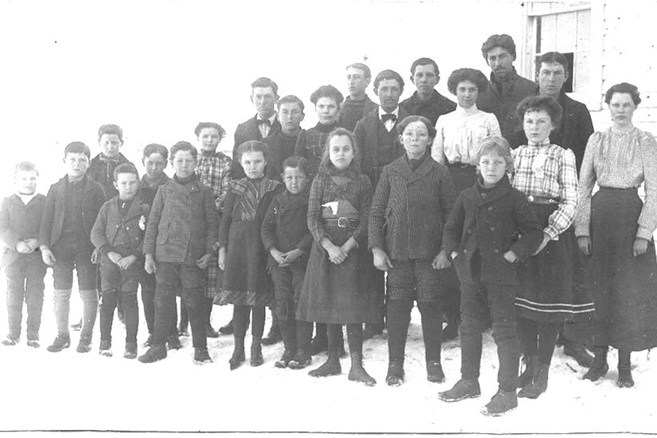
Swanville Class of 1898-99
courtesy of Lisa Nugent
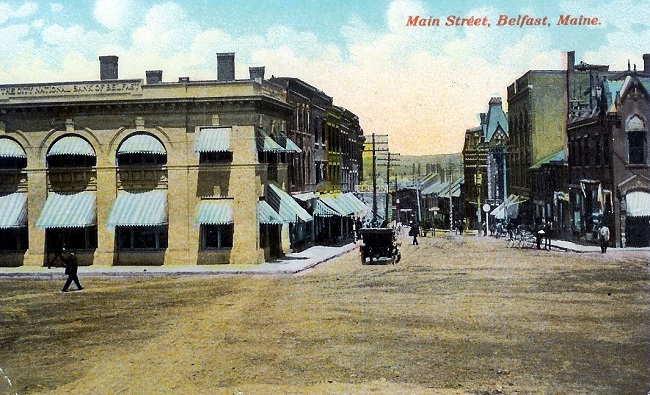
Main Street, Belfast
"In the year 1860 there were 11,375 mariners in the State of Maine. They
comprised almost one-fifth of the population. Of these, 759 were masters of
ships. In turn nearly half of these were in command of "Cape Horners."
"The little town of Searsport with 1,700 inhabitants will serve as an example.
It was known in every deepwater port in the world. Over a hundred and fifty
masters of full-rigged ships knew it as home. In the seventies and eighties, it
is estimated that 10 per cent of all the shipmasters in the American merchant
marine had Searsport as their hail. In 1889, 33 captains out of 77 were in
command of Cape Horners.
"Many of their vessels were built for their own
account in the Matthews, Merrithew, Carver, and McGilvery yards at the head of
the harbor. In later years, when the shoal waters precluded the launching of the
larger ships, the Searsport captains had their ships built up the Penobscot at
Brewer and Bangor. Out of twenty full-rigged ships built there, Lincoln Colcord
lists at least eight for Searsport accounts."
--William Hutchinson Rowe,
The Maritime History of Maine: Three Centuries of Ship Building and Seafaring,
Gardner, Maine, The Harpswell Press, c1989, pp 286-287.
Extracted from
Searsport Sea Captains, published by the Penobscot Marine Museum in Searsport.
Copyright © 1996- The USGenWeb® Project, MEGenWeb, Waldo County

This page was last updated
07/12/2026