

Weston County
WYGenWeb

* Has Better Prospects than Any Other Town In the West
* Oil and Gas, Gold
and Silver Ores, Iron and Tin Ores, Stock-Raising and Agriculture are the
Substantial Elements of Future Prosperity
Cities are built where there is
a demand for them. Wind may create a temporary boom, but substantial growth
always follows only where there are the opportunities for coining the almighty
dollar. Pleasures, theories and prejudices form a large part of this world, but
after all - it is the desire to amass riches that brings about the construction
of brick blocs, paves streets and oils the wheels of commerce. One may pick out
a pretty location and say, here a city should be built - but it is not built.
Ony may look around and say that this being a natural gateway, or a splendid
stopping place, or a natural center, a city should be built here - but is it
not. It is often true that men amuse themselves by picking out "natural
roadways" for railways, and because of these they say their town must be a
commercial center - but it does not become one. In mining countries it is often
true that men say to each other that when a particular vein shall be followed
far enough riches will be struck and that will build for them a city - but they
are disappointed. It is not the theory that a city ought to exist, it is not a
fanciful notion that because a site is particularly appropriate it should be
build upon - in truth, the rigid laws of trade recognize no theory or conceit,
nothihng except the one cold, hard fact that if there are real elements of a
commercial value whose development will create great riches, there and there
only will a city be built. These elements may simply be an exchange of
commercial products and the place a convenient center. It may be the development
of new enterprises. But whatever it may be, there must be behind and above and
around it all the glitter of the silver dollar.
The Journal believes,
honestly, and with a sincerity that is backed by a sacrifice and a change that
for good or ill unites our future with that of the town, that Newcastle is to be
a city of proportions that will rank with the thirty largest of the United
States. The conclusion was not reached until after a thorough inquiry into the
elements that were expected to create a city here, adn it was reached before
business interests had been given the opportunity to create a prejudice. Like
the dear, good old lady in the class-meeting we have but to [learn]. I can only
say, I am glad that I am here, and like her will give the reasons for the "faith
that is in us."
COAL
But while a good coal for domestic use is a
valuable commercial article, and the number of men employed will do much toward
supporting a town, its value is more than doubled when it is known that it is a
good coke-producer. It requires a large force to mine the coal, but requires a
larger force to convert the same coal into coke. And when we know that the Black
Hills are full of
GOLD AND SILVER ORES
it is realized that the
demand for coke will be almost unlimited. the B.&M. built a branch several
hundred miles long to reach the coal - it is now ready to commence work upon
another line to connect the coal and coke with the ores. When this connection is
made, it must inevitably result in the establishing of
REDUCTION WORKS
at Newcastle. The road will reach Lead City, the center of the ore country.
The road will be pleased to sup-**** Homestake company and the ***perators with
coal and coke, but **** the matter of establishing new **** - which will be
found **** profitable with cheap **** coke arises it will be found *** ** build
them somewhere *** Homestake company have **** water that falls ***. No
independ-*** Consequently the ore will be loaded upon the cars and carried -
where? To the coke, of course. Otherwise the cars would come back empty.
PETROLEUM
Over one hundred men have said to us during the last six months
that "if they strike oil near Newcastle, of course it will make a city." It has
not been our duty to convince them that petroleum has already been found. The
time was not yet ripe. It is true that the first well bored in this vicinity
struck oil and gas in such quantities and force that only by great labor could
the flow be stopped adn the well plugged. It is true that this find was one of
those rare streaks of luck where the drill happened to strike a crack in the
earth, thus finding 175 feet from the surface the oil and gas escaping from a
reservoir probably 2,000 feet deep and possibly five miles away. But the proof
is positive that there is an immense reservoir of oil and gas below us, and when
the walking-beam drill is used, the well properly cased, adn preparations made
to receive and care for the crude petroleum, then the oil will be struck and the
world shown a genuine "spouter."
THE NORTHWEST EXTENSION
There are
a thousand indications that the B.&M. expects to make Newcastle a division
station for three branches. Two miles of track have been constructed upon the
Buffalo extension and a careful survey made to the end of the route. It is not
necessary to here give the reasons, but the line will be extended a few miles
west this summer. Next year it will probably be extended to Buffalo and later,
if the alliance between the Northwestern and Union Pacific continues to exist
and the necessity for another western outlet for the B.& M. is as urgent as it
is now, a connection with the Northern Pacific may be formed.
Buffalo is
an incorporated city about 165 miles northwest of Newcastle. It has a $40,000
brick courthouse, a school house costing $20,000, a hundred barrel flouring
mill, an electric light plant, a waterworks system representing $50,000 and
other public improvements. Among the private enterprises are a $10,000 brick
banking house, a dozen or more mercantile buildings costing from $4,000 to
$10,000 apiece, besides a couple of hundred valuable brick and frame residences.
A government military post is located two miles from the city, and the
surrounding country is fertile and well developed agriculturally.
A LEAD
CITY
extension from the Cheyenne river is now practically in course of
construction. The benefits to be derived from this branch are fully set forth in
an article on another page. Another line to Lead City will be built from the
Newcastle mines, through a tunnel and almost directly across to Lead City. This
will tap Nigger Hill gold, silver, iron and tin district and result in bringing
reduction works for these ores to Newcastle. The Journal has already devoted so
much space to this district, that we cannot enlarge upon it now. Suffice it to
say, that there is mineral wealth enough in this district to build a dozen
cities, that we have the coal and coke for its reduction, and that the possible
results of a combination are beyond the most sanguine imagination.
TIMBER
The western slope of the Black Hills is covered with a dense growth of pine,
which resembles in outward appearance the Norway pine of the east, but gives far
better lumber. This pine is a tall, straight tree, free from limbs for over half
its height. The wood is soft and white, with a straight grain, free from knots,
and answers fully the demand of the builder. The trees will, as a rule, furnish
good straight saw-logs from thirty to fifty feet in length, averaging from
twelve to twenty inches in diameter. These pines are also found west of the main
Black Hills range growing in belts along the sides of the varous peaks and on
the higher ridges and plateaus, and in the canyons. Along the edge of the plains
the pines are often replaced by burr-oak and white elm of moderate size. These
trees are also found in groves in the valleys and parks between the hills, and
occasionally associated with white birch in the ravines. The oak and elm grow to
a medium size, averaging from thirty to fifty feet in height and from fifteen to
twenty inches through, large enough to prove valuable for many purposes. In many
canyons the black and white spruce grow thickly, and from eight to fifteen
inches in diameter, giving a valuable timber for trestles and small bridges on
account of its great strength. Ti* wood is white, tough, elastic and fine
grained. The Indians formerly used this wood for his lodge pole. There are but
few living streams that are without their fringe of cottonwoods, boxelder and
willows. One of the most pleasing portions of the scenery characteristic of
northeastern Wyoming the gently swelling praries, with groves of oak and pine
beautifully interspersed. Those who have looked upon this region as a portion of
the dreary, treeless plain; or who have gained their ideas of the territory by
riding over the Union Pacific railroad, can upon visiting this region imagine
themselves among the groves of New York state, or looking down upon some of the
caves of the Carolinas.
There are seven saw mills supplying lumber for
the Newcastle market. As there is no limit to the timber that can be used for
this purpose, this promises to become one of the leading industries. The
treeless plains of Nebraska make a demand for lumber at good prices that can be
relied upon. If lumber can be shipped from the pineries of Wisconsin to Chicago,
from there to Omaha, and from the latter city to the towns in the interior of
Nebraska and sold at a profit to the manufacturer, two wholesale dealers and one
retailer, there ought to be enormous profits in its manufacture here to supply
the same trade.
LIME
A large number of men are engaged in burning
lime, and there is a good field here for someone to engage in the business on a
large scale and ship to other towns along the line of his branch of the B.&M.
SALT
A salt spring two miles from the mines is expected someday to
become the basis for a profitable industry.
GYPSUM
is found in
large quantities and awaits the necessary capital to utilize it.
FUEL
An important item in the year's expense is fuel. Here both wood and coal can
be had for about the expense of hauling.
BUILDING STONE
One would
naturally expect to find valuable minerals in a land where the edges of every
geological formation from the granities to the tertiary crop out. Building stone
of almost every variety and description abound, granite, brown, red and green in
color, with trachtyte, proph*y adn other ingenious rocks to complete the list
for heavy massive work. Limestone of all shades and color, hardness and texture,
and marble, white, banded, red, salmon colored, green and brown will attract the
attention of those who appreciate the ornamental as well as useful. Vermont and
other eastern states send their marble ot the Pacific. There is no reason why
this country should not send their marble to compete with and rival it.
FARMING
No portion of the west is better fitted as a home for those who
are willing to aid nature in feeding the millions than portions of Weston
county. Thousands of acres of land are yet open for settlement, and it has
already been demonstrated that immense and certain crops of wheat, oats, barley,
millet, timothy, potatoes and all classes of garden vegetables can be raised
successfully, and for which a ready market can be found in the mining camps of
the Black Hills. The large and successful mining industries of Weston county and
the Black Hills, and the stock interests in the extreme west, the coal and oil
interests which are being so rapidly developed, all insure to the farmer and the
small stock raiser, a good market and high western prices for the products of
his farm and stock ranch.
A COUNTY SEAT
It is probable that within
ten days the call for an election to create the county of Weston from the south
part of Crook county will be issued. As Newcastle has no competitors for county
seat honors, and there is no opposition to the formation of the county, it is
only a matter of forty days' time when the town will be a county seat. It
requires no argument to convince everyone that this is a great advantage, that
capital and people will come here more readily, and gives the town a stability
that can be depended upon.
A LAND OFFICE
It is reported at
Sundance that Delegate Carey is working to secure a change of the location of
the new land office from that place to Newcastle, and that the present session
of congress will surely establish the new district. The Journal can give no
information in regard to Judge Carey's position, and believes he will do what he
thinks wil lbe for the best interests of the settlers without regard to the
claims of either town, but it does know that Newcastle has several votes in
congress that can be depended upon to be friendly to its interests, and votes,
after all, are what usually settle such questions.
PLENTY OF WORK
While it is ture that in every town there seems to be more mechanics and
laborers than the just proportion, principally because when there is work large
numbers are demanded, and when times are quiet they are the first to be out of
employment, at the same time there has been no reason why workingmen here should
not be busy most of the time. There has been a great deal of work done here, and
there seems to be every prospects that those who want to work can find plenty of
it to do. Throughout Nebraska wages for laborers are from $1.00 to $1.25 a day.
Section men on the railroad receive $1.15. Here the lowest wages paid are $1.75,
and skilled labor is of course proportionately higher. There is a demand at the
mines for one hundred more laborers at this time.
NEW BUILDINGS
Thirteen lots were purchased of the Lincoln Land Company upon which the
purchasers took advantage of the rebate on condition that they would erect
two-story brick buildings this summer. The first of these - Meyer Frank's - is
now in course of construction. It will be two stories hight, and a basement, and
24x70 feet in size. The outside will be of pressed brick. As soon as brick can
be made here work upon the other buildings will be commenced.
Source: The Newcastle Journal, 05 Apr 1890, p. 4A, part of title missing because the top left corner torn
A Brief Review of Businesses Established
Wholesale, Retail and
Professional Men Well Represented
But There's Plenty of Money to be Made Here
by Everybody
Seven months ago on the site where Newcastle now stands there seemed
to be nothing but hills, sage-brush and a few grader's stakes. The 10th
day of September 1889, is regarded as the birth day of the town. The
weather was anything but pleasant. The heavens were overcast with dark
and lowering clouds. The wind blew almost a gale, the dust and wind
vieing with each other in an effort to make it disagreeable for those
who desired to unite their fortunes with the destinies of the new town.
There were a large number of men who had ridden or driven a fair
distance across the country, far ahead of the railroad, and over many
miles of land that still belonged to the government and that seemed to
have no value, to here purchase twenty foot lots for $1500 each.
Certainly a mature judgment is the only thing that could picture a
bright future under such unpropiatious circumstances. Among the first
purchasers of lots were Isaac H. Chase, Franklin & Baer, Rounds & Baird,
Fawcett, Delahant & Aflebach, McLaughlin Bros., Roderick Bros., Wiker &
Irwin, J.A. Larimer, Mondell & Patton, Meyer Frank D.W. Fawkes and Co.,
Wineland ******am, W.H. Fanning and Jas. ***Cr**, nearly all of whom
have ***** substantial buildings and become permanent and reliable
business men of the town. Before the evening of September 10, thirty
thousand dollars' worth of lots had been sold and the work of building a
[city] at the mouth of Coal Canyon was then begun.
It was
only seven months ago, the nearest railroad was sixty-nine miles away,
and the B.&M. had only reached Crawford, ninety-eight miles south. The
nearest town was forty-three miles distant. Until November 15--half the
age of the city--all stocks of goods, supplies, provisions, builders'
material (except lumber), machinery, hay, grain, etc., were hauled by
wagon a distance of not less than fifty miles, a large part of the time
it being necessary to transport everything from Hat Creek, seventy-five
miles distant, and during the early days of the town's growth from
Crawford, ninety-eight miles south.
Despite these almost
insurmountable difficulties by the time the railroad reached this point,
there were over *** people here who expected to make Newcastle their
home, fifty thousand dollars worth of real estate had been purchased,
fully fifty business houses had been erected, and that many business men
were rushed from early morning till late at night.
And now the
City of Newcastle has over one hundred business men, about seventy-five
******** ****uses and a stability ***** that invites everyone *****
****ble calling to come and share ***** future that is certain to ***all
of prosperity that may be *** marvellous than the Black Hills country,
noted for wonderful developments, has ever known.
The City of
Newcastle now has:
WHOLESALE:
1 grocery, dry goods and
clo***, 2 hardware, 1 lumber yard, 1 commission, 3 hay and grain, 2
liquors and cigars, 1 meat market, 1 brewer,
RETAIL:
3
hardware, 3 groceries, 3 dry goods, 5 clothing, 3 drugs and medicines, 2
furniture, 2 milliners, 3 lumber, 2 news stands, 1 auction house
OTHER LINES:
6 attorneys, 2 physicians, 1 bank, 4 livery
stables, 3 newspapers, 1 restaurant, 4 hotels, 5 chop houses, 15
saloons, 4 laundries, 3 blacksmith shops, 1 lodging house, 2 drays, 2
shoemakers, 1 tailor, 3 barber shops, 1 bath room, 1 harness shop, 2
taxidermists, 2 warehouses, 1 carpenter shop, 1 hospital, 1 billiard
hall, 1 jewelry store, 1 brickyard, 7 sawmills, making lumber
exclusively for this market, 1 round house, 1 brass band, with
instruments costing $350, 1 board of trade with fifty-one members.
The B.&M. has twelve miles of side-track, a large depot, ware-house,
ice-house, a Kerr coal chute and a ten-stall round-house at this place,
and the extensive grading done and improvements made *** *** they regard
Newcastle **** *** most important por*** *** They are extensively ***
the town it occupies a continuous place on the maps and on the C.B.&Q.
folders and there is *** reason for believing that it is their intention
to throw the weight of their immense influence in favor of the growth of
this place.
The coal mine of Kilpatrick Bros. & Collins, to reach
which the B.&M. built from Alliance to this place, and which is the
basis for the past growth and future prosperity of Newcastle, is located
in Coal canyon, eight miles north of the town. It was impracticable to
place a town nearer the mines because it would have been necessary to
build it upon the divide three hundred feet above the mines. Instead, it
was placed *** the railroad at the mouth of the canyon and at the point
where the *** country joins the Black Hills and where the indications
for striking oil are the most encouraging. It is as much the coal town,
however, as if the opening to the mines were within the town limits, the
headquarters and general store being here and most of the general
business being transacted here.
There are a great many cattle
ranches within trading distance of Newcastle for which this is a supply
point. "Trading distance" means in come cases 100 miles, but as this is
the nearest town it gets the trade, just the same.
The Cambria &
Newcastle Water Supply company is perhaps one of our most important
ventures. The city being within the oil district, it is not possible to
secure good water in wells. About three months ago the above named
company was organized [and] since then a large force [workmen] have been
kept busy upon *** that is to supply Newcastle [with] plenty of good,
clear, soft water [fron] a mountain stream found *** miles north of town
and four miles north of the mines. It is expected to have a supply of
water in Newcastle by the first of May.
Jobbing houses have been
established with the expectation that when the B.&M. branches are built
out of here, this will be a center for the distribution of goods, and in
a comparatively short time reach that size which would secure
distributing point railroad rates. There is good reason for the belief,
and wholesale firms that open in business here now will have a great
advantage over all competitors when the work of opening up a territory
is commenced. The freight line to Sundance and Buffalo is already
helping to establish a good jobbing trade with these points.
Being the county seat of Weston county, Newcastle's stability is
established. No matter what may happen to the general resources of the
country, the collection of taxes from the whole county and the
expenditure of the money at the county seat may be depended upon. There
is no possibility of a change of the county seat, and there will
therefore be no fight to hold it. The land business for one hundred
miles east and west and forty-eight miles north and south--and it will
be considerable--will be transacted here. No matter how many towns may
be established, they must regard Newcastle as the leading town and pay
tribute with their best trade--the cash trade.
The first
impression of Newcastle is that the the site is a poor one. It seems to
be crowded next to the foothhills of the Black Hills, over half of the
land platted lying within the pine timber of the hills, considerable
grading has already been necessary. A walk through the different
portions of the town, however, convinces one that the site will be a
pretty one when the rest of the grading is done and the residence
streets opened through the timber. Every residence lot will be covered
with fine large pine trees, and as many can be left standing or cut out
as desired. The hills and knolls , when properly terraced, will make far
handsom (page torn) -dence sites than the leve (page torn) solid brick
blocks lining (page torn) of main street, a large (page torn) a large
court-house and (page torn) -dences among the (page torn) castle will be
(page torn) places in the (page torn)
Source: The Newcastle Journal, 05 Apr 1890
The dastardly attempt to take the life of Mayor Mondell last Monday evening
was one of the most unprovoked and entirely unjustifiable crimes ever committed
by a fiend in human shape. Hurrying from the meeting of the city council to
attend the mass convention, he was halted in front of the St. Elmo hotel by John
Hines and asked if he would give the latter a chance to save his property. With
the remark that he was in a hurry and would see him later, Mr. Mondell started
away. Hines then pulled a 45-calibre revolver, and, without saying a word,
fired, the ball striking Mr. Mondell in the fleshy part of the right hip.
Thinking he had missed his mark, the cowardly scoundrel grasped his pistol in
both hands, aimed at Mondell's head, and again fired. Mr. Mondell dodged in time
to save his life, the wind from the passing bullet touching his face. He ran
into the Windsor hotel, and in a few minutes he reached his room in the brick
block, where he has since received every care that a host of friends could
devise. While the wound is a serious one, it is not regarded as dangerous to
life.
Hines was arrested and lodged in jail, and on Tuesday bound over to
the district court in $5,000 bonds. There had been no personal trouble between
Hines and Mr. Mondell. The latter is general manager for Kilpatrick Bros. &
Collins, and the firm having trusted Hines for lumber, rent of lot and groceries
to over $500, to secure which a mortgage was given, had placed the account in an
attorney's hands for collection. Mr. Mondell had said nothing to Hines for
several weeks, and there was absolutly no excuse for the desparate deed.
Source: The News Journal, Friday, 25 Apr 1890, p. 5C
On October 22, 1903 word was received that a large band of Sioux Indians from
Pine Rilge Agency, South Dakota, led by Eagle Feather and Brown (both Carlisle
educated Indians) were unlawfully slaughtering game. A warrant was issued for
their arrest and placed in the hands of Sheriff Miller of Weston County. A small
band consisting of nine Indians were arrested and taken to Newcastle. Later a
large band of 23 bucks and squaws was found on the Cheyenne River. They refused
to be arrested, broke camp and left. The Sheriff’s posse was too small to
prevent the move, but later on the thirty-first an enlarged posse overtook the
Indians on Lightening Creek in Converse County and called upon the Indians to
surrender. Their answer was a shot which killed one of the posse. Here a fight
took place in which Sheriff Miller and Deputy Faulkenburg were killed and
several of the posse wounded. Four Indians were killed and five wounded. The
Indians hot-footed to South Dakota, but at Edgemont, nine Indians were arrested
by a Weston County posse and taken to Douglas in Converse County where the fight
took place.
Immediately upon ascertaining the facts relative to this
matter, I communicated with the Secretary of the Interior Department. I demanded
the return of the Indians by the Department to the Sheriff of Converse County
for trial for the murders committed by them and for the illegal killing of game.
Based on a false report of an agent sent to investigate, the Secretary feared
there might be mob violence. I went to Douglas, interviewed the officials and
many citizens and found there was no truth in the Agent’s report. I wrote the
Secretary fully, regarding the matter and the concluding paragraph was as
follows:
"The Supreme Court, in the Race Horse Case, passed upon the right of the State to prosecute Indians for violation of its statutes. We propose to exercise that right. Northwestern Wyoming has been very troubled for several years with Indians from Reservations in the Dakotas and Montana going through the state killing game and cattle. We trust that the sad occurrence which has just taken place will at least have an influence upon the Department to keep its Indians at home. I, again, assure you that the Indians will receive every protection necessary and they will be accorded a fair trial."
Unfortunately, at the preliminary hearing, county officials persuaded the Justice of the Peace to refuse to bind the Indians over to the District Court for trial because they feared the expense of a trial would bankrupt the county.
Contributed 2025 Jun 25 by Norma Hass, extracted from 1957 Yesterday's Wyoming by Fenimore Chatterton, pages 88-89
Weston County was organized in 1890, and was named after a gentleman of that
name, who was interested in building the Burlington railroad through that
section of the state. It is 100 miles long by forty-eight miles wide, comprising
3,133,440 acres, and has a population of 3,604. The total assessed valuation of
all kinds of property in 1906 was $1,904,700.56, divided as follows: Farm lands
and improvements, $338,224.65; town lots and improvements, $127,270.00; cattle,
$438,204.00; horses, $102,026.00; sheep, $324,475.50.
Weston County,
although enjoying an altitude between 4,000 and 5,000 feet above the sea level
and possessing good soils, is not so well watered as other sections of the
state, owing to the absence of large streams having their sources in the lofty
mountains of the snowy ranges. The rainfall, however, is considerably greater
than at a higher altitude, averaging from eighteen to twenty inches per annum.
The dark, loamy soils, in part of the county, are quite productive without
irrigation, and the reddish gypsum soils found at the base of table lands retain
the moisture and are very fertile. Precipitation is mainly in the spring ahd
early summer, and crops make rapid progress from germination to maturity. Wild
fruits of the smaller varieties, such as plums, gooseberries, currants and
strawberries, grow plentifully. All the farm products known in the northern
latitudes are produced in this region, even Indian corn, and the yield is most
excellent. Wheat of the spring varieties yields over fifty bushels, rye over
forty, oats seventy to even one hundred bushels; and corn, of the flint, dent
and squaw varieties, also makes good returns. Timothy, alfalfa, red clover and
other tame grasses are cultivated with success, as are also potatoes, rutabagas,
turnips, carrots and sugar beets, the last named producing as high as six tons
per acre, with twenty per cent, of sugar, as shown by analysis. Stock growing
makes an excellent accompaniment of farming throughout this region. Shorthorn,
Hereford, Sussex and West Highlands cattle find favor for the range. Horses also
receive much attention and are increasing in value. There is good pine timber in
the Black Hills, and numerous saw mills supply the wants of the settler. Gypsum
is found in inexhaustible quantities, and superior quality of building stone,
granite and lime. Salt producing springs have been discovered near Jenney's
Stockade, and an oil district in the same locality covers over 400 square miles.
(See article on Oil.) Weston county is famous for its coal, which finds a ready
market in the adjoining states of South Dakota and Nebraska, and along the line
of the Burlington railroad, which traverses the entire length of the county,
east and west.
Newcastle, the county seat, is a thriving town. The first
building was erected in September, 1889, the Burlington railroad having reached
that point in the previous month. After the discovery of coal the population
grew very rapidly, and in 1900 was 756. In 1890 extensive waterworks were
constructed at a cost of over $100,000 by the Cambria Mining Company, which
furnish an abundant supply of water for Newcastle, Cambria and the great coal
mines. A $6,000 town hall and $12,000 school building have been erected. Within
the immediate vicinity are several oil wells, the first discovery being made
fifteen years ago. Salt wells have been opened in the vicinity of Newcastle, and
promise to develop into a large and profitable industry. All lines of business
are well represented and prosperous.
Cambria is a coal mining town, the
population being actively engaged in that industry. The quality of coal mined is
excellent and is described elsewhere in this publication. Modern equipment and
methods are the characteristics of the mining plant. The coal here is of a
coking quality, and coke ovens are in operation. The population of the Cambria
district is about 1,000.
The State of Wyoming and the Experiment Station
of the United States are conducting agricultural experiments near Newcastle.
Much of the land in eastern Weston County can be farmed without irrigation.
Wherever water can be secured crops which cannot be grown without an ample water
supply can be raised, while by saving the proper seeds the, dry farmer can be
successful even under ordinary farming methods, and it is seldom that a full
crop is not raised.
In locating a farm, it is necessary that the
experiments of present residents should be considered, as not every tract of
ground can be successfully farmed, some of them being too exposed for maturing
grain.
The United States land office for this county is located at
Sundance.
Contributed 2025 Jun 25 by Norma Hass, extracted from 1907 State of Wyoming by Wyoming Department of Immigration, pages 43-44
CHEYENNE, Jan. 13 - Pioneer Park, the birthplace of Frontier Days was swept
by a $30,000 fire Sunday night. The grand stand, skating ring adn adjoining
structures were burned and nearby buildings in the park addition were damaged.
Part of the Irwin Bros. Wild West show outfit, including tents and seats was
destroyed.
Source: The News-Journal, 16 January 1919
The blizzard of 1949 continued for three straight days. It began on Sunday,
January 2, and raged continuously until Tuesday night, January 4. According to
the report in the Newcastle News Letter Journal, "only a reasonable amount of
snow fell but with the high winds over the entire area visibility was null and
the drifting of snow was extremely bad." [Newcastle News Letter Journal, January
6, 1949]
Earl Christensen and other ranchers in the area were completely
snowbound and could not get any farther away from the house than to care for the
livestock in the barns. They worried a lot, and with good reason, about the fate
of the livestock out in the storm. The blizzard covered the state of Wyoming,
but due to slightly different circumstances, different areas suffered in various
ways.
As is often the situation, the city of Newcastle suffered very
little because of the storm. However, the community was completely isolated for
several days and even though local businesses remained open, grocery stores sold
out of such items as milk, butter, and some meat items. The local bakery, owned
and operated by Steve and Dorothy Accola, provided bread for the entire
community as well as for Osage, Red Butte, Prairie Store, and the Mountain Inn
during the entire emergency. This was particularly difficult since the yeast
supply for the bakery customarily came in twice weekly from Rapid City, South
Dakota. Since the yeast did not arrive, the bakery made bread by juggling
formulas and, thus, using less yeast as well as using small cakes and packages
of yeast from the grocery stores. According to the News Letter Journal, the
bakers unwrapped eighty dozen small cakes of yeast during one night in order to
make the ten oven loads of bread needed to meet the demand. [Journal, January
13, 1949]
The blizzard drastically affected train service. The last mail
train came into Newcastle on Sunday evening, January 2. The last train out until
after the storm was No. 42 Sunday evening. Monday noon, the local freight train
came into Newcastle from Edgemont and was stranded in the local yards for
several days. The eastbound local freight was stalled at Upton on Sunday
evening. Mail service finally was restored Tuesday, January 11, when No. 42 from
the west arrived at about 7 p.m., and train No. 43 came in about one hour later.
[Journal, January 13, 1949] Clearing the tracks was an extremely difficult task,
took much time, and had to be done again and again as the wind drifted the snow
back onto the tracks.
The aftermath of the storm was in some ways more
challenging than the worst part of the blizzard. In the few days following the
most severe snowfall, ranchers tried to assess the damage and cope with the
results. They tried to save as many livestock as possible, replenish depleted
supplies, and get members of their families to the various communities for
medical or other needed services.
The situation was not critical in the
Four Corners area. Ranchers there still had horses and sleds which were much
more useful in deep snow than the two-wheel drive vehicles or even the
four-wheel drive jeeps owned by ranchers in the west country and the Clareton
area. According to Earl Christensen, drifts were twelve to fifteen feet high on
his ranch. Travel was mostly accomplished by following the ridges which were
windswept and mostly free of snow. Most of the cattle on the Christensen ranch
survived, however. They were familiar with the landscape and knew where to go
for protection from the wind and snow. According to Jean Sherwin Sears, their
ranch lost no cattle for the same reason.
Other ranchers were not
as fortunate. Christy Smith, who had just moved his cattle to the south ranch
from the prairie area north of Newcastle for winter grazing, lost about one
hundred head. According to the News Letter Journal, losses in other parts of
Wyoming were greater than they had been in Weston County. In Niobrara County,
livestock losses were estimated at about four percent with the area around Van
Tassell hardest hit. Losses there were from fifteen to twenty percent of some
herds. [Journal, March 3, 1949]
The after-effects of the storm, with
temperatures plummeting to forty degrees below zero, took a serious toll on
livestock in Campbell County. These figures were reported by Louis Sehilt, of
the Wyoming agricultural extension service. The News Letter Journal listed
estimated cattle losses in Weston County at that time on the basis of figures
from individual ranchers. The estimates included more than five hundred cattle,
including calves, and more than six hundred sheep. [Journal, January 13, 1949.]
The cattle died after they moved along the fence lines and then piled up in
the comers. Covered with snow, they suffocated under the drifts. Others died
from the extreme cold. Icicles froze over their noses and eyes, keeping them
from seeing. Earl Christensen reports seeing dead cattle the entire way from
Upton to the Cheyenne River.
The losses would have been even greater were
it not for the numerous groups and individuals who helped the stricken ranchers.
It was a week before many ranchers could get out and get feed for the livestock.
A trainload of hay was brought into Newcastle in box cars. The ranchers went to
town in caravans so that they could help each other get through the drifts. The
National Guard helped with "cats" and rotary plows. The oil companies also had
equipment which was utilized to open roads and get to ranches. The U. S. Army
Corps of Engineers conducted "Operation Snowbound" and manned a sub-area office
in the Weston County Court House. The front page of the News Letter Journal
reported, that "Continued snow, cold weather and ground blizzards have hampered
opening of roads in Weston County within the last week ... roads previously
opened are now closed." [Journal, February 17, 1949]
The problems
continued for ranchers many weeks after the original snow. The same issue of the
Journal reported that "Much of the hay that comes into Weston County has been
trucked in from South Dakota. Truckers have had a very difficult time in getting
through on the highways because of the drifting snow ... a convoy system has
been used, in which trucks loaded with hay and other needed ranch supplies
follow bulldozers when opening up the roads." [Journal, February 17, 1949]
The army operations ended in the county on Wednesday evening, February 23,
more than six weeks after the onset of the storm. The News Letter Journal listed
the equipment used to keep the roads open in the county during the emergency.
"Equipment used in opening the snow in Weston County has included eleven
bulldozers, four patrols, one Laternal dozer and three rotary plows. Two of the
rotary plows were sent in from Yellowstone Park and Estes Park... A rotary plow
belonging to the Wyoming National Guard has been used in the Upton vicinity
...companies (help by keeping) the roads open to their drilling operations."
[Journal. February 23, 1949] Earl Christensen remembers various oil companies
had many pieces of equipment that were utilized to help keep roads open.
The ranchers also aided the oil field workers and rode horses to check on the
"dog houses" and well locations to be sure that no workers were stranded in the
country without supplies. Local pilots were called into service and, according
to Earl Christensen, this was the first time he could remember that aircraft
were used in an emergency in Weston County. He remembered that Clyde Ice was at
the Newcastle airport and that he airdropped needed medicine to stranded
families. Christy Smith had a small plane with skis and used it to help. So did
Peter Smith and Gus Sherwin. Christy Smith dropped a set of chains for a car to
one rancher. The chain landed fine, but there "wasn't much left of the sack,"
Earl Christensen said. Christy also dropped mail. The drop was so accurate at
the Ben Morris ranch that one of the two mail sacks rolled up against the side
of the house.
The remains of the cattle which perished in the storm did
not go entirely to waste as crews came out to the ranches and skinned them. The
hides were sold to commercial firms.
John C. Christensen had just been
elected to the Weston County Commission in the November, 1948, election. He took
charge of the emergency operations for the county soon after Joe Watt,
commission chairman, rode a horse into Moorcroft and from there telephoned,
informing Christensen of his appointment to the job. The county relief board was
composed of Christensen, Wyoming Highway Department project engineer H. J.
Mitchell, county agent Garth Percival, and Red Cross representative Jennie
Kirkwood.
Few country homes had telephones in those days and the few that
did had no service because many of the lines blew down. The county relief board
took on the job of keeping people informed about the conditions throughout the
county. Operations directed by this and other government agencies brought relief
to the people and livestock keeping the losses to a minimum in Weston County.
Contributed 2025 Jun 25 by Norma Hass, extracted from 1996 Annals of Wyoming by Wyoming State Historical Society, pages 2-3
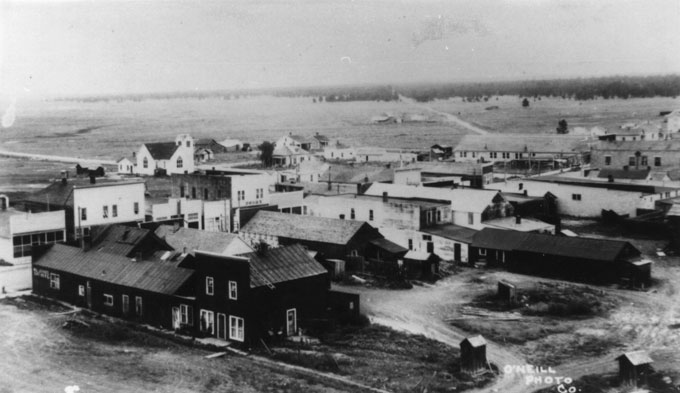
Upton
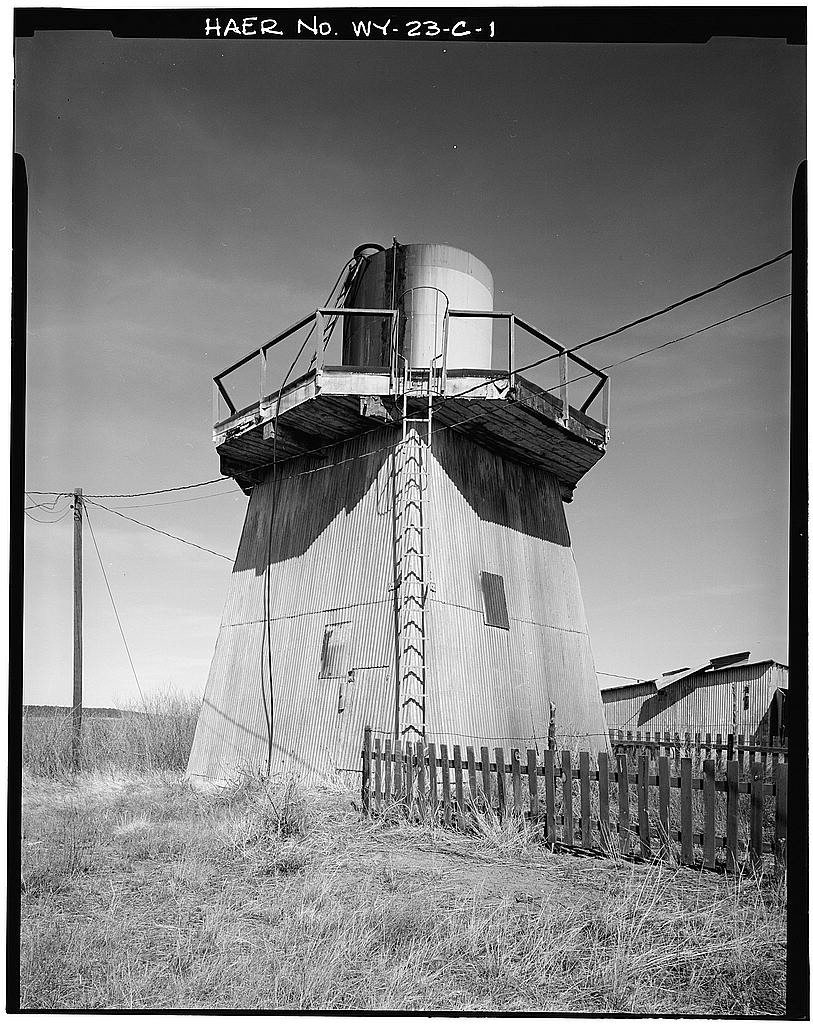
Clay Spur Bentonite Plant & Camp, Water Tower, Clay Spur Siding on Burlington Northern Railroad, Osage
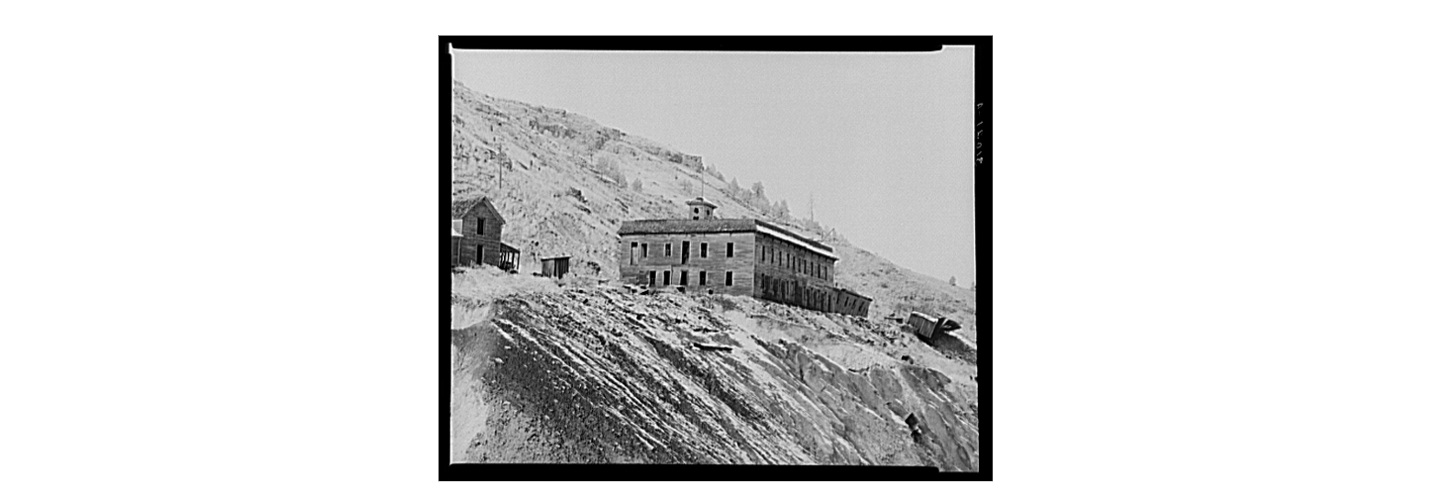
Old Hotel in Cambria
A Cup of Coffee and Cake: 10 cents at the
Newcastle Bakery and Restaurant --The Newcastle Journal, 05 Apr 1890, p. 1F
Lodging: $2.00 a day at the Hotel de Newcastle --The Newcastle Journal, 05
Apr 1890, p. 4F3
The Town of Buffalo has: $40,000 brick courthouse;
$20,000 school house; $50,000 waterworks system; $10,000 banking house --The
Newcastle Journal, 05 Apr 1890, p. 4B3
Public school teachers' salary:
$15,000 for 50 teachers in Big Horn County --The Newcastle Journal, 06 Oct 1905,
p. 1F13
In compliance with your request, I write you a brief description
of the schools of Weston County. You will no doubt remember that two years ago
we had but one school in Weston County, that in Newcastle, with an enrollment of
about sixty pupils, and employed but one teacher. We now have in the public
school, Newcastle, an enrollment of one hundred and twenty-six, divided into
three grades, with Prof. A. L. Putnam, of St. Paul, as Principal, Miss E. C.
Patterson and Miss Eva Ogden, assistants.
On a slight eminence
overlooking the city of Newcastle has been erected a magnificent school
building, at a cost of $10,000.00. The building is of brick and our native white
sandstone, planned by Conver & Porter, architects of Madison, Wis. It is
beautifully finished and furnished, thoroughly ventilated, and heated by the
Ruttan system. Of her school and school building Newcastle is justly proud.
The first school in Cambria was opened in March, 1891, with an enrollment of
thirty pupils. We now have in the same school an enrollment of about
seventy-five, have nine months' school, and employ two teachers: Miss Luella
Roadifer, Principal; Miss Laura Clay, assistant. At Cambria, has just been
completed a new school building, at a cost of $2,500.00, which is well finished
and furnished.
At the Beaver Creek, Briar Hill and Gupton schools we have
six months' school during the year, and about November 1st we will open a school
at Merino, with an enrollment of fifteen pupils.
Though our schools are
few and the enrollment comparatively small, I doubt if any county in Wyoming can
show a greater rate of increase during the two years just past.
Our motto
for the schools of Weston County is: "Not the largest, but the best."
Very respectfully,
MRS. J. L. BAIRD,
Supt. of Weston County
October 15,
1892. [pages 50-51]
A new District has been formed in Weston County, embracing portions of Districts Nos. 1 and 2. The meeting to elect officers will be held on July 10th. The greater portion of their district has been in District No. 2. Now, the question is this: The levy on taxable property that was made last May was paid of course to District No. 2. The new District being formed, we wish to know what the law is concerning this tax. If the new District (No. 3) receives any portion of the funds in the treasury of District No. 2, also, if the cash on hand in District No. 2 is apportioned to District No 3 according to the number of scholars in the new District. [page 47]
The schools of Weston County are doing excellent
work. School buildings have been erected during the past two years, old
buildings have been repaired, and apparatus has been purchased. Nearly every
building has a dictionary, reference books, and supplementary reading. The
Cambria schools have a library of about 200 volumes, also a reading table
containing the best magazines.
Institutes have been held each August, and
teachers and parents agree that they are exceedingly helpful. Public
examinations have been held at close of Institute.
The visits each term
to the various schools are among the pleasant features of the Superintendent's
work, and observation proves that schools taught by the same teacher for a
series of terms advance more rapidly than where a change is made each term.
As there is improvement in text books each year, we would be greatly
benefited by securing the best texts.
At the close of 1898, we have
seventeen schools in the county, while in 1890 there was but one. District No. 1
maintains fifteen schools of from six to nine months each year. District No. 2
has one school of six months each year. District No. 3 has one school of six
months' term, but half the term is taught in a remote part of the district.
There are over sixty scholars in the district and but fifteen can attend school
on account of distance. Lack of funds prevents their having longer terms and a
greater number of schools.
EMMA P. BOWMAN,
County Superintendent.
[page 62]
In compliance with your request, I herewith
submit the following report of the schools of Weston County. The two years of
school work have passed very rapidly and have been most interesting.
There are now four districts in this county. In these four districts there are
forty-eight schools with a total enrollment of one thousand fifty-five pupils.
We have but three town schools. Newcastle is an accredited high school.
Cambria has ten grades. Upton is taking up eleventh grade this year to
accommodate some of the students. Newcastle employs eight teachers. Cambria and
Upton each four teachers.
Within the last two years Newcastle has built a
$13,000.00 addition. Cambria a new school house, costing about $8,000.00, and
Upton has a new building costing $10,000.00 Several new buildings have been put
up in the county.
All the schools are in a prosperous condition. Most of
the rural teachers have their homes in this county and several of these are high
school graduates from our own schools. Their work is very satisfactory. They are
wide awake young teachers and anxious to succeed.
The town teachers are
receiving at least seventy-five dollars and the rural teachers forty-five and
fifty, according to grade of certificate.
The Course of Study issued by
the State Superintendent in 1912 is the basis of the work in our schools. The
course outlined for the Newcastle high school by Superintendent Fraizer is also
used.
County examinations are given pupils who complete the eighth grade.
I have made out the questions and corrected the papers. Those passing receive
diplomas which admit them to the high schools of the county. This plan has been
used here about a year and in this time thirty-two were successful in getting
diplomas. Several others tried but failed in the examination. Enrollment in the
high schools this year is about seventy.
Interesting and inspiring
institutes are held each year. The last two years Mr. W. B. Mooney of Greeley,
Colorado, and Miss Eleanor Davidson of Denver were instructors. The first year
our teachers were so delighted with them that they were invited to come again
this year. Their work was very practical and a source of enthusiasm and culture.
The attendance each year was about fifty.
Last year the Weston County
Teachers' Association met three times. Once in each town. Although it is hard
for many of the teachers to be present there was a good attendance at each
meeting. Much good resulted from these and it is hoped we will be able to have
some meetings this year.
I cannot write this without mentioning the
members of our School Boards. We are blessed with the best set of men that any
one could wish for. That is the great reason our schools are in such good
condition. It is a pleasure to work with them.
During my term in office,
I have been much indebted to the State Superintendent, the State Board of
Educational Examiners, our State University and the County Superintendent, with
whom I have worked.
With best wishes for the welfare of the schools of
Wyoming.
Respectfully submitted, ORISE L. CARPENTER, County
Superintendent. [pages 44-47]
In response to your
request, I submit the following report of the schools of Weston county for the
years 1913-1914.
Much good has been accomplished in our schools the last
two years. Our teachers have done very creditable work. They are using every
effort to keep their work carefully graded and follow the state course of study.
There are 1257 children of school age in the county. Of these 987 belong to
District Number One which includes Upton, Cambria and Newcastle. There are now
eight teachers in Newcastle, four in Upton and seven in Cambria.
Several
improvements have been made in our buildings. Nine new school houses were built
and several improved and remodeled. Two large rooms have been added to the
Cambria building.
Terms have been lengthened from six to eight months in
several schools and teachers' salaries have been raised five dollars per month.
Some of our teachers have attended our University especially during the
summer and more plan on going. Many of us realize that we have missed much by
not being able to attend our University, but may yet take advantage of its
opportunities and we encourage our teachers and young people to attend.
Our institutes have been most helpful — the one just closed being one of the
best we ever had. We were fortunate in having President Duniway with us one day
and such instructors as Dr. Butterworth, Mr. Oviatt and Miss Prahl. We are much
indebted to the University for sending an instructor in Agriculture.
The
Weston County Teachers Association usually meets three times a year, once in
each town. Meetings are planned for the coming year.
Altogether the
outlook is bright and we look for much good work this year.
Respectfully
submitted, ORISE L. CARPENTER, County Superintendent. [page 54]
Contributed 2025 Jun 25 by Norma Hass, extracted from 1890-1917 Biennial Reports of the Superintendent of Public Instruction
Copyright © 1996- The USGenWeb® Project, WYGenWeb, Weston County

This page was last updated
07/23/2026