

Weston County
WYGenWeb

Long necked girls will be sorry to hear that collars on
waists and jackets are to be reduced in height.
There is a fancy for
white fans or for fans of solid balck, merely decorated with gold or silver
sparkles.
Walking jackets are not as heavily embroidered as they were and
can be almost called "severely plain."
Bonnets are small and made of much
richer and more expensive materials than have heretofore been used.
Any
kind of white ruching at the neck is now obsolete, on the authority of the most
fashionable modistes.
In many cases the evening bodice for young girls is
merely pointed and filled in with lace, while the sleeve is entirely omitted or
is an elbow sleeve.
Little boys' costumes are of velvet with soft silk
blouse vests and wide collar and cuffs of Irish crochet or any rich effective
lace in Vandyke or tour-Eiffel points.
The long low toque is the popular
hat with young ladies, and when strings are added at the end of the crown it
becomes the favorite bonnet with those who are older.
There is a decided
objection among mothers to the adoption of the extreme decolette styles, worn by
the older women of society, by girls in their first or second season.
The
use of a collar and cuffs, or revers of fine knife pleating in tinted silk, the
color of the frock, or of white wool in contrast to it, is a feature of
children's dresses this season.
Bonnets are very small and velvet
rosettes placed directly in front are a favorite trimming. Flat Alsatian bows
are seen, but oftener a little height is given to the low crown.
Toques
for morning and plain wear are made of the material of the dress, with velvet
folds along the edge and some box pleats and loops to heighten the front
slightly.
Source: The Newcastle Journal, 04 Apr 1890, p. 2E5
The largest supply of human hair comes from Switzerland and Germany, says a Paris letter, and especially from the French provinces. The country fairs are attended by agents of merchants in London, Paris and Vienna. Only at intervals however, is a prize like a perfect suit of golden hair obtained; and it is said that there are orders in the shops of Paris and London for all the golden hair that can be obtained in the next five years. When a stock of hair is collected by agents it is assorted, washed and cleaned. Then each hair is drawn through the eye of a needle and polished. --The Newcastle Journal, 04 Apr 1890, p. 3F15
The wild and wooly west is supposed by eastern people to be a region fraught with danger to peaceable citizens, yet Bishop Whittaker, who spent five years in Nevada without seeing a pistol drawn, was recently fired at in a Philadelphia church. --The Newcastle Journal, 04 Apr 1890, p. 3F16
There is one thing that is sillier than the foolishness of the saleswoman or the sewing girl who is indignant if mentioned otherwise than as a lady, and that is the snobbery of women who earn their living by collecting statistics, performing clerical work, or by journalism, and persist in calling themselves ladies whenever they mention themselves and their less-generously paid sisters together. Now, a working-woman is a working-woman, neither more nor less, whether she toil with her fingers or after the method of the unfortunate Miss Biffin, and the more able, the more learned, the more refined she is, the less necessary she will find to advertise that she is a lady. Boston women, to do them justice, are very rarely afflicted with this species of snobbery, but in New York it seems, judging by some letters written from that city, to amount to a disease. They are more sensible in Washington. Said a spirited little department clerk, with a pedigree long enough to extend across Georgetown bridge, "No, I am not a lady. I work for my living; but I have a lady to do my washing. Her son told me so. Said he, 'My mammy say to go and tell Miss Bell de lady dat do her washin' say to send it along d--quick.' No, I'm not a lady."
The proper thing to do is to have a plaster-cast taken of your right foot, and then get a professor of chiropody to tell you all about yourself. Large, well-formed, symmetrical feet indicate breadth of mind and firmness of purpose. Broad-soled, flat-heeled feet show a grasping disposition. This sort is to be found in Chicago. The New York girl's foot is pink and white and beautiful but really strong, though it looks delicate. The foot of a Southern girl has a small ankle, high instep, curved like a bow, and had a delicate tracery of veins all over the surface. Spanish and Cuban women have the most perfect feet. Our professors say nothing about Englishwomen. Their art has never been practised in your dear little island that we all love so much. I am longing to be back in London. I like your men so much. You see, an American girl is predisposed in favor of Englishmen, because the best heroes in our fiction are English all the time. They stalk through the story with a beautiful mixture of dignity and sweetness. I'll marry an Englishman, I'm resolved. Tell your friends that I am coming back in the spring with that determination. It will act well, for the men who wouldn't like me to marry them will clear off when I'm about, and those that are of a coming-on disposition can stand around while I make my selection. --The Newcastle Journal, 11 Apr 1890, p. 6D4 & 6D6
The man who was forcibly ejected from a car in San Francisco after tendering in payment of his fare a $5 gold piece, which the conductor refused to accept, has just recovered a big verdict against the company. The supreme court held that $5 was not an unreasonable amount for the agents of a corporation to change. --The Newcastle Journal, 18 Apr 1890, p. 6A7
The city marshal is cleaning up the streets and allyes. The ash piles are disappearing and the dead dogs are on the move. --The Newcastle Journal, 22 Apr 1892, p. 4A
Good Looks: Good looks are more than skin deep-depend upon a healthy condition of all the vital organs. If the Liver be inactive, you have a Billious Look, if your stomach be disordered you have a Dyspeptic Look and if your Kidneys be affected you have a Pinched look. Secure good health and you will have good looks. Electric Bitters is the great alteratrive and tonic acts directly on these vital organs. Cures Pimples, Blotches; Boils and gives a good complection. Sold at any drugstore, 50c. --The Newcastle Journal, 22 Apr 1892, p. 4A
Risking human life in balloon ascensions is as appropriately a matter for legal interference as swimming a whirlpool or leaping from a high bridge, and it is high time that it should be recognized in that light. The morbid fondness for an exhibitor which involves the greatest amount of danger with a very small degree of skill needs no fostering. --The Newcastle Journal, May 1892, p. 2A
The News Journal, Friday, 02 May 1890, p. 5B
Died, at Newcastle, at 6
a.m., Monday last, W.J. Flaherity. Deceased had been in poor health for some
time and on Sunday took an overdose of morphine an attempt to alleviate his
sufferings. A coroner's jury was empaneled adn found a verdict in accordance
with the facts. A brother of the deceased was sent for and arrived in time to
have charge of the funeral arrangements.
The News Journal, Friday, 09 May 1890, p. 5E
Sundance News, From the
Gazette
On Friday, May 2nd, 1890, on Inyan Kara, at the school house on
the 101 road, a serious accident occurred, by which a boy in attendance at the
school lost his life. Floyd Edward Hamilton aged thirteen years was the victim.
The lightning struck the building and followed down the wall when it left for a
better conductor, striking the boy on top the head it passed through, coming out
under the chin, again entering the body at the breast it passed down the body
and the left leg to the floor killing him instantly. A younger brother who was
in the seat with him was knocked to the floor, several were considerably
shocked, but no others were injured. The funeral services were held Sunday,
conducted by Rev. M. Nichols. Mr. and Mrs. James I. Hamilton have the sympathy
of the entire community, in this their sad bereavement.
News Journal, Friday, 25 May 1890, p. 4B
A Brutal Murder
Crawford Times: About half past five Thursday evening a shot was heard in
Deitrick's saloon, and Tim Springs was seen to run from the place. In a few
seconds a large crowd of men were running for the saloon. Marshall Morrison was
on the spot in short order and found Springs in an alley and promptly arrested
and lodged him in jail. The crowd at the saloon found Wm. Nee writhing in the
agonies of death with a bullet hole through his abdomen. Doctors worked with him
but to no avail. He breathed his last in 24 minutes after the shooting.
The murdered man, Wm. Nee, is a quiet young man, about 28 years of age, and
hails from Richlin Center, Wis., where his parents are said to be well to do and
highly respected people. They were wired by his friends and an answer came back
that a brother would leave for Crawford at once. Mr. Nee has been employed on
the B.&M. bridge force for about nine months and was well liked by all his
companions. Not being in the habit of carrying a gun he was not armed at the
time of the shooting.
The murderer, Tim Springs, is an all-around
tough, who has been in Crawford two or three years, employed most of the time as
a spittoon cleaner and general roustabout in the saloons. He has been trying to
be tough for some time. His example should be a warning to other would-be toughs
who are allowed to carry guns about town.
Coroner Meyers of Chadron was
wired, and being out of town, Sheriff Dahlman came up and empaneled a jury who
found that Wm. Nee came to his death by a pistol shot fired feloniously by one
Timothy Springs.
Newcastle Journal, 22 Apr 1892
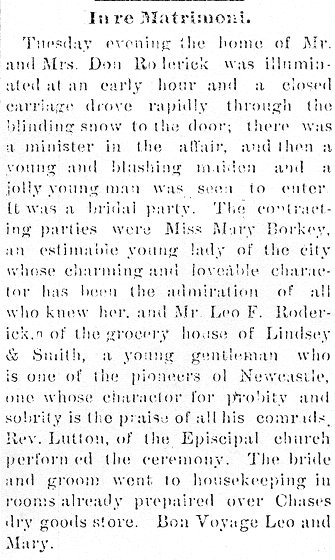 In re Matrimoni: Miss Mary Borkey weds Mr. Leo F. Roderick
Tuesday evening the home of Mr. and Mrs. Don Roderick was illuminated at an early hour
and a closed carriage drove rapidly through the blinding snow to the door; there was a
minister in the affair, and then a young and blushing maiden and a jolly young
man was seen to enter - it was a bridal party. The contracting parties were Miss
Mary Borkey, an estimable young lady of the city whose charming and loveable
character has been the admiration of all who knew her, and Mr. Leo F. Roderick,
of the grocery house of Lindsey & Smith, a young gentleman who is one of the
pioneers of Newcastle, one whose character for probity and sobrity is the praise
of all his comrads. Rev. Lutton, of the Episcipal church performed the ceremony.
The bride and groom went to housekeeping in rooms already prepaired over Chases
dry goods store. Bon Voyage Leo and Mary.
The News Journal, Friday, 06 Oct 1905
Shooting At Upton
Last Saturday word was received of the killing by shooting of Chas. D. Minter at
Upton.
As near as can be learned Chas. D. Minter and a man named George
Block, who was in the employ of Mrs. Turner McKenzie, had some trouble while
dipping sheep a few miles from Upton. Block quit and went to Upton. On Saturday
the dipping was completed and Minter went to Upton on business. The men met at
George Benedict's place and the trouble again begun, Block, who was the
aggressor, pulling a knife and Minter a gun. Bystanders interefered and the
parties separated, both leaving the place, Block going to the house where he was
staying and Minter going to the railroad station.
All at once, Mr. Minter
made some excited remark and went out and almost immediately shooting was heard,
some five or six shots being fired when Minter fell to the ground having been
hit by a bullet. While no one can be found who saw Minter shooting, the general
belief is that after going out doors he began shooting at Block who had secured
a horse and borrowed a revolver of a neighbor. After one or two shots had been
heard, Block was seen to get off his horse, draw his gun and begin shooting and
at his second shot Minter fell.
After being shot, Minter was carried to
the home of Turner McKenzie and died in a very few minutes, the bullet having
severed the large artery extending to the thigh. Dr. Horton was called as soon
as the shooting occurred but Mr. Minter was dead long before his arrival.
Justice Cooper was wired for and went to Upton and held and inquest, the
jury finding that Chas. D. Minter came to his death from a gun shot wound, from
a gun held in the hand of George Block, and made no attempt to fix the
responsibility.
Block was taken in charge by Deputy Sheriff Perry and
brought to Newcastle.
County Attorney Falker went to Upton on Monday and
after thoroughly investigating the matter, decided to file no complaint and
Block was released.
The deceased leaves a young wife, aged parents, a
brother and two sisters to mourn his sad and tragic taking off.
The
funeral was held at Upton on Monday, Rev. J.A. Neill of this place officiating.
This sad affair should be a lesson to all who are in the habit of going
armed, as dangerous weapons and a hot temper have caused many a homicide.
The News-Journal, 16 January 1919
Caught Stealing - Commits Suicide
When caught in the act of skinning a beef belonging to the Keeline', Thos. M.
Rogers, after attempting to settle the question goes home and commits suicide by
shooting himself several times with a revolver.
On January 3rd, Thomas
Rogers, manager of the Geo. E. Allcott ranch, fifty miles southwest of Gillette,
was apprehended by two of the Flying Circle ranch hands in the act of
slaughtering a nice fat critter branded with the Keeline irons, and on seeing
what might come from same, goes to the Keelines and offers to settle for five
hundred dollars if they would say of the matter. He was informed that it was not
the first offence and that they would prosecute him for his acts. It seems that
rather than face the charge with the possibility of going to the penitentiary,
Mr. Rogers went to his home and there committed his rash and cowardly act. The
body was found the following day by neighbors.
Mr. Rogers came to
Gillette about four years ago and was hired by Mr. Alcott first as sheep herder.
After proving his worthiness he was later given the job of camp tender, later
being given charge of the ranch.
Mr. Alcott says the man leaves no
relatives so far as he knows, and had proved himself a dependable and honest
workman. He was of middle age. - Gillette News.
The News-Journal, 20 Feb 1919
Mrs. John Cool died at four o'clock
Thursday February 20, 1919, at the home of her son, Wiley's at Fourcorners, Wyo,
death being due from smallpox. Mrs. Cool has been a resident of Weston County
for twenty-four years, having lived the greater part of that time in the Boyd
vicinity. Prior to coming to Wyoming, Mrs. Cool lived in Kansas. Deceased at the
time of her death was 80 years, four months and fourteen days of age, and leaves
to mourn her departure, her husband, two sons, adn two daughters, all residing
at Fourcorners excepting a daughter, Mrs. Lucy Russell, who resides in
Washington.
No arrangements have been made for the funeral, but in all
probability will be private owing to the contagious disease. Interment will be
made in the Boyd cemetery.
The News Journal, 17 Nov 1921
Cambria Man is Killed By One He Attempts to Shoot
George W. McCrea
Fires Five Bullets Into Body of Fausto Musso to Protect His Own Life
A
deeply regrettable incident occurred at Cambria about 10 o'clock last Sunday
evening, in which Fausto Musso was shot and killed by George W. McCrea in self
defense.
Mr. Musso had earlier in the evening been very abusive to a
number of men, including Mr. McCrea, going so far as to threaten their lives and
when about 10 o'clock he met McCrea on the street near the Episcopal church the
trouble was resumed. As he attempted to draw his gun on McCrea he was shot and
fell to the ground. After he fell he again attempted to use his revolver, and
his turbulent spirit was subdued only when four other shots followed, every one
of which found lodgment in his body. Several people hearing the reports ring out
on the night ran to the scene, finding Musso beyond human aid. Mr. McCrea went
at once to the home of the constable, C.O. Six, giving himself up and turning in
his weapon.
Just a few moments previous to the fatality, Musso had been
urged to go home and cease his disturbance. When he obstinately refused it was
decided to call the sheriff from Newcastle, but before telephone connection
could be made Musso had received the fatal wounds.
The coroner's inquest
was held in hadd Monday afternoon, when witnesses were examined in the presence
of a large number of interested spectators, and it was proved beyond a doubt
that the act of McCrea was in self defense. At the conclusion of the evidence
Mr. McCrea was released.
Several legal men from Newcastle were present at
the inquest, which was conducted by Coroner George DeBow.
Reports are
that it was at a game of cards the trouble originated, Musso, uninvited,
entering and eventually getting into dispute about money in the course of which,
it is said, he not only appropriated money not his, but struck several men, one
of whom was McCrea. It is further said that at that time McCrea refused to use
firearms in settling the matter of the money difference; that it was only when
it was life or life that he used the gun.
Mr. McCrea, a young man of
about 27 years, has been a resident of Cambria not quite a year, coming here
from Denver, Colo., and had spent a number of years in Texas and New Mexico. He
is an ex-service man, having spent about two years in the navy, and is employed
in the engineering department of the Cambria fuel plant and by his quiet,
pleasing manner has won many friends.
Mr. Musso was born in Italy and
when a mere boy come to America, his mother having died he came to live with
relatives in Michigan. At the time of death, he was about 32 years old. About
nine years ago, he came to Cambria. Two years later he was obliged to answer
charges brought against him in Michigan, being arrested here by former Sheriff
Hackney, with the aid of Fred Holwell and Judge Nelson, his reputation for utter
disregard of consequences at that time marking him as dangerous. After his
return from Michigan to Cambria, with the exception of several months in the
service, he has resided there ever since. He was a citizen by law and very loyal
to the colors. He was a large powerful man of splendid physique, socially very
kind and obliging until under the influence of intoxicants or in the grasp of an
ungovernable temper, when he was intolerant and abusive, destruction of
everything in his way seeming to be his moving thought.
Mr. Musso was a
member of the I.O.O.F. lodge and also of the Miners' local union and had held
various offices in the same. His aged father is still living in Italy, his wife
and two children in Michigan. A brother, Joe Musso, resides in Sheridan, is very
well known and highly respected here and also several cousins in and around this
vicinity.
The funeral was held in Newcastle Tuesday afternoon from
Nichols' mortuary. George DeBow, for the Odd Fellows, Thomas Harrison, for the
Miners and Ora Frazine for the Legion, read the ritual of their respective
organizations, after which interment took place in Greenwood Cemetery,
Newcastle.
The Weston County Gazette, November 1921
The Quicker Trigger Finger Won the Draw
McRea, a stationary engineer at the mines in Cambria, shot and killed Fausto
Musso, a coal miner, in a street brawl, Sunday night. Musso, according to
reports, had been drinking moonshine and entered a mine shack, where he
brandished a club, forcing McRea and others to give up money.
Later,
Musso and McRea met in the street and after a few words, each pulled a gun and
McRea beat Musso to the draw. McRea gave himself up and later was exonerated by
the jury on testimony of witnesses who said the shooting was done in self
defense.
The Meeker Herald, 2 Sep 1938
According to the Dolores STAR, Mr. Edgar L. Manaugh, one of the most respected
citizens of Montezuma County and pioneer cattleman of Montana, Wyoming, and
Colorado, died at the Cortez Hospital on Wednesday of last week, September 14th.
Funeral services were held at Cortez and the remains shipped to New Castle,
Wyoming, for burial.
Edgar L. Manaugh was well known in Rio Blanco County
(Colorado) where he and his family had many friends. The Manaugh family came to
the White River country about twenty-five years ago, Mr. Manaugh having sold his
cattle outfit near New Castle, Wyoming, just before coming here. He bought the
K-T ranch from Messrs. Isaac Baer and Thomas Kilduff. He was an old time cowman
and immediately fitted into the community. He retained this big cattle outfit
until about 1920 when he sold it back to the Baer family. Mr. Manaugh was
appointed county sheriff, completing the unexpired term of Henry Wilson. The
next year the family returned to Wyoming where Mr. Manaugh took over his old
holdings for a few years. Ten years ago the family located in Montezuma County
near Dolores. The Depression and various reverses caused him to lose his
property, but he never gave up until his health broke a few months ago.
The deceased is survived by his wife, Mrs. Lotta Manaugh and their daughter
Betty, to whom the White River friends extend their sincere sympathy.
The News-Journal, 26 Aug 1943
Joseph Bird is Killed in Action in European Area
This community was deeply shocked last
week when word was received by Mrs. Sophia Bird, that her son Joseph had been
killed in action on August 13. The death of Joseph Bird was Newcastle's first
war casualty to occur on foreign soil.
On Thursday, August 19, Mrs. Bird
received the following telegram from Washington, D.C.:
"The Secretary of
War asks that [missing section] I assure you of his deep sympathy in the loss of
your son, Technician Fifth Grade Joseph Bird. The report received states that he
died on the 13th of August in the European area. Letter follows." (signed) Ulio,
the Adjutant General.
To date Mrs. Bird has not received the letter from
the War Department giving the details of his death.
Joseph Bird was born
November 15, 1910 on the family homestead near Buckhorn. He received his
education in rural schools of the county and in the Newcastle schools. He was
inducted into service in October 1942 and until that time had always lived near
Buckhorn where he was engaged in farming and in the sawmill business.
In
addition to his mother, survivors include four brothers, Clarence, Daniel,
Aloysius, Isidore, all of Buckhorn, four sisters, Pauline Robbins of Colorado,
Katherine Hansen of Wyoming, Dorothy Corliss of Nebraska, adn Cecilia Hawk of
Osage, other relatives and many friends.
The News Letter Journal, 25 Nov 1943, p. 1
Charles Jorgensen Dies in Saw Mill Accident at Upton
A fatal accident occurred at the Jorgensen
sawmill at Upton about 1:30 Monday afternoon, November 22, when Charles P.
Jorgensen, owner of the mill, fell into a power saw which was in operation at
the time. The whirling saw severed his left leg and he was thrown to one side of
the machine.
It is believed that some of Jorgensen's clothing caught in
the saw and he was pulled into it. Death came a few moments later. though he
called for help he was dead by the time a companion reached the scene.
Circumstances showed the mishap was accidental so no coroner's inquest was
considered necessary. The coroner's verdict was that of death from shock.
Mr. Jorgensen was 60 years old at the time of his death. He was born in
Omaha, Nebr., July 7, 1883. With his parents he resided on a farm in Webster
county, Nebraska. Later he attended the Omaha Commercial College from which he
was a graduate.
On September 10, 1910, he was married to Frankie H.
Martin at Guide Rock, Nebr. They lived in Omaha until 1914 when they came to
Crook county, Wyoming, where they lived until they moved to Upton over twenty
years ago.
Mr. Jorgensen had been in the sawmill business since 1926. He
took an active part in civic work, serving ten years as secretary-treasurer of
the Inyan Kara National Farm Loan Association and had served Upton in the
capacity of the justice of the peace for many years.
Survivors include
his wife, Mrs. Frankie Jorgensen of Upton, two sons, Wallace of Yukon Territory,
Canada, and Lloyd of Milton, Oregon, one brother, George of Ruskin, Nebr., two
sisters, Mrs. Carl Christensen of Ruskin, Nebr. and Mrs. Mabel Marlow of Kansas
City, Mo., three grandchildren and many friends.
Funeral arrangements are
pending word from relatives. The Sedgwick Funeral Home is in charge.
Upton News - The News Letter Journal, 25 Nov 1943, p. 3
A tragic death
resulted here Monday afternoon about 1:30 at the Jorgensen sawmill a half mile
from town when Charlie Jorgensen lost his life by accidentally falling into a
power saw which was in motion. That morning, Hank Hockett had charge of the saw
and as they returned to work after the dinner hour, Charlie took over. They has
been working but a short time when the accident occurred. His right leg was
severed by the saw and he called instantly to his help mate instructing to get
him to town immediately. He lived about four minutes after he was recovered from
the saw by Hank.
Jorgensen, who was 62 years old, has lived in this
community about 22 years, having first established his home in the country
adjoining the Fredrickson ranch about eleven miles north of town. He continued
to operate his sawmill after he moved to Upton and was constantly engaged in
this business.
Surviving him are his wife, two sons, Lloyd of Oregon and
Wallace of Whitehorse, Mont.
Sincere sympathy is extended to the family
by his many friends in this locality.
Upton News - Obituary - The News
Letter Journal, 02 Dec 1943, p. 3
At the Community Hall, last Friday
afternoon, last rites for Charles P. Jorgensen were held at three o'clock with
Rev. Harold W. Heckman of the Congregational Church of Edgemont, S. Dak.,
officiating. Burial was in the Greenwood Cemetery of Upton. Pall-bearers were Ed
Messersmith, C.C. Benne, Gregory Falk, Earl Braley, Phil Fraker and H.L.
Pringle. Music was under the supervision of Mrs. Thomas Stirling.
Charles P. Jorgensen was born in Omaha, Nebr., July 6,
1883. His parents were Mr. and Mrs. Chris Jorgensen who are both deceased. He
was 60 years of age at the time of his death, November 22nd.
He moved
with his parents to a farm near Invale, Nebr., when just a youngster. He
remained there until 1904 when he went to Omaha to attend the Omaha Commercial
College from which he was a graduate.
On September 4, 1910, he was
married to Frankie H. Martin at Guide Rock, Nebr. They lived in Omaha until 1914
when they moved to Crook county, Wyoming where they resided on a ranch in the
Arch creek community until they moved to Upton in 1935.
Mr. Jorgensen had
been in the sawmill business since 1926. He took an active part in civic work,
serving 10 years as secretary-treasurer of the Inyan Kara National Farm Loan
Association. He served as Justice of the Peace in Upton for many years and was
holding this position at the time of his death. Recently he became a charter
member of the newly formed Lions Club.
Survivors include his wife, Mrs.
Frankie Jorgensen of Upton, two sons, Wallace of Yukon Territory, Canada, and
Lloyd of Milton, Ore., one brother, George, of Ruskin, Nebr., two sisters, Mrs.
Carl Christensen of Ruskin, and Mrs. Mabel Marlow of Kansas City, Mo., three
grandchildren, other relatives and many friends. He was preceeded in death by
his second son who was two and a half years old when he passed away.
Note: Mrs. Frankie H. Jorgensen died on 21 Jul 1979.
Copyright © 1996- The USGenWeb® Project, WYGenWeb, Weston County

This page was last updated
07/23/2026