

Merrimack County
NHGenWeb

Please share your Family Group Sheet information, Descendents Chart, Photos, etc. of a Merrimack County ancestor. Simply email your contribution to the County Coordinator.
AIKEN, Walter
BATCHELDER Family
BATCHELDER, Joseph
BROWN Family
BUSWELL Family
CARR Family
CATE Family
CATE, Shadrach M.
CLARK, Nathaniel
CLOUGH Family
CLOUGH, Jeremiah
CORSER Family
DANIELL, Warren F.
DIMOND Family
FITZGERALD, Edward
FRENCH, David J.
HILL Family
KENDRICK, Stephen
LOVERING Family
LOVERING, Samuel B.
MARTIN Family
MOORE Family
MOORE, Stephen
MORSE Family
ORDWAY Family
OSGOOD Family
PHIBRICK / PHILBROOK Family
ROWELL Family
SANBORN Family
SARGENT Family by E. Sargent
SARGENT Family by W. Clark
SARGENT, Thomas
STEVENS Family
SULLOWAY, Alvah W.
TENNEY Family
TILTON Family
TILTON, Timothy
WEEKS Family
WEEKS, Stephen
WILLEY Family
WOOD Family
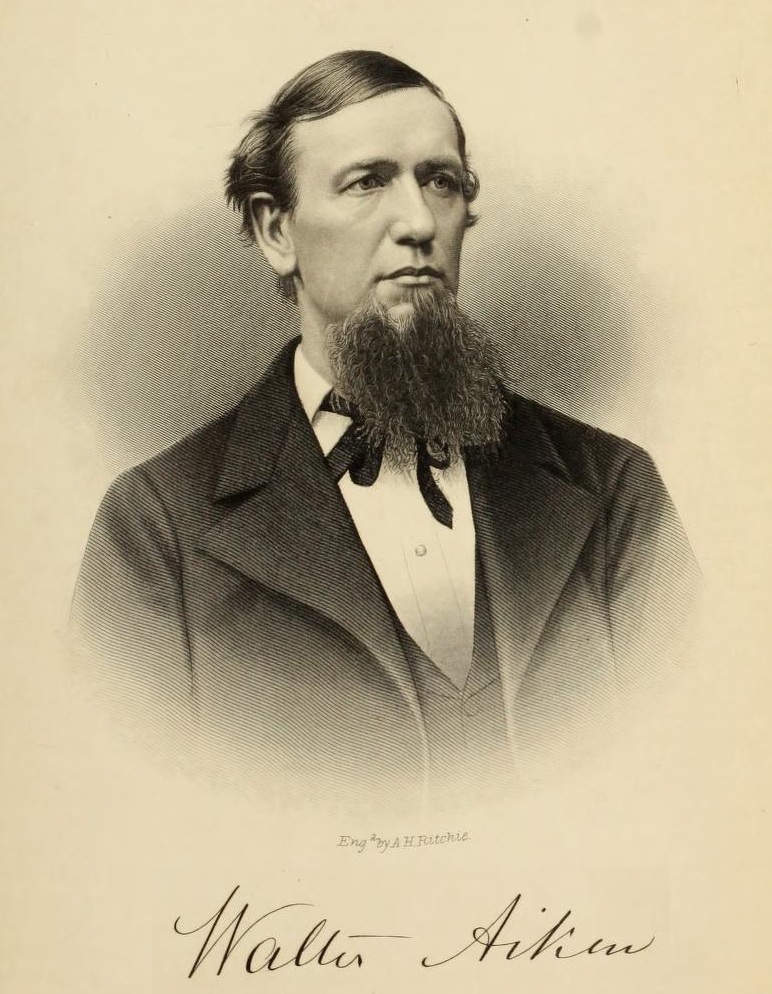 The first ancestor, Edward (1), came from the north of Ireland about 1722,
and settled in Londonderry, N. H., and became one of the proprietors. His son,
Nathaniel (2), lived in Londonderry and was an energetic businessman. One of his
sons, Thomas (3), moved to Deering, N. H., and carried on farming there. His
son, Matthew (4), was born in Deering, N. H., March 21, 1776, and moved to
Pelham, N. H., and was a saddler and harness-maker there. He married Sally
Hackett, daughter of Colonel Hackett, of Portsmouth, N. H., who built there the
first frigate for the United States government that was engaged in the
Revolutionary War.
The first ancestor, Edward (1), came from the north of Ireland about 1722,
and settled in Londonderry, N. H., and became one of the proprietors. His son,
Nathaniel (2), lived in Londonderry and was an energetic businessman. One of his
sons, Thomas (3), moved to Deering, N. H., and carried on farming there. His
son, Matthew (4), was born in Deering, N. H., March 21, 1776, and moved to
Pelham, N. H., and was a saddler and harness-maker there. He married Sally
Hackett, daughter of Colonel Hackett, of Portsmouth, N. H., who built there the
first frigate for the United States government that was engaged in the
Revolutionary War.
The children from this union were James Gilman (5),
born May 10, 1795, who was a soldier in the War of 1812, and was last heard from
by his family as an officer at the battle of New Orleans, where it is supposed
he fell, January 8, 1815. Herrick (5) was born in Peterborough, N. H., June 8,
1797. Sally (5), born May 10, 1799, married Phineas Stevens, who was an engineer
and built a number of prominent mills in New Hampshire. Emma (5), born June 10,
1802, married David Hamblett, a millwright, of Manchester, N. H., and removed to
Beckett, Mass., and there died September 25, 1878.
Herrick (5) first set
up in business as a manufacturer of machinery at Dracut, Mass., and moved to
Franklin, N.H., and set up business in the old shop of Daniel Herrick, in 1838,
which business he carried on in that vicinity for many years. he was an inventor
and received letters patent on many useful and cunning machines, among which
were a "spiral-brush" and a leather-splitting machine. He also received several
medals for valuable inventions. He conceived the plan of using a cog-rail for
steep grades on railroads and constructed a model at his shop that worked well.
Thinking to apply his invention upon a road to to the top of Mt. Washington, he
rode up on horse-back, and although convinced in his own mind that by his plan
the summit could be reached, he was unable to convince the railroad men and
capitalists that his plan was feasible, and the honor of the achievement, a few
years later, went to others. Mr. Aiken was a good citizen, a successful business
man and a kind husband and father, and died November 7, 1866.
At Dracut,
Mass., February 5, 1830, he married Ann Matilda, daughter of Isaac Bradley, of
that place. She was born August 28, 1810, and was a descendent in the fifth
generation of the renowned Hannah Dustan, of Haverhill, Mass. She died January
6, 1884.
The children from this union were Walter (6), born October 5,
1831, in Dracut, Mass.; Jonas Bradley (6), born August 23, 1833, at the same
place; James Hackett (6), born June 20, 1835, died of cholera in Calcutta.
Francis Herrick (6), born June 10, 1843, in Franklin, N. H. He succeeded his
father in business carrying it on successfully. He built a fine residence in
Franklin and died January 16, 1876. He was a prominent member of the Masonic
fraternity, a thirty-two-degree Mason. He married Hannah A. Colby, of Hill, N.
H., September, 1865.
Charles Lowe (6) was born July 23, 1845. he resided
in Elkhard, Ind., for several years and is now an employe of the Old Colony
Railroad Company, at Taunton, Mass. He married Isabella Burleigh, of Thornton.
Jonas Bradley
(6), the second son, has been quite prominent among the business connections,
although he retired from active business some years ago. He married, first,
Helen M. Scribner, of Franklin, in 1864. She died April 14, 1865, the same day
upon which President Lincoln died. He married, second, Addie G. Proctor, of
Northfield, Vt. The only child from the first marriage, Alice Matilda (7), died
in infancy. The children from the second marriage are Mary Louisa (7), born
November 19, 1867; Charles Wilson (7), born August 21, 1869; and George Proctor
(7), born December 5, 1873, who was drowned May 10, 1876.
Walter, the
subject of this sketch, passed his boyhood at the old home, and, in addition to
the advantages of the common schools, he attended for two years the Gilmanton
Academy and also the institutes at New Hampton and Tilton. He entered his
father's machine-shop at an early age, and, having a natural talent for
mechanics, he rapidly developed, and at the age of twenty-two years started in
business for himself in an upper room in his father's shop, where he invented
and built one of the first knitting-machines in the country. A pioneer in the
invention and manufacture of knitting-machines, Mr. Aiken has taken out over
forty patents, and his latest machine makes a perfect stocking without seam in
less than five minutes and works automatically. He also invented a machine to
make gimlet-pointed screws. Mr. Aiken is also a woolen manufacturer, producing
as many as four hundred dozen pairs of stockings per day. He also built the
house on the summit of Mt. Washington, owning one-half of it; assisted in
building the railroad up the mountain; became the general manager at the opening
of the road, in 1869, and has continued in the capacity, making the most
complete success as a financial venture. Mr. Aiken designed the locomotive in
use on the Mt. Washington Railway. He, in connection with Sylvester Marsh, has
perfected and carried into complete operation the work which Herrick Aiken had
so many years before conceived, viz: to build a railroad to the top of Mt.
Washington. His residence, on a bluff overlooking the village, is one of the
finest in Franklin. Mr. Aiken owns the Hamilton Hotel, at the Bermuda Islands,
with all the modern improvements and capable of entertaining two hundred and
fifty guests. He built the signal station on Mt. Washington for the United
States government in 1873; built the Summit House in 1872. Mr. Aiken is a
Democrat; was in the War of the Rebellion; has been a representative to the
General Court for four years and is a director of each of the banks in Franklin,
and a prominent member of the Masonic fraternity and also of the Odd Fellows.
"The old Granite State" may well be proud of such sons. He married, first, Susan
Colby, of Warner, in 1853; he married, second, Mary Dodge, of Hampton Falls,
January 1, 1867. The children by the first marriage were James (7), born
February 5, 1854, and Frederick(7), born November 4, 1855. These children are
now living.
Contributed by Herbert L. Girtman, Sr., extracted from 1885 History of Merrimack and Belknap Counties, New Hampshire by D. Hamilton Hurd, pages 326-327.
Reverend Stephen Batchelder the founder of the family in this country, was
probably from the southern part of England, as he certainly preached at a
village a few miles north of Southampton, in the County of Hants, England. The
town of Hampton, New Hampshire was so named at his request. Reverend Stephen
lived in Holland a number of years, and saled from London to Boston,
Massachusetts and 1632, he went directly to Lynn, where he planted the first
church. His daughter, Theodote, wife of Christopher Hussey, also lived at that
place. He lived at Lynn until 1636, and went from there to Newbury, Mass., and
from there to Hampton, in 1638, and then to Portsmouth, about 1647; lived there
until 1650, and went back to England about 1655, and died at Hackney (now
London), in 1660, in his 100th year. His third wife, Mary ____, who he married
1650, was a bad investment, and could not live with her. She was a widow, whose
real character he did not understand. His third wife, Mary, petitioned the court
for divorce soon after, upon the grounds that he married a fourth wife, which
there is no evidence of whatsoever, as he was 94 or 95 years of age when he went
back. His son Nathaniel had three wives and 17 children; was a man of prominence
for many years; in fact, he held a leading position until this death, and 1710.
The woman whom Mr. Bachelor was justified in leaving was soon convicted of
immorality that brought a sentence of 30 lashes and marking her with the letter
A.
There were at least six Batchelders who settled in Loudon, and with
families, and were descendants of the Reverend Stephen Batchelder, of
England,_____1st., Josiah, born in January, 1767, who was son of the Deacon
David of Hampton Falls; Deacon David was son of Josiah, of Hampton Falls; Josiah
was son Nathaniel, Jr., of Hampton; Daniel, Jr., was son of Nathaniel, Sr., of
Hampton; and Nathaniel, Sr., was a grandson of the Reverend Stephen Batchelder.
Major Nathan Batchelder was born Oct. 25, 1734, and was son of Deacon
Ebenezer, of East Kingston. Deacon Ebenezer was son of Deacon Nathaniel, Jr., of
Hampton. Nathaniel, Jr. was son of Nathaniel, Sr. the grandson of Reverend
Stephen Batchelder. Major Nathan was a brother to Richard. Richard was born Oct.
5, 1736. Nathaniel, brother to Major Nathan, was born February 21, 1740. Abraham
and Jethro were sons of Jethro, Sr.; Jethro was the son of Nathaniel, Jr., who
was the son of Nathaniel, Sr. who was the grandson of the Reverend Stephen
Batchelder. Abraham and Jethro were cousins of Major Nathan, Richard and if
Nathaniel. Major Nathan settled at Loudon Ridge, New Hampshire, where are living
some of the descendants of this line. After the Major came to Loudon he took the
name of Esquire Nathan in all the business matters of the town. The descendants
of the Batchelders who resided in Loudon are noted for being good citizens, our
public spirited, firm in their principles and honest in their purposes and aims.
Abraham Batchelder, Esq., and Jethro, his brother, came to Loudon (then
Canterbury) near the year 1760, as Abraham Batchelder was chosen constable and
1765 in the town of Canterbury.
Abraham Batchelder, Esq., was a man of
large business capacity; was a surveyor of land and was engaged in laying out
the town of Loudon in lots. Also, he served as one of the selectmen of the town,
and laid out and made the return of a large number of the highways. Abraham
Batchelder settled on land near the White school house, he having, while
traveling in locality and looking for meadowland with his son Abraham, Jr.,
found the swell of land bordering upon the pond, covered with a most beautiful
growth of birch, oak and white ash, and, at the earnest request of his son,
concluded to settle at this place. The built a log house just north of the one
upon the Ira Osgood farm, and the land in the southeasterly direction to us a
school house, was the first cleared. Afterwards Abraham, Jr., built the
northeasterly half of the old red Batchelder mansion, as it now stands.
This lot of land was called a pitched lot, and contained 100 acres. It was
afterwards divided by the highway leading to Gilmanton, and that part lying
westerly of said road passed into the ownership to another person. The
irregularity of the line of the boundary of some of the adjoining lots is caused
by the pitching of the owner. Several other lots were pitched upon in the same
manner. During the first years of clearing the land and many privations had to
be endured. In the first year they were short of food for bread, and Mr.
Batchelder was obliged to cut some of his rise before was ripe,dry it as much as
possible, and carry in upon his shoulders to Canterbury for grinding, a distance
of several miles. The corner raised and used for bread was pounded in a wooden
mortar into meal. This same mortar is still it in existence, and consist off a
maple log about two feet long, with the bark still on, standing upon one end,
while in the other is a cavity, made by burning out the wood by fire, in which
corn or salt was placed and pounded with a wooden pedestal. The mortar may be
seen by examining the attic of the old mansion.
Jethro Batchelder located
at the village then known as Batchelder Mills. He was a largely and owner, the
proprietors giving him 400 acres as an inducement for him to build mills upon
the privilege at that place. The land given embraced that tract now owned by
Joseph P. Batchelder, and also the Cate farm. Mr. Batchelder built the first
house at the village, and it is known as the Captain P. Robinson house. He was
the ancestor of the race of Batchelder's in the south part of the town, and
Abraham was that of the line living at the center. The line of descent for
Abraham was Abraham Batchelder, Jr., born in 1744. His wife, Anna Judkins, was
born in 1755, married in 1772. Their children are Nathan Batchelder, born in
1773; Abraham and Josiah Batchelder (twins), born in 1775; Hannah Batchelder,
born in 1776; Josiah Batchelder (2d), born 1779; Philip Batchelder, born in
1781; James Batchelder, born 1783; John Batchelder, born 1785; Sally Batchelder;
Jonathan Batchelder, born 1790; Judith Batchelder.
Jonathan Batchelder
married Lois Wells and had a family of 12 children, Abraham, Mary, Ann, Stephen
W., True, William T., Nathan, Nancy G., Sarah S., Hannah E., H. John, John (2d)
and Benjamin.
Benjamin Batchelder married Mary E. Batchelder, of
Meredith, New Hampshire, and has a family of two children, named Martha E. and
John. He resides upon the farm and occupies the original house in part that was
built by Abraham Batchelder, Esq., his great grandfather. He has held the office
of post master at Loudon Center, New Hampshire, for a number of years.
Cyrus Batchelder, who was the son of James, brother of Jonathan, lived in
Loudon, and had two children, named James K. P. and Georgia, who maried the
Reverend Warren Applebee. Mr. Batchelder has been elected to the office of
selectmen, has held that of town treasurer and has represented the town in the
Legislature.
Jethro Batchelder was born in 1723, married Abigail Lovering
and had a family of eight children, named William, Abram, Jethro, Daniel, Libby,
Nathaniel, Jacob and Aaron.
Mr. Batchelder was a onetime the largest
taxpayer in the town, but for some reason lost and consumed his property, until
he was in his old age provided for his children, who built a small house upon
the hill near Mr. Abram Batchelder's, where he died, and was buried in the old
village burying ground.
Libby Batchelder and Esquire Nathaniel lived in
Loudon and had large families, and were men of note in the today.
Capt.
Abraham married Betsy Batchelder. Was born in 1759, and they had a family of 11
children, named Smith, born 1785; Zephaniah, born 1786; Olive, 1788; Nathaniel
born 1790: Gardner, born 1792; Betsy, born 1793 Asa, born 1795; Lois, born 1797;
Enoch W., born 1798; Joseph, born's 1800; and Clarisa, born 1802.
Zephaniah Batchelder married Mary Eastman and had seven children, named Harmon
E., Abraham G., Mary, Arvilla, of Genette, Martha and Louisa.
Abraham G.
Batchelder Mary Rebecca Fifield, and had five children, named Fred, Frank,
Charles, Asa and Frank. Mr. Batchelder is a good representative of the family;
is a man of ability and judgment, and is often applied to for advice and
assistance in public as well as private life. He has acquired a good property,
and has been successful in the profession which he has chosen for a living.
Deacon Harmon E. Batchelder married Clarisa Sanborn and has one daughter,
who married Samuel M. True, and she has three children, named Nellie, Blanche
and Mary. Mr. Batchelder resides upon the homestead of his father, Col.
Zephaniah, and is a large farmer, and is Deacon of the Congregational Church at
Loudon Village.
Genette Batchelder, daughter of Zephaniah, married
William T. Wheeler and has no children. Mr. Wheeler is engaged extensively in
farming, and has been successful in his avocation.
Gardner Batchelder
married, first Clarisa Bradley, and, second, Nancy Young, and had a family of 16
children, named Nathaniel S., Emory B., Judith, Stephen, William, Abby, Henry
F., Winthrop, Abram and other infant children.
Henry F. Batchelder
married Lydia S. Rogers, and has three children, named Marion, Emma and Helen.
Marion married Fred Lawrence and has one son, named Henry B.. Emma married Frank
E. Robinson. Helen died in 1883. Henry F. Batchelder has been a trader in
groceries and dry goods for a large number of years and has acquired a good
property. He has held the office of post master at Loudon for 24 years. His life
has been marked in his dealings with others by integrity and uprightness, and he
is a respected citizen of this town. His business is now carried on under the
firm name of Batchelder and Robinson, and they are extensively engaged, and in
addition to the trade, in lumber business, and at present are the largest
business firm in the town.
Abram Batchelder married______Whitney, of
Canterbury, and they have one child, named Ivy.
Asa Batchelder, brother
of Zephaniah, married in 1795, Rachel True, and had a family of seven children,
named Augustine, Abram, Roscoe G., Ancie and three others, who died in infancy.
Ancie Batchelder married Joseph Wiggin, and had two children, named Nattie
and Gertrude. Mr. Wigin married, first, Eliza Walker, daughter of Ruel Walker,
and had four children, named Eddie, Willie, Gertrude and ____. Mr. Wiggin
commenced the business of a tanner when a young man with Mr. Walker, and
afterwards married his daughter. He soon became the owner and has since carried
on an extensive business, and is a prominent invaluable citizen.
Asa C.
Batchelder, son of Abraham G., married Jennie Badger and has a family of five
children, named Edwin, Emory, Kate, Gennette and Lillian.
Nathan
Batchelder married Margaret Bean, April 8, 1756, and had a family of seven
children, named Richard, born December 8, 1756; Phineas, born Nov. 16, 1760;
William, born March 19, 1762; Joseph born Jan. 2, 1764; Ebenezer, born Oct. 2,
1769; Dolly, born February 13, 1772; Josiah, born January 24, 1775. Esq. Nathan
settled at Loudon Ridge.
William Batchelder, son of Richard and great
grandson of Esquire Nathan, married Mary Sargent, of Canterbury, New Hampshire,
and had a family of six children, named Mary E., Jeremiah, Nettie P., William N,
Sarah A. and Park B.
Nathaniel Batchelder had the following children:
Betty, born February 10, 1783; Sally and Fanny (twins), born Nov. 23, 1784;
True, born July 20, 1794.
Libbe Batchelder The following children: Nabby,
born June 19, 1779; Peter, born Aug. 2, 1781; Dolly, born March 23, 1784; Polly,
born Sept. 28, 1786 Sukey, born March 8, 1790; Manly and Betsy (twins), born
Aug. 10, 1793.
William Batchelder had the following children: James, born
March 18, 1784; John, born July 25, 1786; William, Jr., born May 28, 1791;
Hazen, born April 16, 1793.
Contributed by T. J. Rand, extracted from 1885 History of Merrimack and Belknap Counties, New Hampshire by D. Hamilton Hurd, pages 499-501.
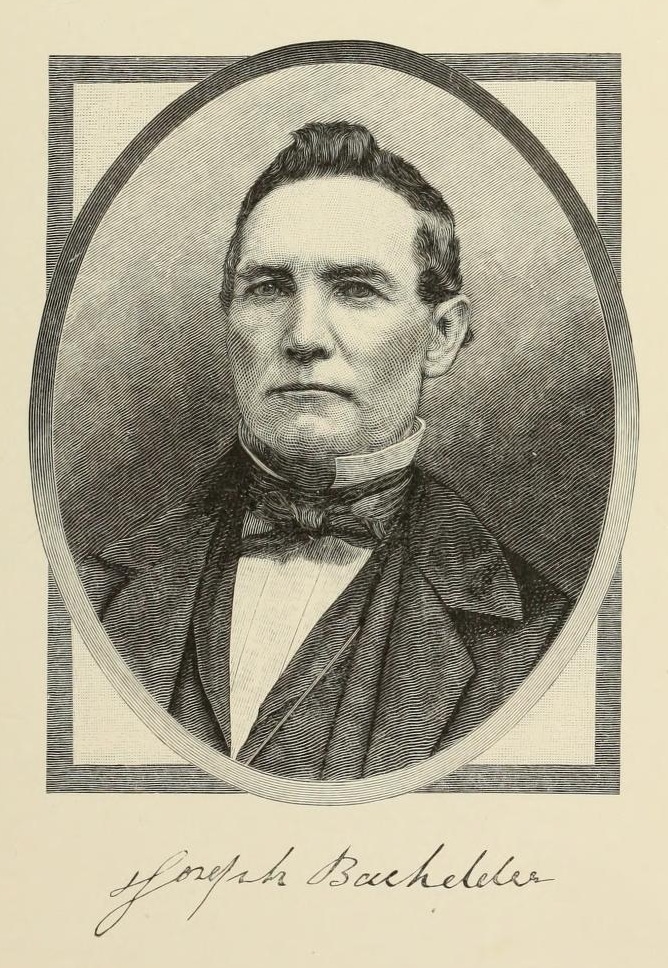 Joseph Batchelder was the son of Capt. Abraham Batchelder (3), and was born in
Loudon in 1800. He is the descendant of Jethro, and is the direct line from the
Rev. Stephen Batchelder, from England. He married Hannah H. Hill, by whom he had
a family of six children, John Q. A., born March 10, 1826; Otis H., born
January, 1828, died Nov. 17, 1859; Clarisa, born Jan. 6, 1830; Joseph P., born
Oct. 21, 1835; Elvira A., born June 4, 1839; Roseltha, born April 17, 1845, died
Sept. 20, 1860.
Joseph Batchelder was the son of Capt. Abraham Batchelder (3), and was born in
Loudon in 1800. He is the descendant of Jethro, and is the direct line from the
Rev. Stephen Batchelder, from England. He married Hannah H. Hill, by whom he had
a family of six children, John Q. A., born March 10, 1826; Otis H., born
January, 1828, died Nov. 17, 1859; Clarisa, born Jan. 6, 1830; Joseph P., born
Oct. 21, 1835; Elvira A., born June 4, 1839; Roseltha, born April 17, 1845, died
Sept. 20, 1860.
John Q. A. married Eliza J. Sanborn, daughter of Edmund
Sanborn; has lived in Massachusetts since 25 years of age; has no children.
Otis H. married Maria Howard, of Lawrence, Massachusetts, where he was in
trade until his death, and left no children.
Clarisa marries Cyrus T.
Batchelder, and resides in Peabody, Massachusetts, and is engaged in trade.
Joseph P. married Elvira A. Whitney, of Canterbury, and had one child, named
Alfred P.
Mr. Batchelder married, the second time, Abby J. Demmeritt. Mr.
Batchelder resides upon the homestead and occupies the pleasant mansion of his
father. He is a most thorough and practical farmer and an honored and respected
citizen of the town. His son, Alfred P., married Nellie M. Brown, of Canterbury,
and has one child, named Ernest L., which constitutes the sixth generation of
Batchelders that have been born in this Batchelder mansion and have lived in the
same, beginning with Jethro.
Joseph Batchelder died in Loudon March 29,
1877. He was an able, upright and a respected citizen of the town, and was
always interested deeply in the cause of education, the progress of science and
religion. He, with his wife, where members of the Congregational Church at the
village in Loudon for many years. He was an excellent and practical farmer,
having one of the finest situations in the town, upon which he has made
extensive improvements. He was firm and decided in his opinions, and unyielding
in the principles which he believed to the right. He did not interest himself in
political matters to any extent, and was never elected to any of the ordinary
offices of the town. He was successful in his acquisition of property, and at
his death possessed a large and valuable estate. A relic is retained in
possession of the family, which is the wig worn by Jethro, Sr, who was a bald
headed man. An interesting incident is related at his birth, which is, that
while going for the necessary assistance in the case, to a neighbor's, the
person, in crossing a brook, caught by an elm tree for support, which uprooted
and was transplanted afterward near the residence, and which measured, in July,
1885, 17 feet in circumference. In the year 1808 a bear was killed, which had
two young cubs. The oil was taken from the old one. Some of it was sealed up in
a small bottle, some of it which was shown the writer in 1885, it being 80 five
years old. One of the cubs was killed with its mother; the other was taken to
the breast of a woman who had lost a new born babe.
Mr. Batchelder, upon
the 50th anniversary of his marriage, was presented, by his connection and
friends, with a valuable gold headed cane, which is kept in the family and
highly prized.
Contributed by T. J. Rand, extracted from 1885 History of Merrimack and Belknap Counties, New Hampshire by D. Hamilton Hurd, pages 510-511.
General Richard Brown was born in Gilmanton in 1787, and was the youngest
child of Job Brown, of that town. Richard was a descendant of John Brown, who
was born in Hampton and 1589, and of the sixth generation. He married three
times, and had a family of seven children, named Sarah A., John S. R., Jane S.
R., Mehitabel, Elvira W., Adeliza and Hulda. Gen. Brown was a distinguished
military man in Loudon, in which he kept much pride. He was a strong respected
citizen, and was esteemed for his great force of character and firmness of
principal.
Deacon John S. R. Brown was born in Loudon in the year 1819,
and married Achsa A. Mills, and had a family of seven children, named Anna E.,
Clara J., Abby M. P., Richard H.P.,Hamlin D., John P. M. and Mary A. Deacon
Brown was the only son, and upon the decease of his father came in possession of
the Homestead farm, where he has resided and giving his attention largely to
that branch of business. He is a man of religious cast of mind, and at one time
in his life was chosen as the colporteur for the American Bible Society. He was
chosen as one of the Deacons of the First Congregational Church, which office he
has filled acceptably and discharged the duties with fidelity. He is strongly
identified with the common school interests and is a citizen much respected, and
is found upon the side of progress and reform. His Christian life and example is
undoubted by his townsmen. Mrs. Brown is an educated and intelligent woman, and
is the author of several poems, which have been read in public frequency and
were well received and commended.
Contributed by T. J. Rand, extracted from 1885 History of Merrimack and Belknap Counties, New Hampshire by D. Hamilton Hurd, page 502.
Elisha Buswell was born Nov. 10, 1757; married, Jan. 15, 1799, Abigail
Perkins, born March 10, 1762, and had a family of four children, named William,
Moses, John and Nancy. Moses Buswell married Betsy Jones, and had three
children, -- John L. and two others who died in youth.
John L. Buswell
married Mary E., daughter of Capt. Daniel L. Sanborn, and has a family of two
children, named Frank J. and Abby J.. Mr. Buswell has held important town
offices and is a respected citizen in the town. He is a practical farmer and has
secured a fine property, with a pleasant location.
Contributed by T. J. Rand, extracted from 1885 History of Merrimack and Belknap Counties, New Hampshire by D. Hamilton Hurd, page 504.
The Carr family descended from Robert Carr, who lived in Salisbury,
Massachusetts, and had a family of 14 children, named John, Sylvanus, Joseph,
Benjamin, Nathan, Joanna, Abigail, Martha, Elliott, Susanna, Nancy, Betty and
Mary.
Elliott Carr married Hannah Dow, and had a family of seven
children, named John, Nathan, Hannah, Betty, Nancy, Rhoda and Sally.
Nathan Carr married Elizabeth Chase in 1812, and was born in Salisbury,
Massachusetts, in 1781, and came to Loudon, in 1790, with his father, Elliott
Carr, and settled upon the farm now owned by Charles D. Carr, and afterwards
bought the adjoining farm of Henry D. Carr. This tract of land was part of the
500 acre lot laid out and given to His Excellence the Governor John Wentworth,
and is called, in the return of the laying of lots, the Governor Wentworth farm.
Nathan Carr had five children, named Charles D., Elizabeth, Nancy, Martha J. T.
and Sarah M.
Charles D. Carr was born in 1813, and married Hannah B.
Prescott. He had a family of three children, named Georgiana F., Charles F. and
Samuel M.. Charles D. Carr was born, and lives upon, the homestead of the Carr
family. He is a thorough and practical farmer, has been successful in acquiring
property and is an honorable and respected citizen of the town.
Capt.
John Carr was a brother of Nathan, and married Sally Brown in 1800, and had 11
children, named Edmund, Elliott, Jemima, Clarisa, John, Abraham, Isaac, Jacob,
Henry T., Hannah and Mary.
Henry T. Carr married Jemima Osborne, and had
a family of five children, named Ann Genette, John, Mary, Jane and Sarah. This
branch of the Carr family became all of the strong and substantial traits of
their ancestors, and are very firm and sanguine in all their undertakings and
principles. John Carr has been engaged at the New Hampshire Insane Asylum for
several years, holding a position of trust and responsibility, and is held in
high esteem by the institution.
Contributed by T. J. Rand, extracted from 1885 History of Merrimack and Belknap Counties, New Hampshire by D. Hamilton Hurd, page 503.
The Cate family in Loudon descended from Stephen Cate, who came from
Deerfield, New Hampshire, in 1784. He had seven children, named Shadrach, born
Aug. 10, 1779; Charles, born Jan. 2, 1781; John, born March 29, 1783; Stephen
and Jonathan (twins), born March 3, 1785; Sally born April 1, 1787; Meshach,
born July 6, 1789.
Stephen Cate settled upon the farm now owned by way of
W. Cate, where he built a log house for himself and family of two children, the
eldest being two and 1/2 years and the youngest but 18 months old. He rode from
Deerfield, New Hampshire, on horseback with his wife, each carrying one of the
children in their arms as they rode upon the same horse. The following year Mrs.
Cate, whose name was Anna, gave birth to the twins, Stephen and Jonathan, whose
weight at birth was 22 pounds, who lived and grew to large and strong men,
looking so nearly alike as hardly to be distinguished from each other. Three of
these boys settled in Loudon, Shadrach, John and Stephen.
Shadrach Cate
had a family of 11 children, of whom eight lived, named Hiram and Hannah
(twins), Rebecca, Eliza, Sally, Judith, Shadrach and Moses. He married Rebecca
Chamberlain, an intelligent and estimable woman. Of his family, Shadrach studied
medicine and is a skillful practitioner as well as a gentleman of influence and
culture, in the city of Washington, D.C.
John Cate settled upon the home
farm; married and had a family of four children; the eldest died at birth. The
others were named Nancy, Miles and Benjamin. At the birth of Nancy Cate, John,
her father, planted an elm tree, which has been growing 76 years and measures 17
feet in circumference at the base.
Benjamin Cate was born March 23, 1814,
and married Eliza A. Wells, daughter of Stephen Wells, of Loudon and has two
sons, named William W. and Carter E. Cate.
He was a man of large ability
and when a young man was often given places of trust. His public life and
influence were extensive, and he became one of the leading men of the town in
which he resided. He was chosen to various town offices and represented the same
in the Legislature. He was a man of genial turn and manner to everyone, and his
assistants and counsel were sought and obtained by his neighbors and friends in
time of need. He was every man's friend. His life was noted for the integrity
and uprightness of character which he ever maintained. His religious principles
were firm and deeply fixed, from which there spread an influence that shaped and
guided the thoughts and acts of those with whom he associated.
William W.
Cate lives upon the homestead of his father, and he is the fourth generation of
the Cate family. His early life was largely devoted to the cause of education,
and he engaged in school teaching to quite an extent, his efforts being attended
with good success. After the death of his father, he engaged in agriculture, and
sustained a high and influential position as such among the citizens of his
native town. He has been elected to, and discharged the duties of, several
offices in town with care and fidelity. His advice and assistance are largely
sought in matters of probate, and he is a man of strong influence in private and
public business. His religious principles are strong and fixed, and his life
thus far well marked by exemplary conduct and sincerity of purpose.
Carter E. Cate was born Aug. 26, 1852. He fitted for college at Tilton, New
Hampshire, and entered the Wesleyan University, at Middletown, Connecticut, in
1872. After two years he went to Dartmouth College, New Hampshire, where he
graduated in 1876. He afterwards attended the Boston University, and in June,
1878, was ordained as a minister of the gospel by the Free Will Baptist
denomination, at Loudon, New Hampshire, where he engaged as pastor and remained
one year. During his stay with this, his own Church and native town, an unusual
and deep-felt interest was manifest throughout the whole town in attending
divine worship upon the Sabbath, such as had not been experienced for a
generation. His preaching was marked with great simplicity and sincerity, which
held the mind and attention of his audience from the beginning to the end of his
discourse. He engaged at Lake Village, New Hampshire, afterwards, and remained
three years; then went Lowell, Massachusetts, and remained one year; then
married Electa Dunavan, and moved to Lewiston, Maine. Mr. Cate inherits the Cate
family characteristics which are so noticeable in the biography of the family.
He is pleasant and affable in appearance, firm in his principles, deeply imbued
with respect for Christianity and all its ennobling and elevating principles.
His success in life has been most excellent, and a brilliant future seems to
await him in the choice of the great calling that he has engaged in as a life
work.
Contributed by T. J. Rand, extracted from 1885 History of Merrimack and Belknap Counties, New Hampshire by D. Hamilton Hurd, pages 506-507.
Shadrach Mellen Cate was born in Loudon, N.H., on
October 24, 1823, and was the tenth child of Shadrach and Rebecca Cate. He
studied medicine in the office of Alpheus Morrill in Concord and both became
converts to homeopathic practice. S. M. Cate then attended the medical
department at Western Reserve College in Cleveland, Ohio (1844-1845) and was
admitted to the Ohio Homoepathic Medical Society. In 1845, he and Dr. Morrill
removed to Columbus and opened the first homeopathic medical practice there. Dr.
Cate then returned to New Hampshire in 1847 and introduced homeopathy in Loudon.
He married Martha J. Messer in January 1849 and, in 1854, received an M.D. from
the Western Homeopathic Medical College in Cleveland.
In 1850, Dr. Cate
was practicing in Augusta, Maine, then, in 1860, in Salem, Massachusetts, where
he became a member of the Massachusetts Homeopathic Medical Society and was its
president in 1866; he appears to have practiced in Salem for many years. In
1893, he was practicing in Harvard, Massachusetts [possibly the source of
confusion with Harvard Medical School], then Lancaster, Mass. (1896) and
Danvers, Mass. (1898). He certainly published "Treatise on some diseases of the
bones and ligaments" (Washington, 1886) and "Correct observation in medicine: an
address before the Mass. Homeopathic Medical Society" (1864), "Some suggestions
on hydrothorax" (1869), and probably other articles in the homeopathic medical
literature.
Shadrach Mellen Cate died April 23, 1898, and is buried in
Harmony Grove Cemetery, City of Salem, in the county of Essex, Massachusetts,
situated in the way called Laurel Path and numbered 1692 on the plan of the
cemetery.
Shadrach M. Cate Sr. was my gg Grandfather and Shadrach Mellen
Cate (above) was my g Grandfather. --Peter Mellen Cate, Dr. Wagner-Jauregg-G.
6-8/4/8, A3430 Tulln, Austria
Dr. Nathaniel T. Clark came to Loudon in 1828, married Clara L. Bond, and had one child, named C. Blanche. He studied medicine at Brookline, New York, and has had practice in New London, Bradford and Manchester, New Hampshire.
Contributed by T. J. Rand, extracted from 1885 History of Merrimack and Belknap Counties, New Hampshire by D. Hamilton Hurd, page 505.
Lieut. Abner Clough came from the Epping, N. H., and settled first in
Canterbury. He married Sally, daughter of Levitt Clough, of that town, and had a
family of three sons, named Levitt, Abner and Jeremiah. Lieut. Abner soon
afterward exchanged land and with the Shakers, who then owned the land upon
Clough's Hill, where Mr. Clough's descendants now reside. The Shakers located
first in Loudon, and held meetings upon this Hill, they being few in numbers at
that time.
Levitt Clough married Hannah Sargent and had three children,
named Levitt, Jr., David S. and Sally.
Abner Clough married Sarah
Haselton, and had three children, named Lucy, Abiel H. and Jeremiah A.
Jeremiah Clough married Polly Hook and had one daughter, named Adeline. He
married the second time and had no children.
Contributed by T. J. Rand, extracted from 1885 History of Merrimack and Belknap Counties, New Hampshire by D. Hamilton Hurd, page 502.
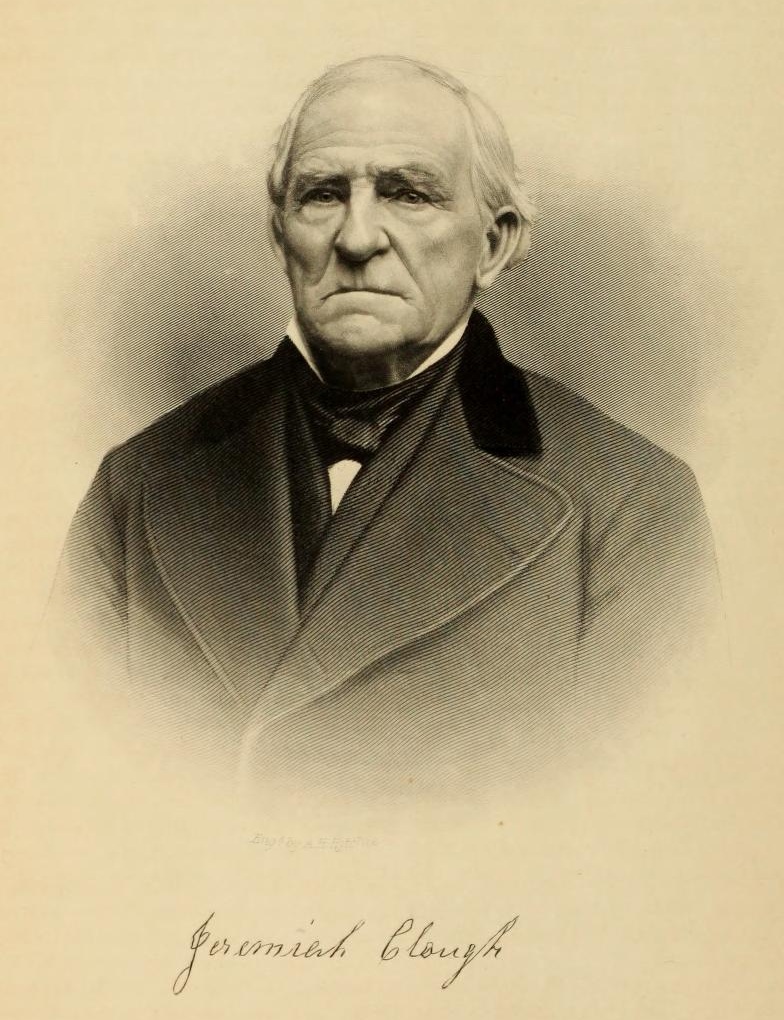 Rev.
Jeremiah Clough was born in Loudon, New Hampshire, February 3, 1792, and was the
eldest of the five children of Jonathan and Betsy Clough. His grandfather,
Jonathan Clough, Sr., moved from Salisbury, Massachusetts, to Loudon about the
year 1771, with five children, and located on that tract which has been known as
"Clough's Hill," then a wilderness. He was born in 1724, and married Elizabeth
Thompson in 1756. His children were named Joseph, Nathan, Sarah, Jonathan, Jr.,
and Love. Mr. Jonathan Clough, Sr., was a man of large business capacity, and
was chosen clerk of the parish for 17 years and selectman for four years. He was
a blacksmith by trade, working both iron and steel. He married three times, but
had no children that lived by either of the last two marriages. Jonathan Clough,
Jr., married Betsy Clough, of Epping, New Hampshire and had five children, named
Jeremiah, Joseph and Benjamin (twins), Jonathan and Sally.
Rev.
Jeremiah Clough was born in Loudon, New Hampshire, February 3, 1792, and was the
eldest of the five children of Jonathan and Betsy Clough. His grandfather,
Jonathan Clough, Sr., moved from Salisbury, Massachusetts, to Loudon about the
year 1771, with five children, and located on that tract which has been known as
"Clough's Hill," then a wilderness. He was born in 1724, and married Elizabeth
Thompson in 1756. His children were named Joseph, Nathan, Sarah, Jonathan, Jr.,
and Love. Mr. Jonathan Clough, Sr., was a man of large business capacity, and
was chosen clerk of the parish for 17 years and selectman for four years. He was
a blacksmith by trade, working both iron and steel. He married three times, but
had no children that lived by either of the last two marriages. Jonathan Clough,
Jr., married Betsy Clough, of Epping, New Hampshire and had five children, named
Jeremiah, Joseph and Benjamin (twins), Jonathan and Sally.
Rev. Jeremiah
Clough married Sabrina Clough, daughter of Levitt Clough, of Canterbury, in
1813, by home he had a family of eight children. Six of them died in infancy and
before maturity. The two youngest or named Jeremiah L. and Charles C. Mr. Clough
married, the second time Deliverance Hodgdon, of Northfield, New Hampshire,
Sept. 10, 1840. They had one daughter, named Christiana, who is the only living
representative of the nine children born to the Rev. Mr. Clough. After his
marriage he moved to Canterbury, with his wife's father, and was, for several
years, a large and successful farmer. He acquired a large property, and was an
industrious and robust man. He was early taught to labor, and during his whole
life was industrious and economical in all his purposes.
In 1819 he
professed religion, and was licensed as a preacher of the gospel in 1835. He was
ordained in 1838, and preached as an evangelist, for 10 years, the doctrine of
the Free Will Baptist denomination. He was chosen pastor of his own church in
Canterbury in 1848, and continued in this relation until the year 1872, when he
suffered a partial shock of paralysis, and retired from the active labors of the
ministry. During his labors with this church a large number were added to it,
and it became one of the strongest in the Quarterly Meeting. In the meantime a
new and commodious church edifice was erected, to which Mr. Clough was a large
contributor. It was dedicated about the year 1853, Rev. Mr. Clough preaching the
ordination sermon. He was a man of great natural ability, and processed fully
the characteristics required in a man of so strong purposes. He was widely known
as an humble and Christian man, devoid of all ostentation and display. His
Christian life was above reproach, while he had the most profound reverence for
the house of God and all its ordinances, making his worship at all times
spiritual and full of devotion. He was full of Christian charity, zeal and
unending love for his church in Canterbury; for Christian ministers, making
large donations to destitute churches, aiding in building houses of worship; the
cause of education and missions; and was always a true friend of the destitute
and needy. His word was never doubted nor his veracity questioned.
He was a
man of large social qualities, possessing true affability of manners, which made
his home social, agreeable and always pleasant to his family, and full of
hospitality to friends and strangers. The words of advice and counsel which fell
from his venerable lips were wise, safe and full of consolation, especially in
times of affliction and trouble. His services were largely sought in affliction
by death of friends, to which his words were as "healing balm". He always
refused remuneration for all religious service throughout his entire life.
His family trials were severe in the loss of his children, but were borne
with Christian fortitude. One of the greatest questions of his life was to
decide whether to devote his life work to the ministry or not. This he decided
upon his knees in the pasture, beneath a tree, which still lives, and spreads
its few branches over the monument of stones which he erected, as a seal of the
vow of consecration which he made to his God more than 50 years since. His last
act of baptism was performed at the age of 82 years. The Rev. Jeremiah Clough
received the honors of his town by being chosen to office and representing it in
the Legislature. About 25 years since he moved from Canterbury to his native
town of Loudon, where he died at the advanced age of 87 years. Jeremiah L.
Clough married Clara Clough, daughter of the Honorable Joseph Clough, of Loudon,
and had two children, named Lucy S. and Jeremiah J.
Charles C. Clough
married Mary E. Osgood, daughter of Ira Osgood, Esq., of Loudon, and had one
child, named Charla E., who lives at the old Clough Homestead in Canterbury.
Charles C. Clough died in July, 1861, a noble and highly esteemed citizen and
Christian man. His widow married, the second time, the Rev. A. D. Smith, of
Laconia, who succeeds the Rev. J. Clough in the ministry at Canterbury.
Contributed by T. J. Rand, extracted from 1885 History of Merrimack and Belknap Counties, New Hampshire by D. Hamilton Hurd, pages 509-510.
The apparently widowed John CORSER came to the settlement from Newbury with his family, except for his son, John CORSER, Jr. (who followed years later). He built the first sawmill in the small community of which he became joint proprietor, or at least its manager with Deacon Isaac Pearson, the partnership continuing until it was ended by a life-threatening accident in about 1745.
"John Corser, tending a saw-mill alone at the head of K[ing] street, while using a crow-bar about a mill log, in an unaccountable manner, the end of the bar struck his head -- cut off his nose -- took out his right eye -- raised the fore half of the skull bone, and left the brain bare, but not injured. In this situation he was soon found by William Emery. Surgical aid was administered, and his wounds healed. He however shortly after lost the sight of his other eye; but lived and enjoyed good health for more than thirty years." -- Ebenezer Price, 1823 History of Boscawen
John CORSER and his wife, Tabitha KINNEY had eight children. Their children were: Polly, Sarah, Tabitha, Elizabeth, John, Nathan, William, and Hannah. All of John CORSER'S children were born before his settling in Contoocook.
Although there were no marriages between the children of John CORSER and Edward FITZGERALD, there were five marriages between John CORSER, Jr.'s children and Edward FITZGERALD's children. Subsequent marriages among cousins were numerous.
241. JOHN CORSER [Jr.] AT KINGSTON AND CHESTER.
It is not known in what year John removed from Newbury to Kingston, but we find that he bought a farm at the latter place in 1753, and another in 1758, sandwiching between them a tract of land which he purchased in Chester in 1756. If he did not remove to Kingston till about 1753, as seems probable, he not only married in Newbury, but had 5 children born to him there, 3 being born in Kingston or Chester, and the last in Boscawen.
His residence in Kingston is described as situated on the road leading from the upper part of the Plains to Danville, about half a mile west of its junction with that running north from the Cong, church. It is (or was formerly) the more westerly of two two-story houses standing alone on the north side of the street.
How long he resided in Chester is not known, but it is presumed that his next removal was to Boscawen. The Chester homestead, writes Bliss Corser, " was situated on the road leading from Hooksett bridge to Chester village. The place was afterwards occupied by one Kelley, as a tavern. I have put up at that place several times." It was perhaps the same as that occupied in 1857 by E. Kelley (see Map of Merrimack County), situated in the N. W. part of the present town of Auburn, set off from Chester in 1845.
242. SETTLEMENT ON CORSER HILL.
Removing to Boscawen with his family in in 1864 [note: this should be 1764] he purchased of Col. Henry Gerrish a large tract of land on the Hill, which has since borne his name, making there a permanent settlement. It appears also that he bought 30 acres of his brother William in 1765. The homestead, afterwards the property of his son David and since owned successively by James Kilburn, Frederic Coffin, David Macurdy, and Hiram Tilton, was situated on Pleasant street, a short distance south of the spot where the Cong. church now stands, in an enclosure through which a cross-road has since been cut, passing near the house. It was a beautiful location, with grand and picturesque natural surroundings, and at one time the center of a jovial social life, such as the presence of 100 untamed country cousins, whose homes were in sight, can be supposed to create. The first dwelling erected was a small building, which was afterwards -- under supervision of his son David, probably before 1780 -- replaced by a large, square two-story house -- one of the old-fashioned farm houses -- still standing, being, as is supposed, the oldest habitation in the town of Webster.
[Note 2nd story window above the door. It figures prominently in this anecdote about John's daughter, Abbynezzer who later married Edward Fitzgerald, Jr.: From "Genealogy of the Corser Family In American" by S. B. G. Corser, page 115: She married when quite young, and, it is said, did not at first favor the advances of her lover, emphasizing her dislike one day -- prompted not less perhaps by a girlish love of mischief, "it was so good a joke, you know" by pouring a bucket of water upon him from the chamber window; which however, had the effect only to draw from him the gallant exclamation, "Oh, the damsel!"]
244. FAMILY AND SETTLEMENT OF CHILDREN.
The first wife of John was Jane Nichols, married in Newbury, and the mother of his children; nativity unknown. There were Nicholses in Boston, Maiden, Hingham, and Reading, at an early date; later also — how early we do not know — at Kingston; but it does not appear that any of the name resided in Newbury prior to 1700. In the latter part of his life he contracted a marriage, brought about by one of his sons, which proved anything but a "breeze of summer" in the family, and resulted in the tragic end of one Costello, a schoolmaster, who committed suicide to escape arrest for having forged a note in favor of the widow of the lately deceased John.
His children settled down around him, the sons receiving a slice of the paternal domain as they came of age, and the daughters bringing their husbands a substantial " fixing out," as it was called. Their children filled the hive, necessitating a swarming in the succeeding generations, which has been so well followed that scarcely a representative bee can be found to-day buzzing about the ancestral cells.
--Samuel Corser, 1902 Genealogy of the Corser Family in America, pages 105-107
Contributed by Cheri Wilkinson
In almost every instance, those who, during the first half of the present
century, laid about the waterfalls of New Hampshire the foundations of our
manufacturing villages, builded better than they knew. They were generally men
of limited ambitions and means, and established their factories without the
expectation that they were changing worthless plains and forests into cities or
plain mechanics into millionaires. They aimed only to create productive
industries and win a fair reward for their labor. But they were skillfull
workmen, and under their inspiration and direction their enterprises have grown
into great owners and called into being communities that are models of the best
that skill and thrift can produce.
To this class belonged Kendall O. and
James L. Peabody and Jeremiah F. Daniell, who, over fifty years ago, built a
paper-mill in the forest that then grew about the falls on the Winnipiseogee
where the wealthy, wide-awake and beautiful village of Franklin Falls now
stands.
The Peabodys built a small mill at this point about the year
1828. Their knowledge of the paper business was very limited, their experiment
was not at first a success; but they were men not easily turned from their
purposes. They secured the services of a practical paper-maker, Jeremiah F.
Daniell, who knew the business thoroughly, and was by education, as well as by
natural abilities, well qualified to prove an efficient helper to men who, like
the Peabodys, were trying to establish a new enterprise in the face of many
discouragements. He had worked at his trade in Pepperell, he married Sarah Reed,
of Harvard Mass., by whom he had two children,- Warren F., the subject of this
sketch, who was born June 26, 1826, and Mary, who died in infancy.
On
going to Franklin he was given an interest in the business and became a
permanent resident. In the face of many obstacles, he secured from South
Windham, Conn., a newly-invented paper-machine, which was transported across the
country by two eight horse teams and set up ready for business. Mr. Daniell
purchased the interest of J.L. Peabody, and the firm became Peabody & Daniell.
The machinery was scarcely in position when a fire destroyed the factory and its
contents, leaving the owners bankrupt in nearly everything but courage and a
determination to succeed, which enabled them to finally rebuild and proceed in a
small way with their business.
The erection of the cotton-mills at
Manchester gave them an opportunity to purchase large amounts of paper stock at
low prices, and from that time they were moderately prosperous. The next year
after the removal of Mr. Daniell from Massachusetts his wife died, and a year
later he married Annette Eastman, of Concord. His son, Warren F., was at that
time a wide-awake boy of ten years. He had picked up a little knowledge in the
Massachusetts schools, and that he might be further educated without much
expense, was sent to Concord, where he worked upon a farm for his board and
clothes and the privilege of attending school a short time each winter, until,
at the age of fourteen, he was called home and entered the paper-mill as an
apprentice to learn the business with which his name is now so prominently
identified. It was his purpose, at a later period, to attend the academy at
Tilton; but on the day on which the term began his father was severely burned,
and Warren F. was obliged to take his place in the mill, where he became master
of the trade in all its branches. As a journeyman, his wages were one dollard
and twenty-five cents per day. Warren F. was ambitious at some time to have a
mill of his own, and with this object in view, he went to Waterville, Me., and
with other parties erected and ran a paper-mill at that place, when, a year
later, he took charge of a mill at Ppperell, Mass., where he remained until
1854, at which time his father bought out Mr. Peabody and asked his son to join
him at Franklin, which he did, and the firm became J. F. Daniell & Son, and
under that name was for ten years prosperous and successful. In 1864, Warren F.
bought his father's interest and became sole proprietor, and so continued until
in 1870, when the mill property, which had grown to be one of the largest and
best-known private manufacturing establishments in the State, was sold to a
company of Massachusetts capitalists, who organized as the Winnipisogee Paper
Company. Mr. Daniell then became connected with a large paper-house in Boston;
but soon tiring of city life, returned to Franklin, and, with a large interest
in the company, became its resident agent and manager, which position he still
occupies. This company owns large paper-mills supplied with the best machinery,
employs three hundred hands and produces about twenty tons of paper daily, and
in its large measure of success is a monument to the sagacity and enterprise of
the man who plans and directs its operations, who, without the help of a liberal
education, has won his way by hard and patient work to a first place among the
business men of the State. While compassing his own success, Mr. Daneill has
contributed much to that of others, and in his struggle upward has pulled no one
down.
The business world acknowledges him as a man of undoubted
integrity, thoroughly responsible and eminently successful; a genial man whose
good fellowship never tires, and whose hospitality and generosity are
inexhaustible. In 1850, Mr. Daniell married, Elizabeth D. Rundlett, of Stratham,
and had one child, Harry W. She died in Pepperell in 1854. He married, second,
Abbile A. Sanger, of Concord, October 1860, from which union there are Eugene
S., Otis, Warren F., Jr., and Jerie R.
Mr. Daniell is much interested in
agriculture, and owns a large farm, which is under a high state of cultivation.
He has long been the owner of the best herd of Jersey cattle in the State. His
stables contain some of the finest horses; he admires a good dog, and is
skillful breeder of swine and poultry. he has contributed much to the
introduction of improved stock, crops and farm machinery in his neighborhood;
has been active and liberal in sustaining the State and local agricultural
societies, and in otherwise promoting the farming interest.
In politics
Mr. Daniell is a Democrat, and such has been his popularity at home that he has
represented his town, which is Republican, several times in the Legislature, and
was twice chosen Senator in a district which no other Democrat could have
carried. He represented his party in the National Convention of 1872, and has
always been one of its trusted counselors and efficient workers, and but for his
refusal would have been its candidate for Governor and for Congress.
During the war he gave himself to the cause of the Union as represented by the
"boys in blue" voting to raise and equip all the men who were needed, giving
liberally to provide for them and their families and supporting by word and deed
on all occasions the cause for which they fought.
Contributed by Herbert L. Girtman, Sr., extracted from 1885 History of Merrimack and Belknap Counties, New Hampshire by D. Hamilton Hurd, pages 324-326.
Isaac Dimond was born in 1767, and married Sally Shaw, and had a family of 10
children, named Betsy, Isaac, Sally, Polly, John, Abigail, Andrew, Gould and
Ruth.
Gould Dimond married Sally, daughter Jonathan Rollins, of Loudon,
and had a family of four children, named Isaac P., Lucy M., Mary E. and Jonathan
M.
Jonathan M. Dimond married Maria Peaslee, and had three children,
named Ardena M., Sadie B., and Inez P.
Lucy M. Dimond married John B. Moore,
of Gilmanton, New Hampshire and had a family of four children.
Mary E.
Dimond married Nathan C. Clough, and had a family of two children, named Minnie
E. and Alice. Mr. Clough is located at the North part of the town, and has been
a resident of the same for 20 or more years. He has held the office of selectman
and has represented the town in the Legislature. He is a firm and reliable
citizen, as well as a man of excellent judgment.
Contributed by T. J. Rand, extracted from 1885 History of Merrimack and Belknap Counties, New Hampshire by D. Hamilton Hurd, page 504.
According to local records, Edward FITZGERALD and John CORSER were among the first thirty-three arrivals in the wilderness that was to become the towns of Boscawen and Webster or Contoocook, as the settlement was then known. Neither man was among the ninety-one grantees of land at the plantation.
Edward FITZGERALD was among the first thirty-three arrivals in the wilderness that was to become the towns of Boscawen and Webster or Contoocook, as the settlement was then known. Edward was unmarried when he reportedly arrived from Newbury settling on land first granted to Richard Hale (father of Nathan "I regret that I have but one life to give for my country!" Hale), Home Lot #37 and Intervale Lot #50. He built his home on what became "Queen Street" "on the Southern slope of the hill (Corser Hill), some three quarters of a mile below the Plain on the road leading to Concord.
Edward FITZGERALD was a farmer who apparently from time to time would supplement his income by working for others. He is known to have helped surveyor, John Brown, extend Fish Street to the town of Franklin. He contributed his labor, when the town hosted the ordination of the Rev. Mr. Phineas Stevens and is identified as a "souldier" of Contoocook in a 1743 petition to the Governor of New Hampshire.
In 1740 Edward FITZGERALD married Mehitable URAN. Together they raised eleven children in the home he had built on Queen Street. Their children were: Jane, Mary, Sarah, James, Rebecca, Edward, Susannah, Dorcas, Rachel, John and Martha.
Contributed by Cheri Wilkinson
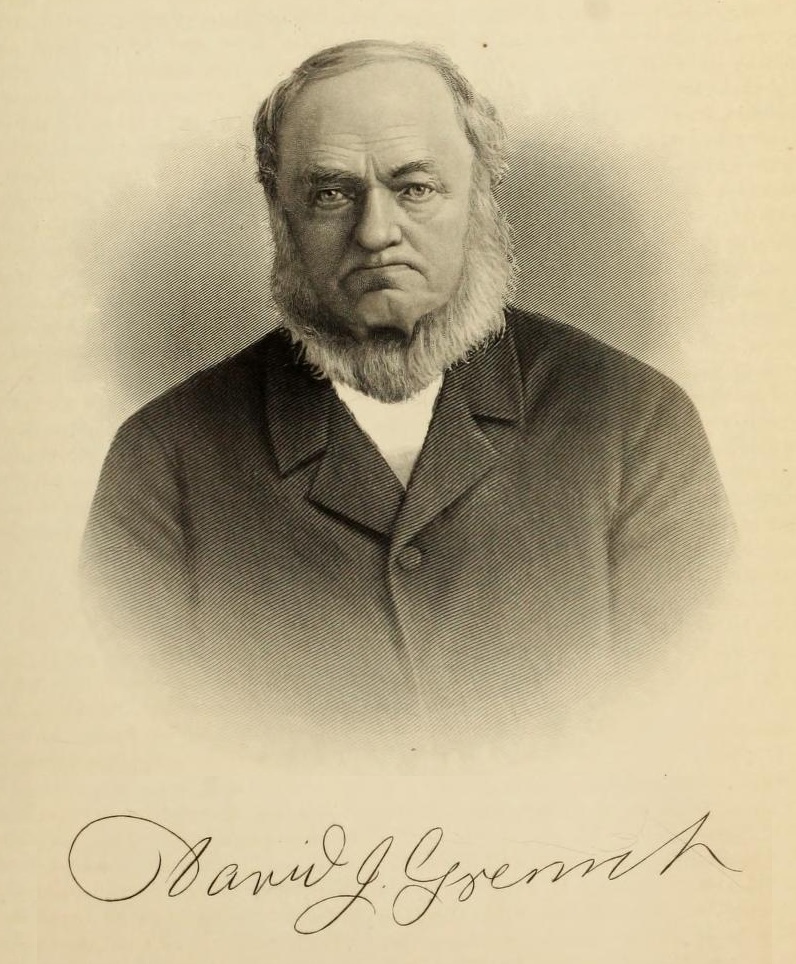 David J. French was born in Loudon Sept. 2, 1805. He was the great grandson
of Timothy French, who came from Salisbury, Massachusetts, about the year 1773,
and settled in the Northeast part of Loudon, and was among the first who settled
in that locality. At that time there was no road leading from the old Dr. Tenney
corner northwesterly to Loudon Ridge, save a sled path used in the winter
season. He cleared the land for his farm, which was a wilderness; built a house
and drew the boards from Cram's mill, in Pittsfield, to board it, upon wheels as
far as the Tenney corner, and then upon a sled in the month of July to his
future residence. His father was Joshua French, who lived upon the farm which
has always been occupied in the French name. David J. French lived with his
father until about 26 years of age, when he married and soon after purchased the
farm where he now resides, and commenced for himself and family a farmer's life,
about the year 1832, which avocation he has followed to the present time, and at
the age of 80 years was found with a scythe in his hand, able to cut and put
into his barn one acre of grass a day. He is a man of robust form, and possesses
a strong and iron constitution, for which the French family have ever been
noted. He has been very successful in acquiring property; commencing with an
indebtedness of $500, he is now the owner of several tracks of land, besides
several thousand dollars in banks and upon loan, which he has earned by hard
labor, and not by speculation or intrigue. Mr. French received only a common
school education, but possesses large, native abilities, which, being well
cultivated, have enabled him by persistent effort to to hew his way successfully
through life. As a politician he is a most thorough Republican, always attending
the annual meetings of the town and manifesting a great interest in every matter
that the pertains to the highest and best interest of his native town, and
acting at all times in his political life as though conscience of his
accountability to a power which is infinite and supreme.
David J. French was born in Loudon Sept. 2, 1805. He was the great grandson
of Timothy French, who came from Salisbury, Massachusetts, about the year 1773,
and settled in the Northeast part of Loudon, and was among the first who settled
in that locality. At that time there was no road leading from the old Dr. Tenney
corner northwesterly to Loudon Ridge, save a sled path used in the winter
season. He cleared the land for his farm, which was a wilderness; built a house
and drew the boards from Cram's mill, in Pittsfield, to board it, upon wheels as
far as the Tenney corner, and then upon a sled in the month of July to his
future residence. His father was Joshua French, who lived upon the farm which
has always been occupied in the French name. David J. French lived with his
father until about 26 years of age, when he married and soon after purchased the
farm where he now resides, and commenced for himself and family a farmer's life,
about the year 1832, which avocation he has followed to the present time, and at
the age of 80 years was found with a scythe in his hand, able to cut and put
into his barn one acre of grass a day. He is a man of robust form, and possesses
a strong and iron constitution, for which the French family have ever been
noted. He has been very successful in acquiring property; commencing with an
indebtedness of $500, he is now the owner of several tracks of land, besides
several thousand dollars in banks and upon loan, which he has earned by hard
labor, and not by speculation or intrigue. Mr. French received only a common
school education, but possesses large, native abilities, which, being well
cultivated, have enabled him by persistent effort to to hew his way successfully
through life. As a politician he is a most thorough Republican, always attending
the annual meetings of the town and manifesting a great interest in every matter
that the pertains to the highest and best interest of his native town, and
acting at all times in his political life as though conscience of his
accountability to a power which is infinite and supreme.
He is a man of
strong religious feeling, and has for many years led a life of daily and family
prayer. Being retiring in his manner and public religious duties and profession,
he has never connected himself with any church, but is a constant attendant upon
worship in the house of God whenever practicable. Mrs. French died Jan. 22,
1872. Since her death and that of his son Isaac, Mr. French has lived at the old
home alone, patiently waiting the summons that shall call him to meet the loved
ones who have gone before.
Dr. Isaac S. French was the only child of
David J. French, and died in the year 1878. He married Augusta French and had no
family. Dr. French inherited from his father characteristics that were strongly
marked in boyhood, and being well cultivated, enabled him to become an eminent
and useful man, although young. He was well educated by his father at Gilmanton
Academy, and studied medicine with the venerable Dr. Nahum Wight; he attended
college at Pittsfield, Massachusetts, and at the medical college at Hanover, New
Hampshire from which he graduated as a physician. He commenced practice in
Salisbury, Massachusetts, and remained one year, and then returned to his native
town and engaged actively in his profession with success. His business relations
were extensive, and he occupied positions of trust. He held the situation of
assessor of the internal revenue for the Congressional district in which he
recited, under the administration of President Lincoln, besides doing a large
local business as a justice of the peace in his own town and surroundings. He
acquired, by economy, frugality and labor, in a few years a handsome property,
and had well established himself among his townsmen in his calling and
profession. He died in the prime of his life and in the midst of his usefulness,
having large "honor in his own country."
Contributed by T. J. Rand, extracted from 1885 History of Merrimack and Belknap Counties, New Hampshire by D. Hamilton Hurd, pages 512-513.
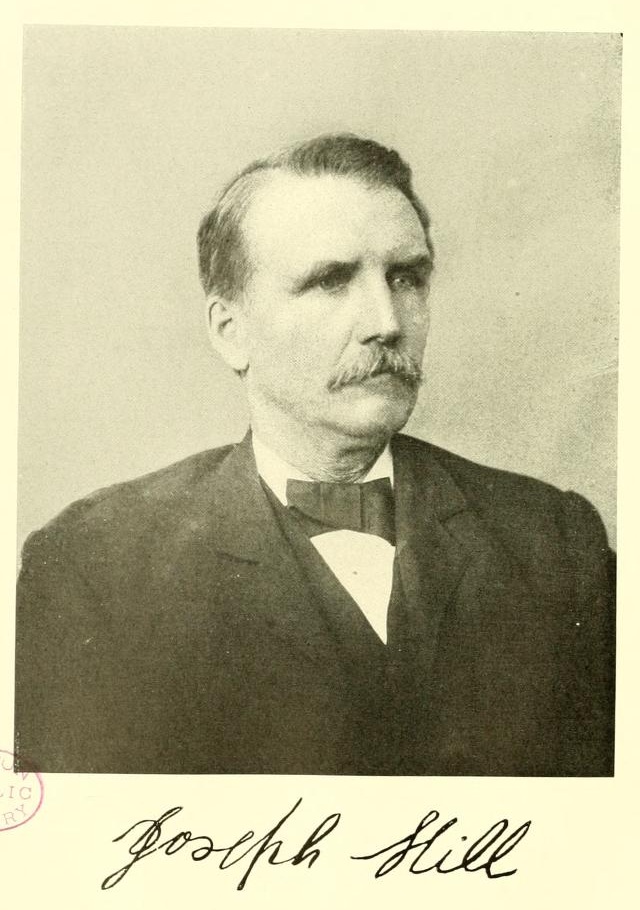 JOSEPH HILL. Valentine Hill (a), the immigrant ancestor of Joseph Hill, of
Winchendon, Massachusetts, was born in England, probably in London. He was an
early settler in Boston, where he was admitted to the church June 12, 1636. He
was a mercer or merchant from London, the records say. He was a prominent and
well-to-do citizen, chief owner of a large wharf property. He was admitted a
freeman May 13, 1640, proprietor, town officer and deacon (with Jacob Eliot). He
was selectman in 1643-44-45-46, deputy to the general court 1652-53-54-55-57. He
bought land at Oyster Bay, then Dover, now Durham, New Hampshire, before 1649
and removed thither. He died in Oyster Bay in 1662. Savage calls him a man of
great public spirit. In the settlement of the estate his widow employed Joseph
Hill, of Maiden, as attorney, suggesting some relationship between these two
prominent Hill immigrants. But there were also several others of this name at
Dover, possibly also relatives of Valentine Hill. John Hill, founder of a large
family in New Hampshire and Maine, settled first in Plymouth, Massachusetts,
removed to Boston in 1630, was admitted a freeman there March 18, 1642, was a
grantee of Nashuay, died in 1647, leaving a son John who settled in Dover on
land inherited from his father. All things considered it seems that there must
have been relationship between John Hill, of Dover and Boston, Joseph Hill, of
Malden, and Valentine Hill, of Boston and Dover.
JOSEPH HILL. Valentine Hill (a), the immigrant ancestor of Joseph Hill, of
Winchendon, Massachusetts, was born in England, probably in London. He was an
early settler in Boston, where he was admitted to the church June 12, 1636. He
was a mercer or merchant from London, the records say. He was a prominent and
well-to-do citizen, chief owner of a large wharf property. He was admitted a
freeman May 13, 1640, proprietor, town officer and deacon (with Jacob Eliot). He
was selectman in 1643-44-45-46, deputy to the general court 1652-53-54-55-57. He
bought land at Oyster Bay, then Dover, now Durham, New Hampshire, before 1649
and removed thither. He died in Oyster Bay in 1662. Savage calls him a man of
great public spirit. In the settlement of the estate his widow employed Joseph
Hill, of Maiden, as attorney, suggesting some relationship between these two
prominent Hill immigrants. But there were also several others of this name at
Dover, possibly also relatives of Valentine Hill. John Hill, founder of a large
family in New Hampshire and Maine, settled first in Plymouth, Massachusetts,
removed to Boston in 1630, was admitted a freeman there March 18, 1642, was a
grantee of Nashuay, died in 1647, leaving a son John who settled in Dover on
land inherited from his father. All things considered it seems that there must
have been relationship between John Hill, of Dover and Boston, Joseph Hill, of
Malden, and Valentine Hill, of Boston and Dover.
Valentine Hill married
(first) Frances who died February 17, 1646; (second) Mary Eaton, daughter of
Governor Eaton. She married (second) John Lovering, of Dover; and (third)
Ezekiel Knight, of Wells, Maine. There is an interesting entry on the oldest
records of Dover births, etc.: "Nathaniel Hill son of Vallentine Hill of douer
by his wife Mary was born in Oyster River the beginning March 1659-60. Mrs. Mary
Hill alias Knight was before me the 23d of May 1702 and acknowledged that
Nathaniel Hill was the son of her first husband Vallentine Hill." (John Woodman,
Justs Peac.)"
Children of Valentine and Frances Hill were: Hannah, born
March 17, 1638-39, married, January 24, I638-9, Antipas Boyce; John, born
September 1, 1640, died young; Elizabeth, born December 12, 1641, died young;
Joseph (twin), born 1644, died same year; Benjamin (twin), born 1644, died same
year; Joseph, born August 18, 1646. Children of Valentine and Mary were: John,
born August 19, 1647; Samuel, born December 8, 1648; Mary, born December 29,
1649, married Rev. John Buss, in whose charge were the records when lost by
fire; Elizabeth, baptized May 25, 1651; Nathaniel, born March 31, 1660, see
forward.
(II) Captain Nathaniel Hill, youngest child of Valentine Hill
(i), was born in that part of Dover now Durham, New Hampshire, March 31, 1660.
He was a taxpayer in Dover in 1681. He settled on his father's land on the north
side of Oyster river. His farm extended from the falls in the river, near Durham
village, across the line of the present Boston & Maine Railroad tracks. He was a
leading citizen, captain in the militia and for many years member of the
provincial council. He married Sarah Nutter, daughter of Anthony Nutter, and
granddaughter of the distinguished Hatevil Nutter. Children of Captain Nathaniel
and Sarah Hill were: Samuel, see forward; Valentine.
(III) Samuel Hill,
son of Captain Nathaniel Hill (2), was born in what is now Durham, New
Hampshire, about 1690. He inherited part if not all of the homestead and lived
in Durham, afterwards Lee, New Hampshire. Among his children was Samuel, see
forward.
(IV) Samuel Hill, son of Samuel Hill (3), was born in Durham,
now Lee, New Hampshire, October 6, 1720 (family record of Frances E. Willard, a
descendant through her mother). He died in Danville, Vermont. Miss Willard in
her autobiograph says that he was a veritable giant; well-to-do;
self-sacrificing; of robust integrity. He married Abigail Hutchins, of another
old Dover family. She was born in what is now Lee, New Hampshire, February 20,
1733, died at an advanced age in 1829 at Ogden, New York. Children of Samuel and
Abigail Hill were: Nathaniel, see forward; John, born about 1760, married Polly
Thompson, 1796, among whose children was Mary Thompson Hill, born January 3,
1805, the mother of the famous temperance advocate, Frances E. Willard. There
were probably other children.
(V) Nathaniel Hill, son of Samuel Hill (4),
was born in Durham, New Hampshire, about 1745. He was a soldier in the
revolution. He was ensign in Captain Alpheus Chesley's company in 1778. Robert
Hill, John Hill and Henry Hill were in the same service and three of the four in
the same company. They were perhaps brothers. Nathaniel Hill married at the
close of the revolution and settled in Loudon, New Hampshire. He was there in
1785, when he signed a petition, and in 1789 his son Nathaniel, Jr. was old
enough to sign as an inhabitant. Loudon was incorporated January 23, 1773, from
Canterbury, which was some fifty years older. The rest of Canterbury was
incorporated as Northfield later. There seems to have been no other branch of
the Hill family in this vicinity. Children of Nathaniel Hill were: Nathaniel,
born about 1770-5; Levi, see forward.
(VI) Levi Hill, son of Nathaniel
Hill (5), was born about 1770-80 either at Lee, New Hampshire, or at Loudon,
after his parents settled there. He received a rather brief schooling. He worked
with his father developing the farm and remained at home helping his father
until his death, when the farm became his. He was a farmer all his life, and
raised sheep and cattle for beef. He also dealt in horses considerably. He
removed to Springfield, New Hampshire, in his later years and bought a farm,
which he carried on until his death. He was a member of the Springfield
Congregational church and was a deacon there as well as at Loudon. He was always
called Captain Hill from his rank in the state militia. He died about 1861. He
married Lydia Wiggin, of Canterbury, New Hampshire, the town of which Loudon was
formerly a part. She was a descendant of Governor Thomas Wiggin, who deeded June
4,1663, a large tract of land at Durham, New Hampshire, to his son Andrew.
Andrew Wiggin became a sort of patron for the township. His son Jonathan, who
died in 1738, had a daughter who married a Mr. Hill. Children of Levi and Lydia
Hill were: Langdon Levi, Joseph Wiggin, born December 12, 1805, see forward;
Susanna, Cyrus, Levi Franklin.
(VII) Joseph Wiggin Hill, son of Levi Hill
(6), was born at Loudon, New Hampshire, December 12, 1805, died November 10,
1886. He attended the public schools there. He removed with the family about
1825 to Springfield, New Hampshire, and helped his father on the farm, but soon
afterward removed to Boston and worked in the City Hotel for about five years.
He returned to Springfield and bought a tract of wood land, which he cleared and
cultivated until 1840. He then traded for a large farm in the eastern part of
the town. Later he sold it to his son Joseph and bought another smaller one,
which he worked for ten years, sold it and bought the one which he owned at the
time of his death. In religion he was a Methodist. In his early days he was a
Democrat, afterward a Republican. He was a representative to the New Hampshire
legislature for two years, and was on the board of selectman of the town. He was
interested in the militia and was lieutenant of the Springfield company. He
married, June 8, 1825, Abigail Cole, daughter of Isaac Cole. Her father was a
molder in an iron foundry. Children of Joseph W. and Abigail Hill were: Benjamin
Franklin, born December 15, 1831, married Lavinia Davis, of New London, New
Hampshire, and they have five children-Nellie, George, Hattie, Mabel, Eugene.
Joseph, born September 10, 1833. Lydia Jane, born February, 1836, married
Leonard N. Heath, of Springfield, New Hampshire, no issue. Susanna A., married
John Crocker, of Grantham, New Hampshire. Emily Elizabeth, married Herbert
Taylor of Andover, New Hampshire, and they had four children-Albert, Grace,
Louisa, Daisy. Nellie, died aged four years.
(VIII) Joseph Hill, second
child of Joseph Wiggin Hill (7). was born at Springfield, New Hampshire,
September 10, 1833. He was educated in the common schools there. At the age of
sixteen he went to Lake Village to school. continuing for two years. He served
an apprenticeship of two years, following it in the winter months with his
uncle, B. J. Cole, learning the iron moulder's trade. He worked at home on the
farm summers during this time and then bought the farm. After working it eight
years he sold it and went to Yonkers, New York, where he worked in the foundry
of the Clipper Mowing Machine Company about three years. In 1873 he went to work
again for his uncle, B. J. Cole, in his iron foundry at Lakeport, New Hampshire.
He later worked for C. B. Mahan in his mowing machine works at Lebanon, New
Hampshire, and for a year for D. B. Emerson. In 1881 he removed to Keene, New
Hampshire, and entered the employ of James B. Elliott, who had bought the
Clipper Machine works at Yonkers. Here he remained until 1883, when he removed
to Winchendon Massachusetts, and in partnership with his son-in-law, Andrew
Bosley, started a foundry. In September, 1905, he built a large new foundry and
removed to his present location on Spruce street, near the Boston & Maine
Railroad, where the business is prospering greatly. The firm makes all kinds of
iron castings. Few men have a more intimate knowledge of the details of their
business or a more careful training than Mr. Hill. He attends the North
Congregational Church. He is a Republican and was a delegate to the state
convention in 1905 and has been to other important conventions of his party. He
is a member of the Avon Club of Winchendon.
He married, June 3, 1859,
Mrs. Elvira (Lull) Towers, daughter of Gilman Lull, of Hopkinton, New Hampshire.
Her father was a farmer. The children of Joseph and Elvira Hill are: Jennie May.
born July 3, 1861, married Andrew Bosley, of Winchendon, and they have four
children- Josephine Elvira, born February 5, 1878; Frederick Andrew, born
February 24, 1880; Bertha Kate, born January 14, 1889; Hazel Elsa, born March 3,
1890. Kate Marcella, born November 13, 1865, married Frederick Vose, of
Peterborough, New Hampshire; have no children. Carrie Abigail, born March 25,
1873, married Frank Joy, of Keene, New Hampshire; has no children.
Contributed by T. J. Rand, extracted from 1907 Historic Homes and Institutions and Genealogical and Personal Memoirs of Worcester County, Massachusetts, ... by Ellery B. Crane, Volume 2, pages 101-102.
Stephen Kenrick, Esq., one of the oldest and most influential citizens of
Franklin, died on the morning of the 4th of August, A.D. 1884, after a lingering
illness of several months.
He was born in Haverhill, Mass., June 15, A.D.
1806; his age, therefore exceeded seventy-eight years. He was the youngest
member of a family of nine children, born to John Kenrick and Sarah Colby. They
were both natives of Amesbury, but became citizens of Haverhill soon after their
marriage. The husband was born December 16, 1764; the wife January 25, 1771.
John died by a casualty in 1806. His widow subsequently became the wife of David
Marsh, and the mother of two other children, viz.: Nathaniel, of Staten Island,
N.Y., deceased, and Mary, wife of Rev. G. W. Kelley, resident in Haverhill,
Mass., now deceased.
The name of Kenrick, or Kendrick, or Kendricke
appears to be of early English origin. The name of John seems to have been
adopted as an early favorite by the family. We find the name of John Kendrick,
sheriff in London, in 1645. The same name appears as Lord-Mayor of London in
1651. John Kenrick was in Ipswich, Mass., in 1657. John Kenrick, John Kenrick,
Jr., and Elijah Kenrick were among the petitioners, in May, 1678 to the
Legislature, to set off part of Cambridge and to establish the town of Newton.
John Kenrick, Jr., of Newton, marched from that town, and was engaged in the
Lexington battle, April 19, 1775. Among the many immediate descendants of John
Kenrick, of Amesbury, Mass., who were distinguished in the walks of business and
professional life, were Professors Henry L. Kendrick, of West Point Academy, and
John Kendrick, of Marietta College, Ohio, both first cousins, and James R.
Kendrick, superintendent of the Old Colony Railroad, who was also second cousin
of Stephen Kenrick, Esq. These gentlemen were all natives of the town of
Lebanon, in this State, and we might enumerate many others of the same family,
and their "kith and kin", or collaterals, in different parts of the Union, as
being prominent and successful business men, and highly respected in their
respective localities.
Early in this century, and prior to 1820, Timothy
Kenrick, the elder brother of Stephen, had emigrated to the town of Lebanon, and
established there a profitable mercantile business. He had acquired early a good
education, and was known and honored by his fellow citizens as a man of
integrity by several public trusts. He was town clerk thirty-seven consecutive
years, and was several times elected their representative to the Legislature. He
was often employed in the settlement of estates of his vicinity, and was for
many years director of the Northern Railroad. He well discharged these important
trusts. In the meantime his brother Stephen was with his kind father-in-law,
Marsh, in Haverhill, where he received good paternal protection and the benefits
of the best schools found there until he arrived at the age of fifteen years. He
then was committed to the care of his brother Timothy, then of Lebanon, and was
employed in his brother's store. Here he received that valuable systematic
instruction which proved useful to him in after-life. We next find him for a
short time in Bangor, Me. Afterwards he was engaged in trade for himself with
Mr. James Howe, at Barnet, Vt.; next, for a short time, at Boscawen Plain, N. H.
Then, in 1831, he formed an advantageous co-partnership with Mr. Brewer, of
McIndoe's Falls village, Vt., and there continued his business until 1836, when
he came to Franklin, and ever since has made his permanent residence here,
identifying himself with the business of this town, and becoming one of its most
active and prosperous citizens.
For many years he was largely interested
in various railroad projects and contracts, in connection with Joseph A. Gilmore
and John A. Lyon. From these enterprises he derived much profit, and became a
large proprietor in several railroads. He was president of the Concord and
Portsmouth Railroad from about 1861 to the time of his death. For many years
before his death he was president of the national bank located at Hillsborough
Bridge, and was interested in its stock. He was also trustee of the Franklin
Savings Bank. He took also a deep interest in the management of the prudential
and financial matters of the town, occupying many of the official stations,
conferred by his fellow-citizens. He was elected one of the selectmen of the
town during the years 1849, 1850, 1851, 1854, and 1872. In 1859 and 1861 he
represented the town in the House of Representatives in this State. For many
years he was a member of the Congregational Church in Franklin, and was one of
its most generous supporters.
In 1833 he married Clarissa A., youngest
daughter of Captain Ebenezar Blanchard, late of Franklin, who still survives
him. To them were born seven children, four of whom were removed in infancy by
death. Another, Dr. Timothy G. Kenrick, died in Naples, Italy, January 29, 1879.
He was born July 8, 1849; graduated at Dartmouth College in 1871; studied the
medical profession, graduating at the Bellevue Hospital Medical College, New
York, June 1, 1874. With much enthusiasm he applied himself to the study of
insanity, and to the best mode of treating and managing those affected with this
unfortunate disease. His mild temper and great power of self-control, united
with his skill and learning, gave him signal success in this department of his
profession. He was fortunate in early securing the patronage and friendship of
Dr. I. W. Barstow, the eminent manager of the Sandford Hall Asylum, at Flushing,
N. Y. He had the full confidence of Dr. Barstow, and was employed by him, to the
mutual advantage of both parties, up to 1876, when Dr. Kenrick was called into a
larger sphere of duties as assistant surgeon in the New York State Lunatic
Asylum, at Utica. It is enough to say that his success here met the expectations
of his friends, and that his professional attainments commanded the respect and
confidence of his associates and the managers of that institution. His life was
sacrificed to the malarial climate of Naples while, in devotion to duty, he was
traveling for the benefit of the health of one of his diseased and wealthy
friends, who was very wisely committed to his professional care. His early,
premature death brought extreme sorrow to the hearts of his parents and his many
friends, who had witnessed his progress and reasonably indulged high hopes of
his future success in life. The lamentation over his loss at home was most
sincere. Abroad "he was by strangers honored and by strangers mourned."
Of the two surviving children, Stephen, the eldest, many years since removed to
the West, where he has been extensively engaged in various railroad enterprises.
We find him now in Wisconsin, married, but without children, and prosperous in
other respects, enjoying the income of the office of general superintendent of
the Fort Madison and Northwestern Railroad. He is cheerful, and apparently
enjoys life well.
The remaining child is a son, in the full vigor of
life, under the name of Charles C. Kenrick, now very active, doing the labor of
two men, being extensively engaged in building houses, barns, stables, shops. As
a farmer, raising more hay and corn than any other person in town, improving
largely, by judicious cultivation, his lands; selecting good breeds of cattle
and horses, and increasing their number; giving promptly a fair day's pay to a
fair day's labor, thus rewarding a large number of laborers, and expending
profitably a good amount of capital daily; improving the condition of his
estates, and augmenting the wealth of the town. We might here also, with
propriety, refer to the extensive traffic in wood and lumber recently carried on
by him, not without profit.
During the long life of his father, Charles
has enjoyed the benefit of his advice, and followed it. Thereby he gained his
father's confidence, and before his death he received from him the conveyance of
a large estate, under the sole obligation to render all needed aid to his aged
mother in sickness and in health. This obligation his kind nature prompts him to
obey to her entire satisfaction.
We now leave the history of the children
and again refer briefly to that of the father. While Mr. Kenrick was a citizen
of Franklin we found him interested and well informed in the important interests
of the town, State and nation. He had leisure, and opportunity to inform himself
so as to discharge intelligently his own private trusts and duties, as well as
those belonging to the good citizen. His knowledge and experience, acquired by
him in trade, banking and railroad affairs, were of much value to himself and
useful to others. We have already alluded to his great ability in acquiring and
retaining successful a large estate. We must not forget to give due credit to a
diligent help-meet, in the name of his wife, who brought to him a considerable
pecuniary inheritance that descended from her paternal estate. This inheritance,
coming down from a worthy ancestry, would, of course, be highly appreciated. It
constituted a valuable accession to the estate, now constantly increasing
through the harmonious action, kind care and economy of both husband and wife.
It is an acknowledged fact that the accumulation of property generally requires
much patience and great mental resources; but a critical world tells us that a
wise appropriation or disposition of a large estate requires the exercise of
still more sagacity, good judgement and wisdom.
Contributed by Herbert L. Girtman, Sr., extracted from 1885 History of Merrimack and Belknap Counties, New Hampshire by D. Hamilton Hurd, pages 321-322.
Moses Lovering came from Exeter, N. H. and settled in Loudon in 1784. He
married Nellie Taylor, of Exeter, and had a family of 13 children, named
Willabee, Nellie, Osgood, Taylor, Nancy, Moses, Jesse, Mary, Zebulon, John,
Daniel, William and Sarah, all of whom lived till from 45 to 90 years of age,
and were married and raised families of children. He came with nine children on
horseback, and drove one cow, upon which depended sustenance of the family in a
large degree. The country through which he had to travel, when near Loudon, was
a wilderness, and the settlers in those towns below furnished him aid in getting
through. He moved into a log house between the dwelling of S.B Lovering and the
highway near the sawmill. Zebulon had a family of 11 children; 9 of them lived,
and were named, Samuel B., True, Almira, Annis J., Sarah B., Louisa, Laura L.,
Abigail and Alonzo B.
Samuel D. Lovering married three times and had a
family of 10 children, named Nancy A., James P., Harlan P., Abigail M., Clara
A., Frank O., Clara A. (2d.) Frank O. (2d.) and Edward E.
The Lovering
families settled the adjoining land, and owned at one time nearly 500 acres.
Samuel B. Lovering married, first Mary S. Rogers; second, Lucy Grace; third
Lavina Hoyt. He owns and has run a sawmill for fifty years, besides being a
thrifty farmer. He has represented the town in the Legislature in the years 1866
to 67, and been a justice of the peace for forty years.
Contributed by T. J. Rand, extracted from 1885 History of Merrimack and Belknap Counties, New Hampshire by D. Hamilton Hurd, pages 501-502.
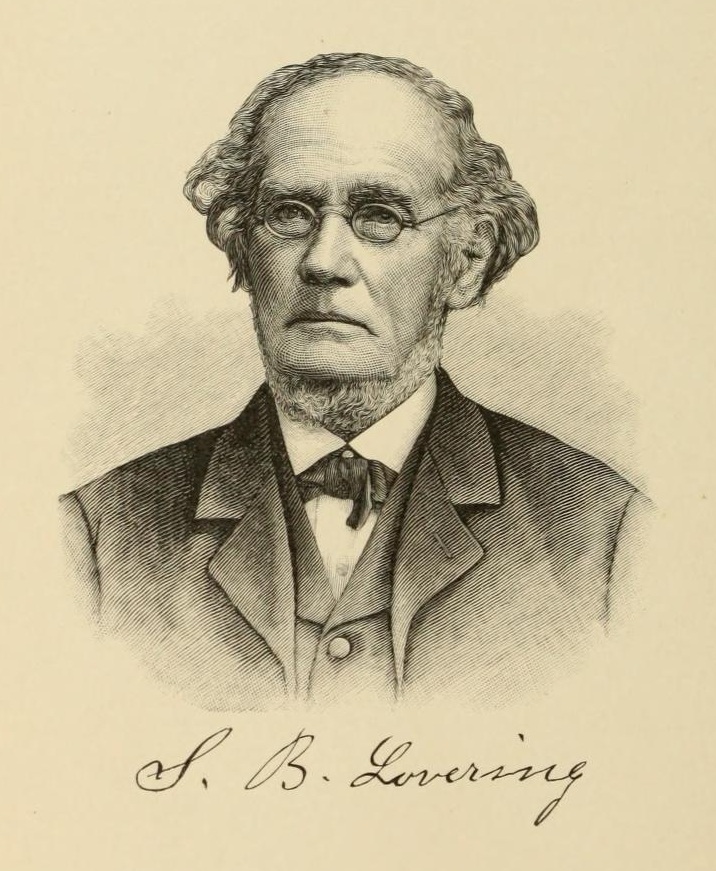 The
first of the Lovering family of whom we have any authentic record was Moses
Lovering, of Exeter, New Hampshire. He married Nellie Taylor, of Exeter, by whom
he had a family of 13 children, 9 boys and 4 girls, viz: Willerby, Nellie,
Osgood, Taylor, Nancy, Moses, Jesse, Mary, Zebulon, John, Daniel, William and
Sarah. Of these, the first 11 were born in Exeter, the latter two in Loudon. One
remarkable facts in a family so large was that they all lived to be from 40 to
90 years of age. They were all married and had families; two of them, Moses and
William, were twice married; Mary was the first who died (about 1815), and
William died in Springfield (1865).
The
first of the Lovering family of whom we have any authentic record was Moses
Lovering, of Exeter, New Hampshire. He married Nellie Taylor, of Exeter, by whom
he had a family of 13 children, 9 boys and 4 girls, viz: Willerby, Nellie,
Osgood, Taylor, Nancy, Moses, Jesse, Mary, Zebulon, John, Daniel, William and
Sarah. Of these, the first 11 were born in Exeter, the latter two in Loudon. One
remarkable facts in a family so large was that they all lived to be from 40 to
90 years of age. They were all married and had families; two of them, Moses and
William, were twice married; Mary was the first who died (about 1815), and
William died in Springfield (1865).
And the year 1787, Moses Lovering, with
his family, left Exeter to make his home in the then sparsely settled region now
the populous and thrifty town of Loudon. Their household goods were brought in
an ox team, while the ladies road on horseback about 50 miles along a forest
pathway over the hills to their future home, a 100 acre lot on the site of Mr.
S. B. Lovering's present abode. There was a primitive affair dignified by the
title of a mill on the place, and which, by diligence and patience, they could
grind a bushel or so of corn. There were none of the comforts, or what would be
considered at the present-day the necessities, of civilized life, surrounding
them in their frontier home; but with the resolute will which characterized the
grand old pioneers of our American civilization, they went earnestly and
hopefully to work and soon converted the forest clad hills into smiling fields
teaming with cereal productions, and gradually gathered around them property and
conveniences. They from time to time added to the original hundred acres until
they possessed a landed estate of over 500 acres. The boys were ingenious as
well as industrious; all of them could skillfully handle carpenter's tools, and
possessed the various requisite qualities and accomplishments for successful
pioneers.
In course of time all the brothers married and settled in
Loudon, and as each one took to himself a companion, the other brothers would
all join together and build for the newly wedded couple a house to live in. In
that early day there was no public school system in vogue, there were no school
houses, and the only tutorship the children of the neighborhood could obtain was
when occasionally an itinerary teacher would come into a community and teach for
a few months at a private house, when those children who lived near enough and
whose parents were able to pay for their tuition were privileged to attend.
Moses Lovering, with a family of 13 children to rear and support, and poor in
purse, could not afford to send his children away to school and so they were
comparatively uneducated. Some of the boys so far educated themselves as to be
able to attend to their business affairs without outside aid in such matters as
required record or correspondence, but they all felt severely the need of better
education. They were very steadfast in their affection for each other, and each
frequently visited the other at their respective homes; and the long winter
evenings were spends in social conversation around the hearth stones of those
huge old fireplaces, where roared and cracked the blazing wood fires of our
grandsires' days.
About 1816, William and Osgood moved to Stewartstown,
New Hampshire, Taylor to Canada, Daniel and William to Springfield, Hampshire.
From there Daniel went to the West and died. The others died in Loudon and
vicinity. The boys were all Democrats in politics.
Zebulon Lovering, the
father of Samuel B., was born in Exeter, New Hampshire, July 15, 1777. He
married, Jan. 21, 1807, Abigail Buswell, who was born in Kingston, New Hampshire
(1787). Upon the death of his father, Moses, Zebulon inherited the homestead in
Loudon and resided there until the close of his life. They had 10 children,
Samuel B.; Almira, born Sept. 10, 1811, married Kingsley Mason; Anis J., born
February 12, 1814, married George W. Neal; Sarah B., born Aug. 14, 1816, married
James McAustin; Louisa, born February 17, 1819, married Aaron B. Young; Lara L.,
born February 27, 1822, married Rev. Stephen Eastman; Abigail, born August 11,
1824, married Osni P. Hamblet; and Alonzo B., born April 13, 1827, married Sarah
Davis. Zebulon died December 21, 1830; Mrs. Lovering, Aug. 21, 1861.
Samuel B. Lovering, the eldest child of Zebulon, was born April 13, 1808. In his
boyhood days the district schools were usually kept about three months and a
year. He began attendance at these went about eight years of age, and continued
until he was 18. After he kept lessons of Master Timothy Gleason in writing and
arithmetic. He was brought up to work on the farm and at the mill. The year he
attended his majority his father died, and the care of his widowed mother and
the smaller children devolved upon him. His father left the farm to him upon the
decease of his mother. Soon after his father's death he rebuilt the old mill,
converting it into a sawmill, and it has been run as such every sinse, sawing
lumber, boards, shingles and laths, averaging about 150,000 per year. He has,
from time to time, made additions to the real estate he inherited from his
father, and now owns about 400 acres of land. He has been a successful and
prosperous farmer. He united with the Methodist Episcopal Church when he was
about 30 years of age, and from that time to present he has been a consistent
member. He is fond of music and accomplished as a singer and instrumental
performer. He led the choir in his church for 20 years, and an old militia days
he played the clarinet at the muster-grounds for 15 years. He has served his
town as selectman and representative to the Legislature. He has been justice of
the peace for nearly 40 years, and has been in Probate Court business since his
first appointment, and has settled many estates and held other positions of
trust.
He married, December 18, 1834, Mary S. Rogers, of Northfield; she
was born April 22, 1811, and was a lineal descendant of John Rogers, the martyr.
The children were;
Nancy A., born January 31, 1836; married Josiah Young, and
lives at Clarksville, New Hampshire.
James E., born March 7, 1838; married
Jennie Hamilton, a school teacher, of Brookline, New York. He was for several
years manager of the Joseph Dixon Crucible Company, at Jersey City; now lives at
Webster, Florida.
Harlan P., born June 12, 1843; married Eliza Wentworth, of
Boston, resides at Tampa, Florida.
Abigail M., born May 14, 1845; married
Augustus A. Arling, and farmer in Canterbury. He died, and she married George
Simmons, of Boston, Massachusetts.
Clara A., born Nov. 18, 1848; died Nov. 5,
1855.
Frank O., born June 1, 1856; died July 7, 1862.
Mrs. Lovering died
Nov. 11, 1858
Mr. Lovering's second wife was Lucy Grace, of Hillsboro, New
Hampshire. They were married Sept. 4, 1859. She was born February 10, 1826.
Their children were:
Clara a, born July 19, 1860; Mary Herman W. Mudgett,
M.D.; now resides at Moore's Forks, New York.
Frank O., born April 2, 1863.
Edwin E., born April 7, 1865. Both the latter are at the old homestead,
assisting their father in the conduct of the mill and farm.
Mrs. Lovering
died March 17, 1878.
Mr. Lovering married in Concord, New Hampshire, Nov.
11, 1880, his present wife, Lavinia Hoyt, of Fisherville, (now Pennacook). She
was born every 26, 1832. She is the daughter of Deacon Benjamin Hoyt, deacon of
the First Baptist Church of Pennacook from its organization until his death,
Sept. 6, 1864. Mrs. Lovering has been a member of the same church since her 19th
year. She for many years taught a class of girls at the Sabbath School there,
and all of them have subsequently united with the Church.
Deacon Benjamin
Hoyt was noted for his moral integrity and strict piety. He was a successful
farmer and a highly respected citizen of his town. He was descended from John
Hoyt, one of the original settlers of Salisbury, Massachusetts. (For a more
extended ancestral history of the Hoyt -- or Hoitt family, see biography of
Thomas L. Hoitt, in this volume).
Mrs. Lovering's mother was Hannah
Eastman, a descendant of Capt. Ebenezer Eastman, who in early life followed the
seas, and was one of the pioneer settlers of ancient Pennacook (now Concord, New
Hampshire). Another of her ancestors was Capt. Joseph Eastman, who figured in
the French and Indian War. Mrs. Hoyt was a very pious woman, and when her
husband, the Deacon, was absent from home, attending evening meetings, she would
talk and pray with her children, and teach them the importance of God's word;
all of them have since become members of the Church.
Contributed by T. J. Rand, extracted from 1885 History of Merrimack and Belknap Counties, New Hampshire by D. Hamilton Hurd, pages 511-512.
Nathaniel Martin, Esq., came to Loudon it was first taxed in 1808. He was
twice married and had a family of 9 children, named Rue, Jane, Elisabeth and
Anna (twins), Mary, Abigail, Nancy, Sally and Theophilus B., Esq. Martin was
engaged often in town business, and was an important and useful man of the day
in which he lived. His name appears often upon the town records as having been
chosen to discharge some public duty, which was carefully and satisfactorily
performed.
Theophilus B. Martin, Esq., married Sally L. Rowell, and had a
family of four children, named Nathaniel (who died), Mary E., Abby and Nathaniel
E. But few men have ever lived in town who have been so frequently chosen to
positions of trust as Esq. Martin. He has represented town and the Legislature,
and been chosen as County Treasurer, besides performing a large amount of
probate and private business as a justice of the peace. He early engaged in the
calling of a schoolteacher, and continued in it until the middle age of life
with success. He was a member of the Church, and was deeply interested in all
matters pertaining to the welfare and best interest of the public. He moved with
his family to Concord, New Hampshire where he died.
Nathaniel E. Martin,
his son, obtained his education at the Concord high school, and afterwards
studied law with William E. Chase, Esq., after which he opened an office in
Concord, and is now connected with the firm of Abin, Tappan and Martin. That
success has attended his efforts which is always the reward of labor and
diligence in every calling in life.
Contributed by T. J. Rand, extracted from 1885 History of Merrimack and Belknap Counties, New Hampshire by D. Hamilton Hurd, page 506.
Samuel Moore was born in Canterbury, and had two wives and a family of 10
children, among whom was Thomas, who was born in Canterbury, and married Comfort
Perkins, and Tenney family of nine children, named Polly, Samuel, Joanna,
Alexander, Samuel, Sophronia, Comfort, Thomas and Myra. Thomas Moore chosen
constable for the town, and was chosen as one of the committee to form school
districts.
Stephen Moore was born in Loudon in 1799 and married Mary Q.
Greeley, of Gilmanton, and had a family of a children, named Joseph, Albert, Ann
Maria, Andrew G., George L., infants son, Caroline A. and Mary R. Mr. Moore
married for second wife Mary Bean, of Deerfield, by whom he had no children. Mr.
Moore was devoted the last years of his life in fitting up a new cemetery, he
having provided a suitable spot and extended a large amount of labor and money
in improving the same.
Andrew G. Moore married Laura A. Batchelder,
daughter of Col. Zephaniah, and had a family of two children, named Charles L.
and Herbert G.. A. G. Moore resides upon the farm owned by his father, Stephen,
and is the one cleared by Thomas Moore. Charles L. Moore married Ida Jameson, of
Fisherville, New Hampshire, and has no children. Herbert G. died in 1884.
John Moore came to Loudon from Canterbury and bought several lots of land at
the Ridge. Was one of the selectman of the town for several years, and assisted
in the laying out of the town into lots and also several of the highways. He had
a family of 11 children, named Hannah, Jacob, Archelaus, Elkins, John, William,
Abia, Betsy, Patty, Polly and Sally.
Archelaus S. Moore, Esq., son of
John, had a family of 10 children, named Abigail, Archelaus S ., Jr. Lucinda,
Abia, Climena, Hannah, Lydia, David, Julia and Jefferson. The Honorable Joseph
Moore, editor of the Manchester Union, is the son of David, and was born in
Loudon.
Archelaus S. Moore, Jr., married a daughter of Joseph Clifford,
of Gilmanton, New Hampshire. His son, Daniel L. Moore, resides upon the
homestead of his father, and has been married twice, having two children living.
Mr. Moore married, last, Mariana Sleeper, of Loudon, and has one child. He has a
large interest in the new cemetery at Loudon Ridge, in which he has erected a
family monument which is both costly and beautiful in appearance and design. Mr.
Moore has added many improvements to his farm and buildings, and is a man of
fine culture and taste. He devotes his time in attention largely to farming, and
is very successful. He is a prominent and respected citizen, he possesses the
characteristics which have made the Moore family somewhat noted throughout each
generation, one of which is an aptness for action upon any sudden emergency,
without any effort or apparent consideration.
Contributed by T. J. Rand, extracted from 1885 History of Merrimack and Belknap Counties, New Hampshire by D. Hamilton Hurd, pages 502-503.
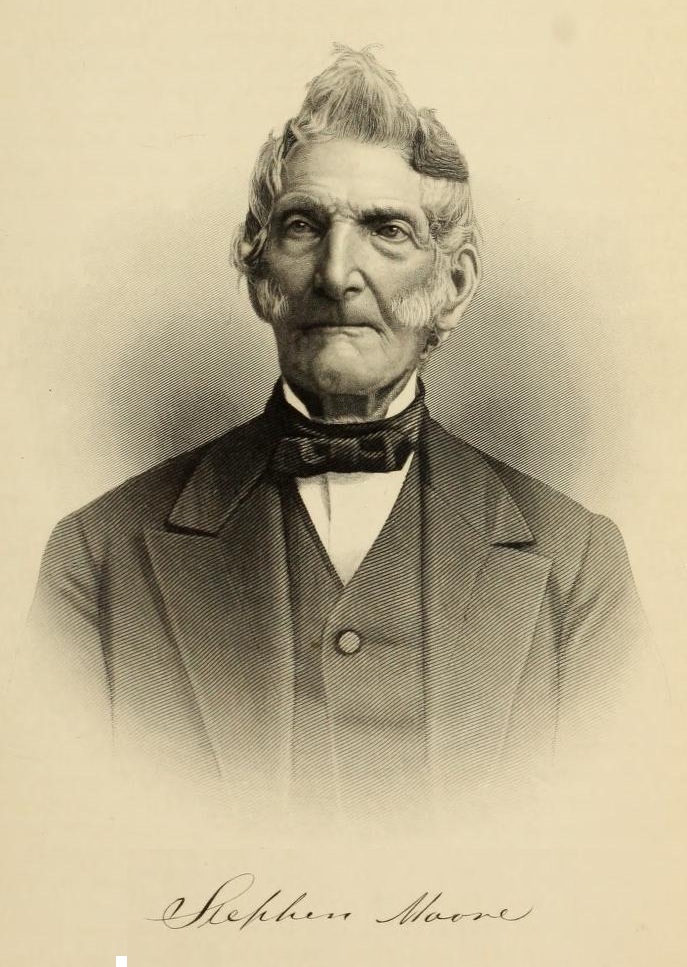 Stephen Moore is the son of Thomas and Comfort (Perkins) Moore, and grandson
of Capt. Samuel Moore, who was twice married and had a family of 10 children. He
was a native of, and resided in Canterbury, where his father was town clerk. He
held a commission as Capt. under King George III but when the revolutionary
struggle began he resigned his commission, and, casting his fortunes with the
colonies, fought during the war on the American side. He died just before
Independence was established, and his son Thomas, then a lad of 15, was bound
out to a farmer at old Hampton, but, becoming dissatisfied with his new home,
and fired with the martial spirit of the times, he ran away and enlisted in the
army, serving about six months.
Stephen Moore is the son of Thomas and Comfort (Perkins) Moore, and grandson
of Capt. Samuel Moore, who was twice married and had a family of 10 children. He
was a native of, and resided in Canterbury, where his father was town clerk. He
held a commission as Capt. under King George III but when the revolutionary
struggle began he resigned his commission, and, casting his fortunes with the
colonies, fought during the war on the American side. He died just before
Independence was established, and his son Thomas, then a lad of 15, was bound
out to a farmer at old Hampton, but, becoming dissatisfied with his new home,
and fired with the martial spirit of the times, he ran away and enlisted in the
army, serving about six months.
Capt. Samuel was by occupation a farmer
and inn keeper. He kept the hostelry known for many years as the McCrillis
Tavern. About a mile south of Canterbury Center.
Thomas Moore was brought
up on a farm, to the time of his father's death. In 1785 he began improving the
tract of land, in which is now the town of Loudon, where he subsequently made
his home. Jan. 11, 1787, he married Comfort Perkins, and, having previously
built a small house on his Loudon land, the young couple at once went there and
began housekeeping, and there the remainder of their lives were passed. The part
of Loudon in which he located was an unbroken forest; he was the first settler
in that part of town.
He was, by natural gifts, a bright, intelligent
man, but had no educational advantages in his youth. When, in after years, he
had gathered a little property around him, and had a child large enough to
receive instruction, he and a neighbor named Wheeler hired a private tutor to
come to their homes, who, spending his time alternately between the two houses,
taught both parents and children. Thomas Moore was always a friend of education,
and when the town began to appropriate money for school purposes, but had as yet
no school building, he tended the use of his dwelling, and the school was kept
in summer time in his barn, and and the winter months in his residence. He was
one of the committee who first districted the town for school purposes, and he
held various minor offices in the town. His family consisted of nine children,
seven of whom reached maturity, viz:
Polly, died unmarried.
Samuel, Mary
Charlotte Foster, of Canterbury, and had one child, now Mrs. Kate Rowe, of
Rochester, New York.
Joanna, died unmarried.
Alexander, married Mary Page,
of New Hampton; had a family of several children, who grew up to maturity.
Stephen, subject of this sketch.
Sophronia, married Jacob A. Potter, of
Concord, and had a family of four children.
Comfort, married William A. W.
Neal, of Concord, and had one son.
Thomas, died young.
Myra, married
Joseph and Wadleigh, of Loudon, and had four children.
Of these nine children
of Thomas and Comfort Moore, Stephen is the only one now (1885) surviving.
Thomas Moore was an industrious and enterprising farmer, and did much toward
improving the tract of land on which he had made his home. In religious belief
he was a Congregationalist, and his wife was a Free Will Baptist.
Stephen
Moore, like others of his time and locality, had very limited advantages in the
way of schooling. Brought up on the farm, he worked hard in his boyhood, but
improved what little time he had for study as best he could, studying nights and
at leisure times, and thus obtained a fair English education. Upon his father's
decease the property was divided among seven children, but Stephen purchased the
interest, from time to time, of the other heirs, until he finally became the
possessor or of the home farm and adjacent wild lands, and here, for more than
half a century, he toiled and labored and reared a family of children. Like his
father, he was hearty, industrious and frugal, and he gradually improved the
farm and buildings thereon, and gathered property around him, until he became in
very comfortable circumstances, and was the proprietor of one of the best kept
farms in his town.
In April, 1809, the barn, home farm of Thomas Moore
was burned, together with four oxen, four cows, 10 tons of hay and farming
implements. Supposed to be the work of an incendiary. There was no insurance.
The esteem in which Mr. Moore was held by his neighbors was evidenced by
numerous small presents, such as lumber, labor, etc.; also a cow given by the
Shakers. Within six weeks after his barn was burned, he, with the help of his
neighbors, had taken from the woods the lumber, and built the barn which at
present stands there. He also built a shed and carriage house connected with the
barn, and dug a well. In 1822 -- 23, Samuel, Alexander and Stephen Moore erected
a sawmill on a small stream running through as the home farm, for the purpose of
sawing their own lumber. A few years later the mill came into the possession of
Stephen. Samuel and Stephen also bought and used the first shingle mill which
was brought into the town. It cost, with right to use the same, one hundred and
fourty dollars. The use it 20 years.
In 1840, Stephen Moore dug a well 50
rods from the building, laid pipes and brought the water to his house and barn.
He also builds a small barn, 30 by 36 feet, for sheep, or the northeast side of
the large barn. In 1848 he built an ell to the dwelling house, 40 by 20 feet,
consisting of kitchen, pantry and wood shed. In 1850 he divided the large barn
in the middle, moved one part back, put in an addition of 20 feet, making it 76
544 feet. He also built a shed, 30 by 16 feet, connected with the small barn. In
1858 -- 51 he raised 650 bushels of rye on outtlands, where he had cut wood and
timber, and cleared for pasture. In 1860 he sowed four bushels of wheat on two
and a half acres of land, and harvested there from a crop of 100 bushels.
In September, 1866, Mr. Moore removed from the home farm to the Village of
Loudon Mills, and the homestead came into the possession of his son A. G. Moore,
who in 1868, raised the barn and put in a cellar, 76 by 24 feet, with the walls
of split granite. In 1869 he built a carriage house and stable, 36 by 26 feet.
In 1874 he put new wheels and gearing in the sawmill, and in 1884 he took up the
lead pipes laid by his father, Stephen, and in their place laid cement lined
iron pipes to the house and barn. He has also continued in various ways to
improve the farm, and has been very successful in conducting it.
Stephen
Moore married, Jan. 31, 1827, Mary L. daughter of Joseph and Nancy (Wells)
Greeley, of Gilmanton, New Hampshire. They had eight children:
Joseph G.,
born December 12, 1827.
Albert, born February 21, 1831; died in infancy.
Anne Maria, born July 17, 1833; died Sept. 20, 1881
Andrew G., born G. Mary
12, 1836; married Laura A., daughter of Zephaniah and Mary Batchelder; and has
one child living.
George L., born March 8, 1838; enlisted in Union Army and
died in hospital, Jan. 12, 1864.
Infant son, unnamed, died in infancy.
Mary R., born Sept. 14, 1842; died Oct. 10, 1876.
Caroline A., born Nov. 23,
1848; died Jan. 1, 1852.
Joseph G., married first Mary A. Arlin, and
second Anne Nichols. He has five children, all sons, and resides in Dubuque,
Iowa, where he is at present engaged in the wood and coal business. He has been,
however, for about 30 years, a railroad engineer.
Anne M., married John
O. Hobbs, of Deerfield. He removed to Newport, New Hampshire, and was a merchant
tailor there to the time of his death. His only child, Ms. Kate Hobbs, graduates
from the academy there in the class of 1886.
Mrs. Moore died March 31,
1854. Mr. Moore married, as second wife, Mrs. Mary Berry, widow of Alanson
Berry, of Loudon, a daughter of Levi Bean, of Brentwood, New Hampshire. Mr.
Moore has given all of his children an academical education, at the various
academies of Gilmanton, Pittsfield, Sanbornton and Loudon.
Since Mr.
Moore's residence at the Village he has accomplished a work at once unique and
interesting. He owned a tract of woodland lying adjacent to the Church in
bordering on the Village, which he made overtures to the Village to assist in
converting into a cemetery; not meeting with a satisfactory response, he
conceived the idea of himself beautifying and adorning the grounds and preparing
it for future use as a resting place for the dead. With characteristic energy,
he at once set about carrying his plans into execution, and here, toiling day
after day, to accomplish his cherished purpose, the last 20 years of his life
have been spent. Beginning this enterprise at an age when most men were ready to
retire from active life, it is astonishing to see what he has, I unaided and
alone, accomplished.
The tract of land selected was, by nature, well
adapted to the use to which he had applied it. It is peculiar in its
topographical confirmation, there being a deep basin in the center, with level
topped ridges surrounding it on three sides, with a slight depression or hollow
leading off on the third. It is a beautifully wooded tract, not dense, but
nicely distributed over almost the entire surface. This tract consisting of
about six acres, Mr. Moore has fenced in with split granite posts, set about 18
inches apart, around three sides of the enclosure and a part of the fourth. The
posts stand about three feet and half above ground and about 18 inches under the
surface. This fence is to be completed by iron rod traversing the top of the
posts and fastened to each, the holes being already drilled for the purpose.
In the valley, in the center of the cemetery, Mr. Moore has leveled off the
land and walled the edges of the basin with split granite. In the center of this
beautiful little plot is a miniature lake, with water clear as crystal, to which
there is no visible inlet or outlet; and in the center of this lake Mr. Moore
has constructed a little island and planted it with flowers. He has also
constructed a beautiful drive around the park or basin, and built a receiving
vault in the hillside, near the entrance to the valley. He has cleared the under
brush from most of the tract, and contemplates laying out drives around and
through it. In doing this work, Mr. Moore has built to himself a monument that
will not only serve to keep imperishable his own memory, but he has prepared a
resting place for the generations that will succeed him, credible to himself,
ornamental to the town and of service to the community at-large.
Mr.
Moore took an active part in building the Congregational Church in Loudon
Village and in supplying the same with a bell. He is a member of the
Congregational Society.
He has never been an office seeker, but has
preferred the quiet walk of the private citizen. In militia days, before the
war, however, he took an interest in military matters and held the rank of
Captain.
Through a long life he has been an earnest, honest, industrious,
hard-working and successful man. Possessed of a strong physique, he still bids
fair to survive many years. He began life prior to the present century, being
born June 29, 1799. He has outlived all of his immediate family, and most, if
not all, of his schoolmates and boyhood companions. His hearing is defective,
but with that exception, his senses are remarkably well preserved, and his
general health exceptionally good.
Contributed by T. J. Rand, extracted from 1885 History of Merrimack and Belknap Counties, New Hampshire by D. Hamilton Hurd, pages 513-515.
Moses Morse Sr. was born in Methuen, Massachusetts, in 1749, and married
Abigail Lovejoy, of Andover, Massachusetts, who was born in 1755 and came to
Loudon in 1787. Mr. Morse bought his land of Ezra Blaisdell, which has always
remained in the Morse named to the present time. They had a family of 10
children, named Abigail, Jonathan, Persis, Moses, Lydia, Moses, (2} Persis,
Deborah, (2) Levi and Isaac. Mr. Morse endured many of the hardships, in common
with other settlers who came to Loudon.
Moses Morse Jr. was born April
13, 1788; married Sally Emery in 1815, and had three children, named Harris E.,
Alvah L. and Julianna P.. Mr. Morse learn the trade of carpenter and
wheelwright, at which he worked in connection with farming. He held several
important offices in the town.
Harris E. Morris married Sarah A. Eaton
and 1842, and had five children, named Mary A., Sarah A., Harris F., Mary E. and
Alvah L.. Mr. Morse has filled positions of honor and trust, represented the
town and the Legislature and served as Sheriff of for a member of years.
Alvah L. Morse married Della M. Pritchard, and has one child named Myrtie M. He
resides upon the Morse homestead, and is the fourth generation. He has held
positions of trust.
Contributed by T. J. Rand, extracted from 1885 History of Merrimack and Belknap Counties, New Hampshire by D. Hamilton Hurd, page 504.
The Ordway family in Loudon descended from Abner and James Ordway, who came from
Tower Hill, in England, to Newbury, Massachusetts, about 1640. Abner settled in
Watertown, Massachusetts, and James in Dover, New Hampshire. Abner married,
August 15, 1656, Sarah, daughter of Stephen Brown, of Newbury, Massachusetts,
she being the widow of Edward Dennis, of Boston, Massachusetts. No descendants
of Abner are found. James married, Nov. 23, 1648, Ann Emory, whose father came
from England some years before, and had a family of 10 children, named Ephraim,
James, Edward, Sarah, John, Isaac, Jane, Hannaniah, Annie and Mary, which were
the second generation. The third generation descended from John, son of James.
The fourth from James, son of John, whose children were Moses and James.
Moses Ordway was one of the first settlers in the town, and married Anna
Huntington. He was born in Amesbury, Massachusetts, April 11, 1721. His wife was
born March 16, 1716, and they settled near the yellow school house, where some
of their descendants have resided from that time. One of the attractions to this
locality were the meadows in the immediate vicinity, from which they cut hay for
their cattle. Moses, Jr., married his cousin Persis, the sister of Joses, and
had 8 children, named Persis, born June 1, 1776; Moses, (3d), born January 1,
1779; Betsy, born March 1, 1781; Stephen, born August 24, 1784; Betsy (2d), born
March 12, 1787; Amos, born Jan. 15, 1790; Aaron, born February 19, 1792;
Hammond, born June 10, 1795.
Daniel and Joses Ordway were descendants of
James. Daniel Ordway married, first time, Deborah Lougee, and came from Andover,
Massachusetts, where he had two children born, Daniel, born Sept. 2, 1773; and
Isaac, born February 6, 1775. There were born at Loudon, Lemuel, Oct. 12, 1776;
Alse, born Nov. 12, 1778; Isaac (2d), born December 25, 1788; Hazen, born April
15, 1783; Polly, born May 21, 1785. He married, the second time, Ruth Moulton,
and had Hiram ,Chlora, Statira, Eneas, Justus, Jairus, and Ruth Ann, making a
family of 14 in all.
Joses Ordway, brother of Daniel, had a family of seven
children, Lucy, born January 1, 1795; Lois, born Oct. 1, 1796; Sophia, born
January 1, 1799; Abiel, born May 3, 1800; John C., born Nov. 3, 1801; Sukey,
born February 21, 1803; Harriet, born April 10, 1808.
Abial Ordway
married Clarisa French, and had four children, Martha S., Abial C., John F. and
Mary J.
John F. Ordway married Georgianna, the only daughter of Samuel
Huckins, of Loudon, and had a family of four children, named Della P., Effie L.,
Lillian M. and Cora F.
Hiram Ordway married Sally Blaisdell, and had one
child, named Myra E., who married Joseph W. Blaisdell. Capt. Hiram Ordway was an
important and respected citizen of his town. He was a carpenter by trade, which
avocation he followed for several years. He held important offices in the town
and was elected to the Legislature. He was of a most genial and quiet
disposition, and his influence was large in his native town, in religious as
well as public matters.
Joseph C. Ordway married Martha S. Ordway and had
a family of seven children, Nelly, Grace, Walter, Henry, Georgianna, Lilla and 1
infant that died.
Joel S. Ordway married M. Jane Wiggins. He resides upon
farm of his father, Lemuel Ordway, and has one child, named Horace F.
Daniel and Joses Ordway were soldiers of the Revolutionary War. Joses served in
Capt. John Abbotts company, and Major Gage's regiment, and Daniel in the foot
company raised in Methuen and Andover, Massachusetts. After the war they came to
Loudon, and settled with their cousin, Moses Ordway.
Stephen Ordway
married Rachel Clifford, and had three children, named Mary, Joseph C. and
Benjamin (twins).
John Cassey Ordway was the son of Moses Ordway (3d),
and married Ruth Sanborn. He had three children, named Eliza, Augusta A. and
Benjamin F. Ordway.
The trials and suffering of the first of the Ordway
settlers were the same as those of others. Upon one occasion Mr. Moses Ordway,
Jr., went to Amesbury, Massachusetts, and brought home one bushel of corn upon
his back, it being a year when the crops were cut off by frost, and his family
subsisted upon the ground nut while he was gone. A glass bottle of curious
device was brought from England by one of the two brothers that first came, and
bequeathed to one Moses, upon the condition that it remain in the family of some
descendant whose name was Moses throughout all succeeding years. Moses Ordway,
III, was the last Moses, and it is now in the possession of John C., whose
father was the last.
Contributed by T. J. Rand, extracted from 1885 History of Merrimack and Belknap Counties, New Hampshire by D. Hamilton Hurd, pages 507-508.
William Osgood, of the first generation, was born in England in 1609, in came
to this country in the year 1638. He sailed from Southampton, on the ship
"Confidence", April 11th.
Capt. Chase Osgood came to Loudon from Epping
in 1794. He had a family of 20 children. He died in 1807 at the age of 88 he was
interred in the burying ground at the Center.
Ebenezer Osgood, Esq., came
from Raymond in 1803, and had a family of eight children, named Enoch, James,
Polly, Bradley, Ira, Lamila, Nancy and Ebenezer.
Ira Osgood, Esq., was
born in Raymond, N. H. in 1799, in came to Loudon when four years of age. He
married Sally B. Parsons, and had a family of seven children, named Henry J.,
Ebenezer P., William P., Charles H., Annie M., Mary E. and Martha E.. Ira Osgood
was fitted for college at the Gilmanton Academy, after which he commenced
teaching school, and to a large number of terms both in and out of town. He was
chosen, and served for several years, as one of the selectman of the town, and
afterwards was chosen representative for two years. He was a man of great
firmness and in all undertakings and prosecuted them to the end. He devoted
several of the last years of his life in compiling the genealogy of the Osgood
family, which consisted of the descendants of eight generations. He died in
April, 1877.
Henry J. Osgood married Hannah E. H. Batchelder, and had a
family of three children, named Mabel, Herbert and Henrietta, and was born in
1825, and by whom the present history has been written.
Ebenezer P.
Osgood married Ann Randall, of Laconia, and has one child, named Charles H.
William P. Osgood married Paulina R. Clifford, of Loudon and has two
children, named Jennie M. and George B.
Charles H. Osgood married, first
Augusta A. Clough, of Loudon and the second time, Ann Lamprey, of Gilmanton, and
has no children.
Annie M. Osgood (unmarried) is a schoolteacher of
considerable note and lives at the Homestead.
Mary E. Osgood married,
first Charles C. Clough, of Canterbury, and the second time, Rev. A. D. Smith,
of Laconia.
Martha E. Osgood married Charles H. Bean, of Lawrence,
Massachusetts who is a large and extensive dealer in lumber in that city.
Contributed by T. J. Rand, extracted from 1885 History of Merrimack and Belknap Counties, New Hampshire by D. Hamilton Hurd, pages 502-503.
Moses Rowell, Sr., was the son of Christopher Rowell of Amesbury,
Massachusetts, and was born June 111764. He married Alice Currier, of Amesbury,
and moved to Loudon in 1791, and located upon Bear Hill (so called), where he
died Nov. 4, 1846. He married, the second time, Nancy Levitt, of Chichester, New
Hampshire, and had a family of 10 children, named Captain John, Moses, Jr.,
Nancy, Micajah, Ruth, Asa C., Harris, Cyrus, Rufus and Sally L. Mr. Rowell was
engaged for some length of time in teaming from Newburyport, Massachusetts, to
Salisbury, New Hampshire.
Moses Rowell, Jr., was born March 21, 1793, and
married Sophia French, daughter of John Levitt French, of Loudon, and had three
children, named Perley W., John F. and Sarah Ann.
Perley W. Rowell was
born December 22, 1823, and married Caroline Clark, of Pittsfield, New
Hampshire, March 28, 1869, and had a family of two children, named Sarah W. and
George W. Mr. Rowell lives upon the homestead of his father, and is a useful and
highly respected citizen of his native town.
John F. Rowell was born Jan.
6, 1826, and is unmarried. He commenced his education at the common school in
Loudon, and afterwards attended at Weare, Lee and Pembroke, New Hampshire, and
graduated at Haverford College, Pennsylvania. He was eminently fitted for a
teacher, which avocation he successfully followed for many years in his
immediate locality. After which he was called to the Friends' School in
Providence, Rhode Island and remained for 20 years. In 1875 he retired from this
school, and, wearied with the duties have a teacher's life, went to California,
and is extensively engaged in agriculture, together with the manufacture and
sale of lumber, of which he has purchased a large and valuable tract. He is an
enterprising and deserving man, and has, by his own efforts largely, acquired
the position which he has so ably filled. The Rowell family are noted for
intellect, ability and great firmness of principal, and are citizens who are
interested and active in everything that advances and elevates the human race.
Contributed by T. J. Rand, extracted from 1885 History of Merrimack and Belknap Counties, New Hampshire by D. Hamilton Hurd, pages 505-506.
The ancestor of this family was Capt. John Sanborn, who married Ruth Rand,
1774, and was born in 1747. His wife was born in 1751.
Captain Sanborn's
ancestry is unknown, and the foregoing is from the town record. He was among the
distinguished citizens of the town, and took an active part in the organization
of the same, and held several offices of importance at several times. He had a
family of eight children, named Elisha, born Nov. 1, 1775; Lydia, born June 3,
1777; Betty, born March 24, 1779; Thomas, born June 8, 1781; Sarah, born July
17, 1783; John, Jr. born August 29, 1785; Edmund born July 21, 1788; and
William, born June 5, 1791.
Elisha Sanborn married ___ Ladd, of Epping,
N. H. and had a family of seven children, named James, John, Nathaniel, Eliza,
Sally, Mary and Ruth. Of this family, James went to Iowa, John to Massachusetts,
and Nathaniel settled in Loudon. He married Nancy Lougee, and had one child,
Charles E.
John Sanborn married Judith Blake, and had a family of six
children, named Stephen, Jane, Judith, Edmund, Almira and and Joseph B. Steven
Sanborn when South and died. Joseph B. resides in Loudon, upon the homestead of
his father, and is a citizen of influence in his native town, having held the
important offices of the town. He is a thorough and practical farmer, has
acquired a good property and succeeded well in his purposes and efforts. He
married Sarah Ann Sanborn, the granddaughter of Jesse and daughter of Jonathan
Sanborn, and has two children, named Joseph E. and Jennie M.. His son, Joseph
E., married Lizzie Adams, of Pittsfield, N. H.
Edmund Sanborn married
Ruth Griffin, and had a family of 9 children, named William, Sally, Daniel L.,
Clarisa, James S., Jeremiah C., Eliza J., John and True H. The sons of Edmund
nearly all settled in Loudon.
Daniel L. Sanborn married Ada Moore, and
had a family of five children, named Jacob O., Ruth J., Joseph T., Charles E.
and Mary E.. Of Capt. Daniel Sanborn's family, Jacob O. is a graduate of
Dartmouth College, and has become an eminent schoolteacher; Joseph T. married
Fanny Peverly, of Canterbury, New Hampshire, and resides upon his father's farm,
having no children. He is an important and respected citizen of the town, having
held important offices in the same.
William Sanborn married Susan Haines,
and had two sons, named Richard P., who resides in Concord, and William H., a
resident of Loudon.
James S. Sanborn married Mary E. Yeaw, of Rhode
Island, and has three children, named John B., Hattie B. and Byron. He has
represented the town in the Legislature, and is a man of wealth.
Jeremiah
C. Sanborn married Betsy French, of Gilmanton, and has one daughter, named Ida
B., who married James S. Tilton, son of Daniel children, and has one daughter,
named Maud.
John Sanborn married ___ Thorndike, of Pittsfield, N. H., and
resides in Laconia, N. H.
True H. Sanborn married Adeline Green, and has
a family of five children.
The Sanborn family have been among the most
numerous of all the families of the town. They have been successful in the
acquisition of property, and have principally settled in fair native town; our
good citizens, and are largely a religious and devoted people.
Contributed by T. J. Rand, extracted from 1885 History of Merrimack and Belknap Counties, New Hampshire by D. Hamilton Hurd, pages 503-504.
Thomas Sargent, Sr., married Abigail Blaisdel in 1772, and had nine children,
named Dolly, born October 28, 1772; Charles, born September 2, 1774; Thomas,
born September 18, 1778; Josiah, born November 7, 1780; Sarah, born February 11,
1782; Susannah, born February 12, 1785; Timothy, born November 27, 1786; David,
born January 11, 1789; John, born December 5, 1791.
Thomas Sargent, Jr.,
had a family of five children,— Hannah. Amos, Maria, Susan and John.
Contributed by T. J. Rand, extracted from 1885 History of Merrimack and Belknap Counties, New Hampshire by D. Hamilton Hurd, page 505.
Moses Stevens, Sr's, family of six children were named Joseph, Jonathan C.,
Elisabeth, Hannah, Eliza and Andrew.
Andrew Stevens married Lucinda
Sargent, and had a family of three children, named Moses E., John and Hannah.
Moses E. Stevens married Nettie P. Batchelder, daughter of William
Batchelder, and has a family of two children, named Winnie M. and William G.
Mr. Stevens is the last representative of the large Stevens family in Loudon
and possesses the strong characteristics which have made them so useful as
citizens in the town. He is a man of ability and influence, and has held
positions of trust conferred upon him by the citizens of the town.
Contributed by T. J. Rand, extracted from 1885 History of Merrimack and Belknap Counties, New Hampshire by D. Hamilton Hurd, page 507.
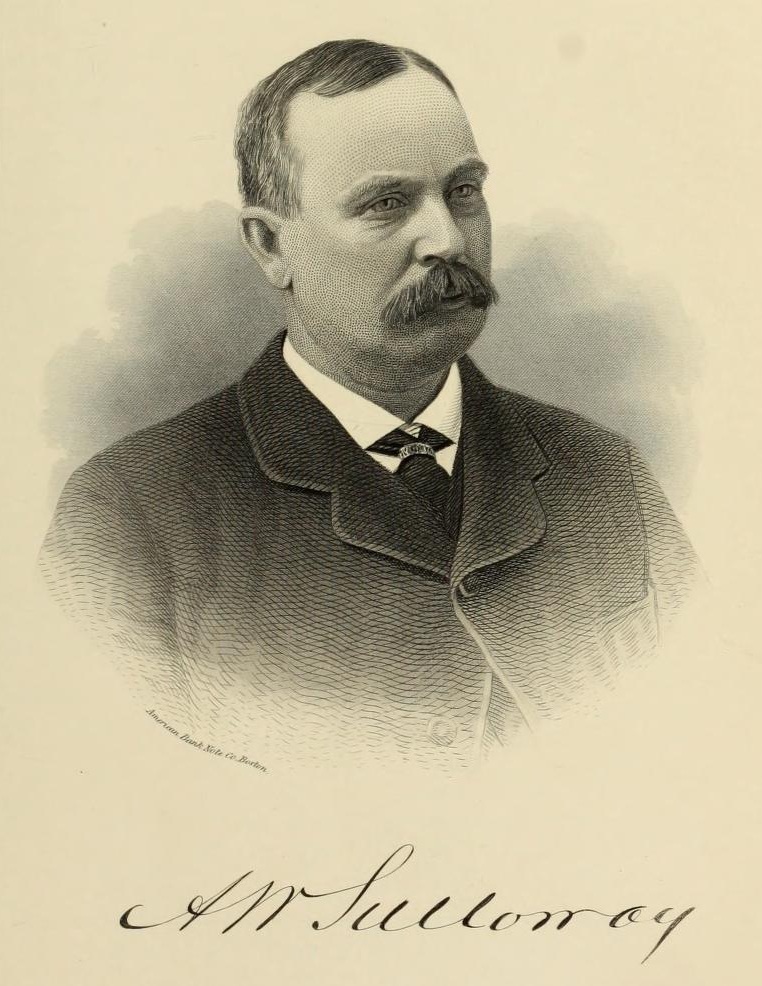 From an industrial as well as a political standpoint, the town of Franklin
has long occupied a prominent position in the State. Highly favored by nature
with the facilities most conducive to the development of manufacturing industry,
there has grown up within its limits, or been attracted thereto from other
localities, a large class of citizens possessing the enterprise, energy and
sagacity requisite to the most advantageous use of those facilities.
From an industrial as well as a political standpoint, the town of Franklin
has long occupied a prominent position in the State. Highly favored by nature
with the facilities most conducive to the development of manufacturing industry,
there has grown up within its limits, or been attracted thereto from other
localities, a large class of citizens possessing the enterprise, energy and
sagacity requisite to the most advantageous use of those facilities.
There are, indeed, few among our New England towns of corresponding size which
include among their inhabitants a larger number of active and successful
business men, or whose progress has been signalized during the last quarter by a
more substantial industrial development.
Alvah Woodbury Sulloway is one
of the best known, most practical, energetic and public-spirited among the
enterprising business men of this prosperous and progressive town.
While
the State of Massachusetts has drawn from our midst a large proportion of the
men whose labors have brought the prosperity and distinction which that proud
old commonwealth enjoys, she has given New Hampshire, in return, some of her own
sons, whose efforts have contributed, in no small degree, to advance the honor
and welfare of the State of their adoption. Among these is the subject of this
sketch. Born in Framingham, Mass., December 25, 1838, Mr. Sulloway is now in his
forty-seventh year. He is the only son and eldest child of Israel W. and Adeline
Richardson Sulloway, to whom three daughters were also born, two of whom are
living, - one unmarried, and the other the wife of Herbert Bailey, Esq., a
prominent manufacturer of the town of Claremont.
Israel W. Sulloway was
born in Salem, N. H., December 24, 1812, and sprang from Revolutionary ancestry
on both the paternal and maternal sides, his mother being the daughter of
Captain Israel Woodbury, of Salem, who served in the patriot army throughout the
war for independence.
He engaged in manufacturing service in youth, and
was for some time an overseer in the Saxonville woolen-mills. In 1848 he removed
to Enfield, N. H., where he introduced the process of making the celebrated
Shaker socks by machinery, being the first manufacturer to engage in this
enterprise.
He established a prosperous business, which he carried on
about sixteen years, when he sold out to his son-in-law, Mr. Bailey, and retired
from active life, locating at Waltham, Mass. He died suddenly, November 20,
1883, - a man of remarkably kind and benevolent disposition, whose sterling
qualities won the respect of all who enjoyed his acquaintance.
In his
father's mill at Enfield, Alvah W. Sulloway, gained that practical knowledge of
the business in which he has since been engaged, which constituted the sure
foundation of the success he has attained therein.
He secured a good
academical education at Canaan and Barre, Vt., and the Green Mountain Liberal
Institute, at South Woodstock; but spent a considerable portion of his time,
between the ages of ten and twenty-one years, in active labor in the mill,
thoroughly familiarizing himself with the various processes in hosiery
manufacture and the general conduct of business in that important line of
industry.
Upon attaining his majority, with that ambitious and
independent spirit which so generally characterizes the youth of New England,
and to which the development and prosperity of all sections of our country are
so largely due, Mr. Sulloway determined to go into business for himself. His
purpose received the ready encouragement and sanction of his father, and, after
due deliberation, he formed a partnership with Walter Aiken, of Franklin, in the
manufacture of hosiery. The partnership continued for about four years, when it
was dissolved by mutual consent, and another firm was organized which put in
operation a new mill.
This firm consisted of Mr. Sulloway and Frank H.
Daniell, of Franklin, who carried on business together until 1869, when Mr.
Daniell withdrew, and Mr. Sulloway has since been sole proprietor. The mill is
situated upon the lower power of the Winnipiseogee, opposite the mills of the
paper company, the power being used in common by the two establishments. The
building is of brick, three stories high, with basement, contains four sets of
woolen machinery, with about seventy-five knitting machines, and furnishes
employment for about ninety operatives, besides a large number of women in the
vicinity and surrounding towns, whose labor is required in finishing the work
which the machines leave incomplete.
The goods manufactured are the
Shaker socks, or half-hose, of which more than three hundred dozen pairs are
produced daily, giving an annual product of about one hundred and fifty thousand
dollars. The monthly payroll averages about two thousand five hundred dollars,
aside from the amount paid for outside labor.
Mr. Sulloway is a business
man in the true sense of the term, and as such he has been thus far eminently
successful. But while devoting his energies and ability to the development of
his own business interests, and thereby indirectly conferring large benefit upon
the community in which he moves, he has never failed to contribute by direct
personal effort to the advancement of all measures of public utility and
material progress, and to his labor and encouragement, personally and
peculiarly, as much as to any other among its many enterprising and
public-spirited citizens, the town of Franklin is indebted for the advanced
position which it holds when regarded from a business, social or educational
stand-point. He was a prime mover in the organization of the Franklin National
Bank, which went into operation in November, 1879, and has been president of the
institution from the start. He has also been a trustee of the Franklin
Savings-Bank ever since its establishment, and for several years past a member
of the committee of investment. In 1880 he was chosen a member of the board of
directors of the Northern Railroad, and in March, 1885, he was appointed
president of the same corporation.
In politics Mr. Sulloway is an ardent
Democrat, an earnest and enthusiastic worker in the party cause, and his labors
in this direction have been largely instrumental in bringing his party into
ascendancy in Franklin, which was for many years one of the hardest-contested
political battle-grounds in the State, numbering, as it does, among its citizens
several of the most active leaders of the two great parties. In 1871, although
the town was then decidedly Republican, he was chosen a member of the State
Legislature from Franklin, and was re-elected the following year. In 1874, and
again in 1875, he was elected to the same position.
In the Legislature,
as everywhere else, he proved himself a thoroughly practical man, devoting
himself actively to business and leaving speech-making to those inclined to talk
rather than work. In 1871 he served on the committee on elections; in 1872, upon
railroads; in 1874, was chairman of the committee on manufactures, where his
close acquaintance with manufacturing interests fitted him for most efficient
service; and in 1875 was again a member of the elections committee. In 1874,
when the Democratic party managers set to work systematically to win a victory
in the State, Mr. Sulloway was nominated for railroad commissioner upon the
ticket headed by James A. Weston for Governor.
Although there was no
choice by the people in the election that year, the Democracy won a substantial
victory in that they secured a majority in the Legislature, and the election of
their candidates for Governor and railroad commissioner followed at the hands of
that body. To the triumph of his party in the State the energetic labor of Mr.
Sulloway in the general conduct of the campaign contributed in no small degree.
As a member of the Board of Railroad Commissioners for the term of three
years, the last year as chairman of the board, he rendered the State efficient
service, carrying into his official labors, so far as they extended, the same
practical sagacity and judgement exercised in his own private business.
In January, 1877, Mr. Sulloway was nominated by the Democracy of the Second
District as their candidate for Congress against Major James F. Briggs, of
Manchester, the Republican nominee. The district was strongly Republican, and
that party had a popular candidate in the field; yet Mr. Sulloway, with no
expectation of an election, made a vigorous canvass and ran largely ahead of his
ticket. He was also the candidate for his party in the district at the next
election, and again in 1880, making lively work for his successful opponent,
Major Briggs, on each occasion. He has been an active member of the Democratic
State Committee for a number of years past, and for the greater portion of the
time a member of the executive committee of that body, having direct charge of
the campaign work.
He was a member of the New Hampshire delegation in the
National Convention at St. Louis, in 1876, which nominated Samuel J. Tilden for
the Presidency, and was an enthusiastic supporter of Mr. Tilden, not only in
convention, but also in the subsequent campaign, in which he was actively
engaged as a member of the Democratic National Committee from this State. In
1880 he was again a delegate to the National Convention of his party at
Cincinnati, where General Hancock was nominated; and in 1884, at Chicago, he was
a zealous supporter of Governor Cleveland.
In religion Mr. Sulloway is an
adherent of the liberal faith. He was reared a universalist, and is now an
active member of the Unitarian Society in Franklin. In this organization, as in
business and politics, he is an earnest worker, and to his encouragement and
material assistance is largely due the erection of the finest church edifice in
town. He has been trustee of this society from its beginning, and is also a
member of the board of trustees of the Unitarian Educational Society, under
whose auspices Proctor Academy, at Andover, is conducted.
In 1866, Mr.
Sulloway was united in marriage to Miss Susan K. Daniell, the youngest daughter
of the late J. F. Daniell, and a sister of Hon. Warren F. and Frank H. Daniell.
They have three children; - a daughter and two sons, - the eldest, Alice, born
August 5, 1871; Richard Woodbury, born February 15, 1876; and Frank Jones, born
December 11, 1883.
Their home is a fine modern residence, erected in
1877, beautifully located in a bend of the Winnipiseogee River, surrounded by
handsome grounds, with all its appointments conducive to the comfort of the
family and the hosts of friends who share their generous hospitality.
Mr.
Sulloway is a man of keen perceptive powers and ready judgement, so that he is
enabled to form conclusions on all practical questions presented with more than
ordinary promptness and accuracy. His opinion in all matters of public interest
and concern in this community in which he resides is as frequently sought and
carries as great weight as that of any other man, to say the least, and the same
also may be said of his advice in private business affairs.
He is frank
and outspoken at all times, and never hesitates to say just what he thinks when
called upon to express himself in any direction. He has many warm friends, and
enjoys a full measure of popularity in social as well as in public and business
circles. He was a moving spirit in the organization of the New Hampshire Club,
an association formed by New Hampshire men doing business in Boston, for social
entertainment, and has been a leading member of the same from the start. Endowed
with an active mind, and healthy and vigorous bodily powers, he has great
capacity for labor, and will unquestionably accomplish even more substantial
results in the future than have already attended his efforts.
Contributed by Herbert L. Girtman, Sr., extracted from 1885 History of Merrimack and Belknap Counties, New Hampshire by D. Hamilton Hurd, pages 322-324.
Dr. William Tenney came to Loudon in the year 1793, and married Abigail
Rollins; married the second time Peggy Flanders, and had four children, named
Abigail, Richard P. J., William D. B. and Joseph J. M. Dr. William Tenney
practiced medicine for a long time in town, and at his decease Richard P. J.,
having studied medicine, commenced his practice in his father's place, and
continued until the year 1846, when he located at the enterprising Village of
Pittsfield, New Hampshire. He had a large practice and was extensively known as
a physician. After his removal he was chosen as a member of the Governors
Council, and filled other places of honor and trust, and died at Pittsfield in
1879. He married Hannah A. Sanborn, and had one daughter, named Abby.
J.
J. M. Tenney, after having spent some years in travel, settled upon the Tenney
homestead and devoted the last of his life to agriculture, and died in 1876.
Contributed by T. J. Rand, extracted from 1885 History of Merrimack and Belknap Counties, New Hampshire by D. Hamilton Hurd, page 505.
Nathan Tilton, born February 2, 1755, married Susanna Gail, and had nine
children, -- Betty, born June 30, 1781; Timothy, born May 3, 1783; Susanna, born
Sept. 4, 1785; Daniel, born Nov. 14, 1787; Nathan, born July 15, 1791; Stephen
born Sept. 29, 1793; Newell, born Oct. 20, 1795; David, born July 1, 1798;
Joseph, born March 4, 1801.
Joseph Tilton, Sr., married, the second time,
Coziah Bagley, Oct. 20, 1783, and had three children, -- Anna, born Oct. 3,
1784; Dolly, born Aug. 6, 1787; Timothy, born Nov. 6, 1791. His first wife died
April 20, 1783. She had two children -- Joseph born April 19, 1781, and Martha,
born March 6, 1783.
William Tilton's family - Eliza Tilton, born July 24,
1788; William J., born May 9, 1790; Timothy, born July 22, 1792; Hannah, born
Aug. 9, 1794; Hannah, born December 17, 1796; Amos.
William Tilton, Jr.,
married Abigail Brown, and had a family of two children, named Louisa A and
Charles S. Louisa A. Tilton married Jeremiah Blake, Esq., son of Enoch Blake, of
Pittsfield, New Hampshire, and had a family for children, named Mary, Ellen,
Warren and Alvah. Mr. Blake is a prominent man in the town, and has been
extensively engaged in managing and executing the business of the town for many
years, and his council and advice is often sought and followed. He has held
several offices in the town and commands respect and esteem of its citizens.
Major Daniel Tilton had a family of 8 children, named Sally, Nathan,
Harriet, Newell, Joseph, Mary A., John S. R. and Samuel.
Deacon Daniel
Tilton had a family of five children, named Nathan F., born April 20, 1797;
Shuah, born May 28, 1799; Abigail, born Aug. 19, 1801; Betsy, born May 13, 1804;
Daniel, born July 26, 1805.
Daniel Tilton, Jr. married Olive Sargent, and
had a family five children, named Charles S., Daniel, John, James S. and Olive
E. James S. married Ida B. Sanborn, daughter of Jeremiah C. Sanborn, of Loudon.
Contributed by T. J. Rand, extracted from 1885 History of Merrimack and Belknap Counties, New Hampshire by D. Hamilton Hurd, pages 504-505.
A letter written by George Henry Tilton in 1924, when he was in his 80's, regarding Timothy Tilton. Timothy (b. 1718 d. 1785), was a son of Joseph Tilton. Joseph (b. 1677 d. 1744), was a son of Daniel Tilton and Mehitable Sanborn of Hampton NH.
"When Timothy Tilton came of age, his father gave him a valuable tract of land in East Kingston, where he made his home, marrying Martha Boynton. About 1770 he bought a large tract of land near Loudon and moved his family there. His home was said to have been very beautiful, was burned down not many years ago be careless children playing with matches in the barn... Timothy was very active during Revolution and the first town meeting held in Loudon was at his house. After his death, Martha married Deacon Thomas Batchelder, who early had married Joanna, Timothy's youngest sister. Deacon Thomas did not live many years and when Martha died she was laid beside Timothy in the little Tilton cemetary on the old farm. It is said of Martha that when over 80 years of age, she rode on horseback from Loudon to Newbury, over 70 miles during one day, called there by sickness, a most wonderful woman. Timothy and Martha had five children, of whom the youngest, David, was one of the early pioneers of Chicago. Nathan Tilton (b. 1755 d. 1804) was a farmer and miller, had a good farm, but died young. Was a soldier in the Revolution. He married Susan Gale of East Kingston, daughter of Daniel Gale (RW) and his wife Patience Eastman of East Kingston."
Nathan and Susan had ten children, one son, Stephen (schoolmaster who lived in Loudon until he married Julia Batchelder in 1816 and moved to Northfield) lived long enough to be able to pass family tradition to his nephew, my ggUncle Henry Tilton.
Contributed by Magdalena Gorrell Guimaraens.
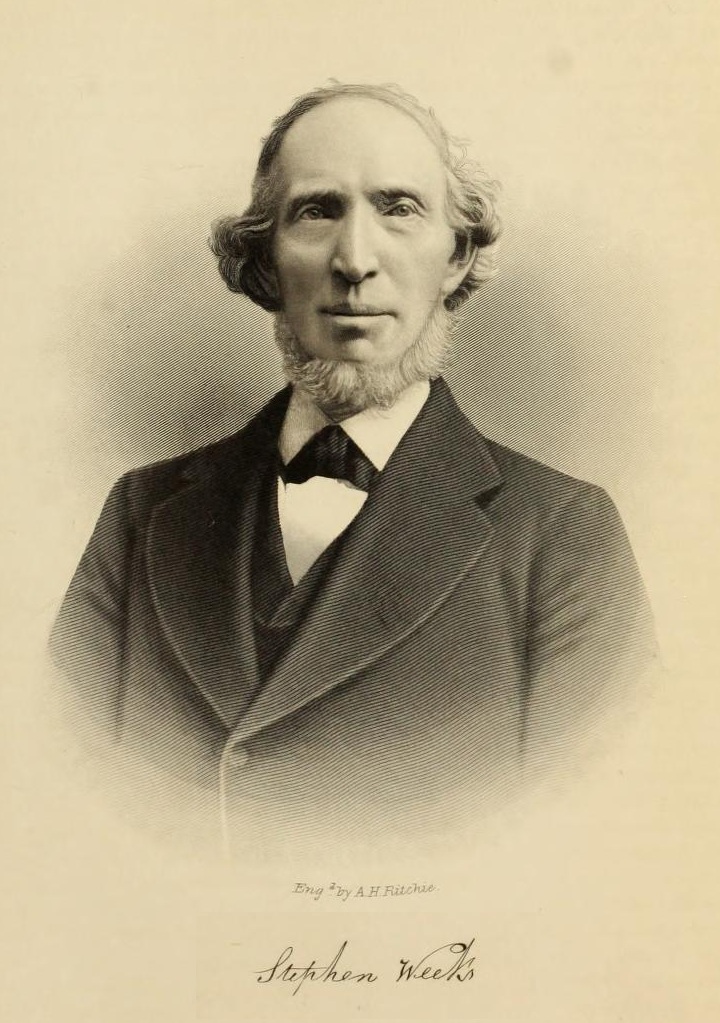 Deacon
Stephen Weeks was the son of Stephen and Betsy (Weed) Weeks, of Gilmanton, New
Hampshire and came to Loudon near 1843. He married, first, Mary A. Stevens, who
died in a short time after her marriage. Mr. Weeks married, the second time,
Elizabeth W. Haines, of Canterbury, who was an intelligent and accomplished
woman. The second marriage of Deacon Weeks resulted in a family of six children,
named Adeline, William age, Martha, Abby, Mary J. and Dora V.
Deacon
Stephen Weeks was the son of Stephen and Betsy (Weed) Weeks, of Gilmanton, New
Hampshire and came to Loudon near 1843. He married, first, Mary A. Stevens, who
died in a short time after her marriage. Mr. Weeks married, the second time,
Elizabeth W. Haines, of Canterbury, who was an intelligent and accomplished
woman. The second marriage of Deacon Weeks resulted in a family of six children,
named Adeline, William age, Martha, Abby, Mary J. and Dora V.
Deacon
Weeks, during his early life, taught several terms of school during the winter,
while any other seasons of the year he bought and sold cattle. Afterwards he
bought a farm and gave his attention to farming as a pursuit. Having been
successful in this calling, several years ago he purchased the farm upon which
the family reside, refitted the buildings and prepared it for his permanent
home. During his residence of about forty years in the town he succeeded in
laying up property amounting to over $20,000 by diligence, labor and economy. He
regarded the interest of the town as a citizen, and gave his influence always in
the direction which he considered as right and just. He was liberal in his
charity to others, whenever called upon for aid and assistance, often bestowing
without invitation whenever and wherever his feelings prompted, and never was
known to turn one away empty. His advice was safe and well matured whenever
applied for. He was of a deep religious cast of mind, a member of the Free
Baptist Church for many years was one of its deacons. His interest in his church
was large and sincere, for which he labored ardently and constantly, and being
one of the large and ready supporters of the gospel and all its wants. He was a
constant attendant, with his family, upon public worship and the Sabbath School.
His last acts in life were of beneficence. He died in January, 1885, a worthy
and is seen citizen of the town, and will be cherished in the memory of many for
the good which he has accomplished.
Contributed by T. J. Rand, extracted from 1885 History of Merrimack and Belknap Counties, New Hampshire by D. Hamilton Hurd, page 509.
Eliphalet Wood married Elizabeth Tilton in 1788. The children were named
Eliphalet, Betsy, William, Sophia, Harry, Mary, Jonathan and Julia. The Rev.
Harry Wood was a minister of the gospel and editor of the Congregational Journal
at Concord, New Hampshire during the administration of President Pierce he
received an appointment as minister to the eastern countries.
Enoch Wood,
brother of Eliphalet, was a trader at the old Wood Place, near the Dr. Tenney
corner. He was a fine penmen, and was chosen to the office of selectman and
clerk for several years. The records of the town, while kept by him, present a
handwriting that is very plain and distinct.
Contributed by T. J. Rand, extracted from 1885 History of Merrimack and Belknap Counties, New Hampshire by D. Hamilton Hurd, page 502.
Copyright © 1996 - The USGenWeb® Project, NHGenWeb, Merrimack County

This page was last updated
07/23/2026