

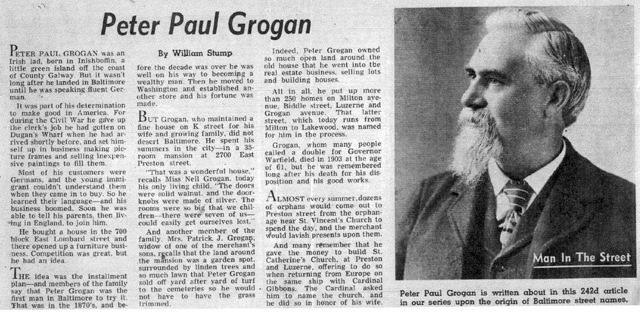
Peter Paul Grogan was an Irish lad, born in Inishbofin, a little green island
off the coast of County Galway. But it wasn't long after he landed in Baltimore
until he was speaking fluent German.
It was part of his determination to
make good in America. For during the Civil War he gave up the clerk's job he had
gotten on Dugan's Wharf when he had arrived shortly before, and set himself up
in business making picture frames and selling inexpensive paintings to fill
them.
Most of his customers were Germans, and the young immigrant
couldn't understand them when they came in to buy. So he learned their
language—and his business boomed. Soon he was able to tell his parents, then
living in England, to join him.
He bought a house in the 700 block East
Lombard street and there opened up a furniture business. Competition was great,
but he had an idea.
The Installment Plan The idea was the installment
plan—and members of the family say that Peter Grogan was the first man in
Baltimore to try it. That was in the 1870s, and before the decade was over he
was well on his way to becoming a wealthy man. Then he moved to Washington and
established another store and his fortune was made.
But Grogan, who
maintained a fine house on E street for his wife and growing family, did not
desert Baltimore. He spent his summers in the city—in a 33-room mansion at 2700
East Preston street.
"That was a wonderful house," recalls Miss Nell
Grogan, today his only living child. "The doors were solid walnut, and the
doorknobs were made of silver. The rooms were so big that we children—there were
seven of us—could easily get ourselves lost."
And another member of the
family, Mrs. Patrick J. Grogan, widow of one of the merchant's sons, recalls
that the land around the mansion was a garden spot, surrounded by linden trees
and so much lawn that Peter Grogan sold off yard after yard of turf to the
cemeteries so he would not have to have the grass trimmed.
Real Estate
and Legacy Indeed, Peter Grogan owned so much open land around the old house
that he went into the real estate business, selling lots and building houses.
Altogether, he put up more than 250 homes on Milton avenue, Biddle street,
Luzerne and Grogan avenue. That latter street, which today runs from Milton to
Lakewood, was named for him in the process.
Grogan, whom many people
called a double for Governor Warfield, died in 1902 at the age of 61, but he was
remembered long after his death for his disposition and his good works.
Almost every summer, dozens of orphans would come out to Preston street from the
orphanage near St. Vincent's Church to spend the day, and the merchant would
lavish presents upon them. And many remember that he gave the money to build St.
Catherine's Church, at Preston and Luzerne, offering to do so when returning
from Europe on the same ship with Cardinal Gibbons. The Cardinal asked him to
name the church, and he did so in honor of his wife.
If you have questions, contributions, or problems with this site, email:
Coordinator - Rebecca Maloney
State Coordinator: Rebecca Maloney
Asst. State Coordinators: Norma Hass
If you have questions or problems with this site, email the County Coordinator. Please to not ask for specfic research on your family. I am unable to do your personal research. I do not live in Maryland and do not have access to additional records.