|
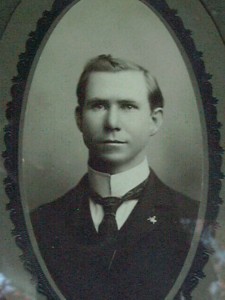
Alfred
Franklin Small
Excerpts from his journal about his adventures in West Texas
including Terry County where he purchased land from Dick Brownfield
in 1903 and, along with a partner,
W. G. Hardin, set up the town of Brownfield.
(This information
is provided by Rick Paddock, his grandson)
| Alfred Franklin Small came to the West Texas area as a young man when he
heard of a "great body of land coming on the market on the South Plains".
In his memoir of "Experiences and Observations", he tells
about the situation.
"The new law allowed one the privilege of taking up as
much as 8 sections, but at the highest bidder. The time, 4 years to pay for it
and the 3% interest rate, remained the same. I thought of going out
to the South Plains and take me up an 8 section ranch. I still had most of my $
where I could get hold of it, but when I got there I was too late.
"I landed at Stanton. Stanton was the County seat of
Martin County, also the county seat Ex-officio for several other unorganized
counties. In the list of unorganized counties, was Terry, Yoakum
and others containing the bulk of the State lands just placed on the market. When
I landed in Stanton they told me about the hot times they had just gone thru,
filing on the lands. They told it so scary it didn't sound very attractive. They
had gotten to the point of holding the door of the County Clerk's office to be
the first to file. Several would be trying to get the same land and
the first to file was the winner.
"That part of it was right. But the first one to the door would not let anyone
else ahead of him who wanted the same. Some times the one holding the door would
be caught napping or out of the chair they used, and the other fellow would slip
in and beat him to it. No one had more rights than others. It was
the one that held that chair. He had zibs on it and the County Clerk and
everyone else honored it. But when one got the chance to slide into that chair,
it was just too bad. He had it. Several scraps occurred and
some close to killings. It had gotten to this stage before I got there. When I
saw it, it didn't look at all inviting. They were still holding the door for
what land was left and I didn't try to do a thing about it. It was dangerous to
try to get in the Court House for any purpose. So I didn't try to do anything
about it. I was just too late."
Small met Ben West at this time and the two ventured west into Midland County
where they camped out and traveled through Andrews and Upton counties.
Ben's wife was a good camp cook who made delicious pies from the green grapes
they found and the men supplied the meat for their meals because there was
plenty of game...prairie chickens, quail, antelopes and rabbits. After a
while they turned north from Upton county to Gaines and Yoakum counties, then
turned east into Terry. They experienced very little
discomforts and camped out near a well on the J Cross Ranch before moving on.
"As we came east from the J Cross we found nesters here
and there and the farther we came, the more we found. We were getting back in
the settlements. Near the center of Terry County we came to the town of
Gomez. Quite a town, it was. It had so much business there that we were not
noticed. We really felt bad over our reception after having been out so long and
hadn't talked with anyone since we left Stanton. Seen hardly a man
for two weeks. We just felt that everybody ought to be glad to see us.
I learned later that Gomez was made up with people largely from Oklahoma who had
come out to get land. but being disappointed in that, they huddled down there to
make a town, and to organize the county. That sentiment didn't please the old
settlers. They didn't want the county to organize. They had had the
almost free use of the lands so long they just couldn't bear to see it settled
up. We drove on East to Lynn county which had just been organized.
The County Seat was Tahoka. They were building their first Court House. Several different businesses were going in."
An old schoolmate, W. G. Hardin, and Alfred met up once again
in Lynn county.
The two had attended a small college at Springtown in Parker County.
Hardin had a lot of information about land and what was available, after being
in Terry county. He knew of the conditions there and was
acquainted with some of the people including the cattlemen who did not want the
county organized. He said the town of Gomez fully intended to
petition the court for the right to organize and make Gomez the county seat.
Hardin proposed to Alfred Small that they buy a section of land in Terry
county, cut it up into blocks, lots and streets and name it to put into the race
for county seat. Hardin knew of some land that could be bought for
$3.00 per acre and urged Alfred to go in with him, saying
they should act at once. Although the proposition did not
immediately appeal to Alfred, he was venturous and eventually agreed to partner
with Hardin in this purchase.
"We hired a couple horses and took off for
Terry County. It was Sunday. Neither of us were used to riding horses. We made the
trip. That was OK, but the next day we could hardly walk, and didn't want to
ride at all. We rode right up to Charlie Walker's house where we
were to stay the night. He seemed to understand. It was late in the afternoon
and we hadn't had any dinner. Charlie already had company.
Mrs. Walker fixed supper and we lay around (we couldn't sit) talking about
the prospective town and the race for the county seat. It seemed to be in the
air. Everybody was talking it. There were already
two distinct factions - Gomez and its influence pushing the organization of the
County - and the cattlemen, large and small, fighting it. Things were, at
this moment, getting hot. Gomez had a post office, printing shop, school,
several business houses, lawyers, doctors and I suppose, over a hundred people. Mail hacks and freight wagons were coming and going, bringing more people and
more things daily. That was a proposition a little bit difficult to face.
Charlie Walker was one of the successful who had filed and was living on his
claim. He had a one-room house about 4 miles north of the town we hoped to
make. I said we talked but I mean that talking was done. I was too tired and
sore. Mr. Hardin was somewhat stove up too, but he didn't complain and had a way
of concealing his ails so that you'd never know there was anything wrong with
him. He talked and laughed and joked and carried on as if the trip had been a
pleasure." |
"We bought the section on July 3, 1903. We were to make a down payment of $700
and Mr. Hardin had it in his jeans. We started out Monday morning as
if we were anxious to get into the inevitable struggle. We went to see Dick
Brownfield. He had the most suitable land obtainable near the center of the
county. He said he would sell us a section with a well and windmill for $3 per
acre, but would not take any part in the town site or promoting the town.
Brownfield said we would have to go to Lubbock to make out the papers, and I was
to go with him. Mr. Hardin gave me the $700 to deliver when the title was made.
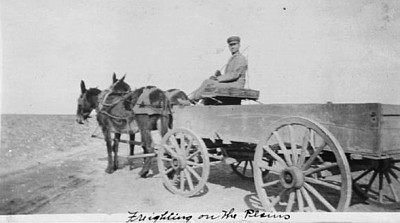
When we returned from Lubbock, we took a 100 ft. wire, went 10 miles north to an
established surveyor's corner. From that we measured with the wire and located
the 4 corners of our section. There were no surveyors, so Mr. Hardin and I used
that wire and surveyed our section into blocks, streets and alleys. That
was quite a difficult job. In order to make square corners, we had to
measure 60 ft. one way and 80 ft. another way with the full length of the
wire for a diagonal, and repeat that at every corner of every block in that 640
acres. But we did it.
"Then we named the town and the streets. We would have named the town Hardin or
Small, but there were already post offices in the state by both names and we
decided to call it Brownfield. Now we had a town, all laid off
into blocks and streets with a name 'n everything. A real town lying out there
on the prairie where the coyotes howled, the prairie dogs barked and the owls
hooted and laughed at it. That was about the only evidence of life of that to-be
town. During the first few weeks of the founding we boarded
with John Lamkin who lived on his claim adjoining the town on the north. There
were no school children there, but we proceeded to build a school house. Some of
the nesters on the east side of the county helped us and we hauled lumber from
Big Springs and put it up. While we were doing that Mr. Wm. Rippetoe had lumber
hauled out for a store. We helped him build. Mr. J. R. Hill and
family came along and stopped. He decided to locate in our town and to
build a hotel. We were growing. We helped him build the hotel. The hotel
consisted of a large room that would hold several beds and a side room to cook
and eat in. Just a boxed house."
Alfred and his partner, W. G. Hardin, soon decided that one of them should stay
in the town to see to its interests and the other should go elsewhere to work
and earn support money. They drew straws. Hardin got the long one
so he left and Alfred was alone in the new town. Alfred wrote much
of his journal about his adventures during this time.
"Other writers have written of the lonesome Plains, but
few, if any, of them ever lived what they wrote as I did........I stayed and
looked and looked and hung on, courage still up but money all gone, sitting here
writing, wondering what to do"
He finally decided to take a trip up to Amarillo and was gone for a while - much
of it an adventurous trip by train when he had no money for a ticket and kindly
strangers helped him get to his destination. Then he and Hardin
signed on for a purchase of several lots south of Fort Worth - lots which later
were of significant value to Alfred F. Small. But, now it was
time to return to their town in Terry county and they did so the first of
May, 1904.
"When we got there we found that the Gomez people
had gotten an order issued by the Court of Stanton to organize Terry County, and
had the election day set to elect the County Seat and the officers. June
28th, 1904, was to be the day. It put us on the anxious list.
All we had was invested in our town site. If we could win the County Seat,
we might have something some time. If we lost in the election, we would
have nothing. We had already given away several lots and were giving them
away as fast as the citizens called for them. But when Gomez took
that step, it fairly enraged the cattlemen. Some of them had already seen the
"hand writing on the wall", and reconciled themselves to the inevitable.
Now the thing was really coming to a focus. The fight was on.
Gomez
and Brownfield were the only contesting places for the county seat.
Interest was at a high pitch. It was a race between the new settlers and
the old ranchmen. From outside appearances they were all friends but
doing everything in their power against each other. And a campaign it was.
A hot one. It progressed with increasing intensity.
"Mr. Hardin and I had already declared
Brownfield as
our home about a year ago. We had left our trunks and things there and gotten
our poll tax receipts for that precinct. It was our home. We had no other.
But our right to vote was hotly contested. Picnics were held. Speeches
were made. Each faction mustered every available vote.
The Terry County Herald at Gomez, then owned and operated by A. W.
Long, was loaded every week with surprises, strategy, back-bitings,
threats and everything it seems, that could be done by so few people. The Herald
certainly did a big business there for a while. Lines were tightly
drawn. Advantage was taken wherever there was opportunity, or authority. Gomez had gotten the start ahead of us in the political field. The local county
deputy officers under Martin County's jurisdiction were Gomez men. The
School Trustees for the County were Gomez men. They allowed a school at
Gomez and other places, but refused it at Brownfield. Our school
house stood there ready for business, but the only business it had before the
County Seat election, was a dance now and then and a few preaching services by
Brother Groves. It stood there vacant, but the fervor of the people
was undiminished. Every man of the county was a sentinel on one side
or the other.
"The time seemed short and June 28th, election day, dawned.
All were alert, but the law hushed the riff-raff. Supervisors and guards were
picked on both sides and every box was watched with unflinching diligence. Not a telephone in the county. And the quickest news was had only by
the fastest horses and horsemen. The tension was at breaking point.
The fate that awaited some was the favor that awaited others, and when the final
count was made, we (Brownfield) were 5 votes ahead. We heard that
about 4 o'clock in the morning of the 29th. When the last runner
came galloping in with the returns of the last box which showed our victory.
Mr. Hill, the hotel man, walked out in front of the hotel and fired his gun
five
times straight up into the air. One by one the voters had dashed up
on their horses all day to vote and to learn something. Then they would set their
hat, put spurs to their steeds and off to another box. Like flitting
butterflies from flower to flower they came and went till every man, without
exception who was allowed, cast his vote. And victory was ours. I
helped hold the election at the Brownfield Box. Dick Brownfield was the
controlling officer. Charley Boone was associate Judge and Joe Lane
and I were the clerks. Joe was a red hot Gomez man, living in the
Brownfield Precinct. He challenged my vote.
"Occasionally thru the day, Joe would take his pistol and
go outdoors and shoot a few times. Heap- Bad-Man.
It was apparently done to scare us. But we laughed at him and kept
ourselves in good humor. All Brownfield - comprising Mr. Hill, Mr. Rippetoe, Mr. Hardin and myself - cast our votes and, with a few neighbors,
stayed up all night, or until we were sure of the results. Again old
Terry reigned in silence. Everyone kept his head and let the thing die.
"Returns had to be made to the Commissioner's Court of Martin County.
Dick Brownfield and I took the ballots on the two-day trip to Stanton and heard
the court as they counted the votes and declared Brownfield the County Seat.
Lucky thus far. Mr. Hardin and I had given, free-of-charge, a lot to
every citizen of Terry County who would accept it. We had given away
exactly half of our town site. Every alternate block. After the
election, we offered, further, to give every one in Gomez, a corresponding
lot in Brownfield, as near as possible, to what he had in Gomez, and move
him over free, if he would come. This offer was made for a given time. Then it
was closed. Several accepted and were moved over. Others would not,
but most of the leading business men came."
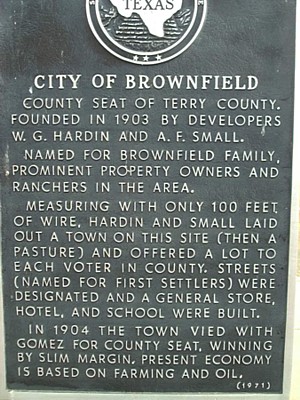
Historical Marker, Courthouse Square,
Brownfield
In 1916, Alfred Franklin Small married
Augusta Lee Roberts. He brought his bride to see the town he
founded but they never actually lived there. They lived in Tarrant
County. Alfred Small died 3 Jan 1943 in Fort Worth and Augusta Small
died 23 Feb 1966, also in Fort Worth. They are buried in Greenwood
Cemetery, Weatherford, Parker County, TX. Alfred and his wife are
gone but the story of his adventures remains with its colorful and interesting
details on life in the early days of West Texas.
Alfred F. Small
Journal
©
Rick Paddock
|
Back
to Terry County Biographies Page
Back
to Terry County TXGenWeb Home Page
|