|
Bay City Hotels
|
|
Bay-Tex Hotel The
Big House Nuckols Hotel Nuckols
House
Mayfield Hotel
|
|
Photos of Como Motel
and Starland Motel
|
|
Hotels Become Landmarks
Shortly after Bay City was founded in October,
1894, John Nuckols built the town's first hotel. Adjacent to the
two-story Nuckols House, situated on the west side of the square,
was a vegetable and flower garden.
Two additional hotels were erected that same
year. The Rowlett House, situated on Avenue F, was a two-story,
24'x60', wooden structure owned by N. H. Rowlett. In 1895 Rowlett
sold the hotel to C. L. J. Sisk. Before the turn of the century,
Sisk traded the Rowlett House to J. S. Gillett for 312 acres of land
at Big Hill.
Shortly after completion of the Rowlett House, a
third hotel was established under the management of Mrs. William E.
Austin. The Austin House was a two-story frame, L-shaped building
extending 60 feet on Seventh Street and 40 feet on Avenue E, in
addition to a kitchen. This hotel became known as the Franz Hotel,
when managed by W. R. Franz, and later as the Commercial Hotel,
under the management of Mrs. C. L. J. Sisk.
By May, 1895, Edgar P. Rugeley had built a
two-story, ten-room, L-shaped house on Avenue F, which was used as a
private boarding house. The Rugeley House later became Bay City's
first hospital and afterwards became known as the Van Shi Inn. In
1986 this house is still in use and in good repair.
By the turn of the century, two other hotels had
emerged, the Kuykendall House, under the management of Emma
Kuykendall, and the Martin Hotel, managed by a Mr. McKenn.
In 1905, John Nuckols (no relation to the Nuckols
previously mentioned), an El Campo businessman, bought the Martin
Hotel and changed its name to the Nuckol's Hotel. The Nuckols Hotel,
situated on the southwest corner of Avenue F and Sixth Street, was
one of the major hotels in Bay City until it was destroyed by fire
in 1945.
Other hotels of this era included the Mayfield
Hotel, the Baker Hotel, and the Hotel Wylie, situated on Seventh
Street and Avenue I. The First Methodist Church purchased the Baker
Hotel in the early 1950s and replaced it with a two-story brick
youth building.
By 1927 the Bay City Hotel Company had begun
construction on Bay City newest and finest hotel, the Bay Tex. This
hotel readily became the site of many social events and business
meetings. A 1934 newspaper schedule in the Daily Tribune noted that
the Chamber of Commerce met at the Bay Tex at noon on the first
Tuesday of every month. The first Rice Festival tea was held at the
Bay Tex in the fall of 1941.
In more recent times, motels have emerged in the
place of hotels. The major hotels of the area in 1986 included: Best
Western Bay City Inn, Holiday Inn, South Texas Inn, Cattlemen's,
Starland, Sunset, and the newest, Econo Lodge.
Daily Tribune, August 22, 1969
Historic Matagorda County, Volume I, 1986
|
|
Nuckols House
John F. Nuckols, built Bay City's first
hotel, the Nuckol's House, shortly after the founding of Bay City in
1894. The hotel was located on the west side of the square and had a
vegetable and flower garden adjacent to it.
The family had been living in Matagorda County
for some time. The 1860 census of Matagorda County listed a John F.
Nuckolls, age 11, living in the Hawkinsville - Kenner Prairie
area of Matagorda County with his parents Fred J.? and Mary Nuckols.
The 1870 census enumerates them as John F. and Mary A. Nuchols ages
54 and 49 and John F. and wife Ellen Nuchols ages 21 and 20 living
in Kenner Prairie. John F. Nuckols, Sr. was the postmaster for
Kenner Prairie November 17 , 1871 - December 14, 1882 and February
24, 1887 until the post office was discontinued on May 11, 1887 and
the mail was sent to Hawkinsville. The older John had died before
the enumeration of the 1880 census, and Mary, along with the younger
John's family was still living at Kenner Prairie. John F., the son,
was the builder of the hotel in Bay City. He died before the 1900
census and Ellen was still living in Bay City in 1900 and 1910 with
her daughter, Annie Benedict, and Annie's family. She died on
December 30, 1915 in Texas City and was buried in LaMarque.
|
|
Rowlett House
The Bay City Breeze, May 30, 1895 reported
the Rowlett House was a 24' x 60' wooden structure first owned by N.
H. Rowlett. who sold it to C. L. J. Sisk in 1895. Before 1900, Mr.
Sisk traded the hotel to J. S. Gillette for 312 acres of land at Big
Hill.
C. L. J. Sisk
A Good Man Who Wouldn't Stay Down
(The following was taken from an account written
by Mr. Sisk about their hotel experience in visiting Bay City in
September 1895 and buying the Rowlett House.)
Mr. N. H. Rowlett had just finished up a
small hotel and had opened it up and at that time seemed to be
doing a nice business. Mr. Rowlett's wife had tuberculosis and
the doctors advised him to take her north, so he and his friends
asked me to take the hotel off his hands at just what it had
cost him. After considering the proposition three or four days
and watching the business he was doing I decided to take the
property. In buying I assumed $1,000, he still owed on the
property.
We had only been in this business a few
weeks when I could see clearly that I had made the biggest
mistake that I had ever made in my life. I began to think
matters over in their true light. Instead of people coming in
they began to go away. A hotel, with every dollar I had on earth
tied up and owing $1,000, and with but few customers, I began to
view the situation as one of the darkest things I had ever run
up against, so I said to myself: "If I can't get some help from
back in Alabama I am sure a goner this time," so I wrote my
brother-in-law, M. T. Trice, and told him how I was up against
it and told him I wanted $500--that I wanted to start a little
store, and in this way felt sure I could pull through. He wrote
back encouragingly, telling me he thought he could let me have
this amount. Then I wrote J. S. Reeves & Co. and told them what
I wanted--that I wanted help to the amount of about $500 worth
of goods to start me up. They replied that they would help me to
that amount, so pretty good feelings came back to me. I felt
sure that with this $500 from Mr. Trice and the $500 stock from
Reeves & Co. I could start up a pretty nice little business and
pull through, so I just went ahead to prepare to begin business
and ordered the $500 stock from Reeves & Co. and wrote to Mr.
Trice to send me the $500, as I was ready to open up business.
But when I received a reply from Mr. Trice he stated to me that
money matters were very tight back there and it would be
impossible for him to furnish me.
Oh, my, when I received this word of
defeat my heart almost went out of me for I would never have
asked J. S. Reeves & Co. for the $500 if I had not felt sure of
the $500 from Mr. Trice, because I knew I could not make a
success in business here with a little stock of dry goods alone.
However, I went along and opened up the little stock of dry
goods, but soon saw it was going to be a failure, and by this
time my debts on the hotel were falling due and we were not
making anything at all in the hotel to meet them with. I did not
know what to do. I knew if I was sued and closed out on the
lumberman's lien I would lose probably every cent I had in the
world, so the only thing to do was to see if I could find some
merchant in the county to take the goods I got from J. S. Reeves
& Co. and let me have to money to pay on the hotel debt. I was
trying to save what I had already put into the property, so I
went to the manager of the Townsite Company and asked him to
help me to get some one to take the goods and let me have the
money. It was a scary time for me, as the lumberman had already
told me he would have to foreclose his lien.
Mr. Magill found a man to take most of the
stock and I gave the proceeds to the lumberman, and this seemed
to satisfy him for a while (and I want to say right here that my
wife never failed to be my partner in all of these struggles;
she never missed an opportunity to hand out lunches at the back
door to the Negroes when they came to town, and it helped out
wonderfully). Finally we paid off the $1,000 but after it was
paid out I felt just like I had nothing, although I had paid
$2,900 for the property I would rather have had $1,000 in cash
than to have had the hotel, for I knew I could take $1,000 and
make a living, but I did not see any possible chance to make a
living out of the hotel, and I do not suppose I could have
cashed the hotel for $1,000.
From the first it looked as though
everything had gone to the bad in every direction. By 1897 the
boll weevil had stuck the country and that put cotton out of
commission, so that left nothing going on but cattle business,
which is a poor business for a town or town business. It just
got to where I was compelled to make a shift, and I did not know
how to go about it. One day I said: "Wife, it begins to look
like you and I and the children will have to take a bundle on
our backs and walk out of this country and go until we can find
some work to do, for there is nothing going on here for us to
do," but finally I struck a man who owned 700 acres of land down
on the bay, eighteen miles below or south of Bay City, and I
told him I would give him the hotel property for 300 acres of
this land. We traded right away, but I felt that the land would
not help me much unless I could sell it or put it up as
collateral and get some money, as money was what I most needed.
I knew I could make a living anywhere with my wife's help.
|
|

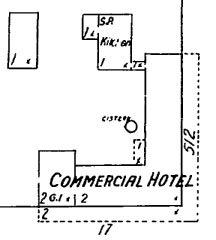
Austin House - Franz Hotel -
Commercial Hotel - 7th Street and Avenue E
Phone Number 114 in 1906
|
Two-story L-shaped frame building
extending 60 feet on 7th Street and 40 feet on Avenue E
with a kitchen. First managed by Mrs. William E. Austin,
then W. R. Franz and lastly, Mrs. C. L. J. Sisk.
|
|
Old Landmarks
Razed
One of Bay City's oldest houses is being torn down to
make room for just one more modern filling station.
The house known as the Commercial
Hotel and the first hotel the town had, was built by
Conrad Franz in 1895 and sold to C. L. J. Sisk in 1902.
The timber, which came from Florida,
was intended for Bay City's first courthouse, but after
the county-site was moved from Matagorda to Bay City,
the promoters of the townsite, G. M. Magill and N. M.
Vogelsang, conferred with the citizens and a brick
courthouse was decided upon.
The timber, however, was on the
ground and had to be disposed of. It was bought by Mr.
Franz and was used in the building now being razed.
The Daily Tribune, Tuesday,
July 22, 1930
|
7th Street |
|
|
Kuykendall House.
First-class hotel convenient to both the depot
and the business part of town. Special attention to commercial
travelers and transient trade. Special rates to regular boarders.
Miss Emma Kuykendall, Proprietor.
Matagorda County Tribune, October 28, 1904
|
|
MRS. CATES PURCHASES THE BAKER HOTEL.
Mrs. Bennie Cates of Palacios has bought the Baker Hotel from Mrs.
C. F. Baker and has opened the dining room to the public. We
appreciate this very much, as those in Bay City who have to live at
the hotels, and especially those who have been with Mrs. Baker so
long who were forced to look elsewhere for meals during the time the
dining room has been closed have had a hard time getting meals,
owing to the large crowd of teachers here last week.
Besides this, Bay City needs the place open to help accommodate the
traveling public. Mrs. Cates is not a stranger to us, as she was
born and raised in Matagorda County.
Her many friends will join in a hearty welcome to our city and prove
their appreciation by calling around and enjoying a fine dinner at
popular prices. Knowing Mrs. Cates, as we do, we feel no hesitancy
in saying she will make a success of the business.
We again bid her welcome and assure those who do not know her that
they will find a home-like hotel where she abides.
Matagorda County Tribune, September 20, 1918 |
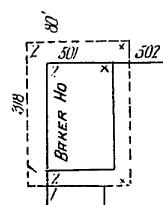
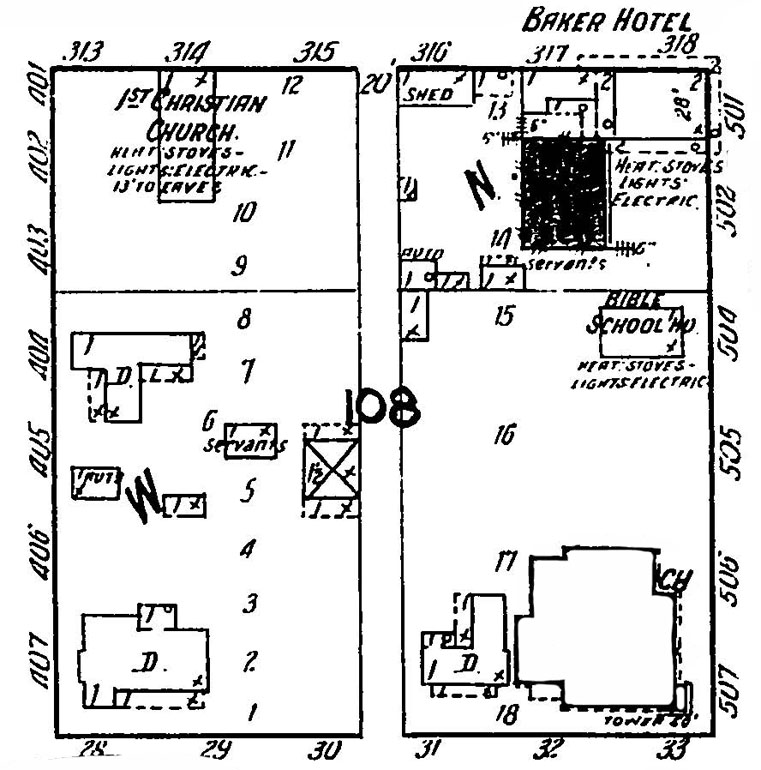
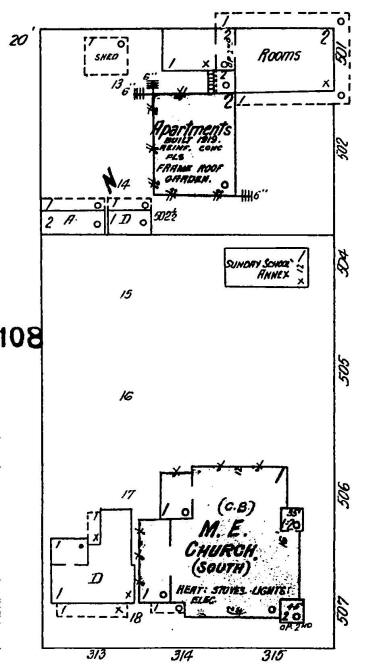
Northeast Corner of
Block 108
5th on the north & Avenue H on the east
Purchased by the First United Methodist Church
which built a Youth Building in its place
|
5th
Street
 |
5th
Street
|
|
|
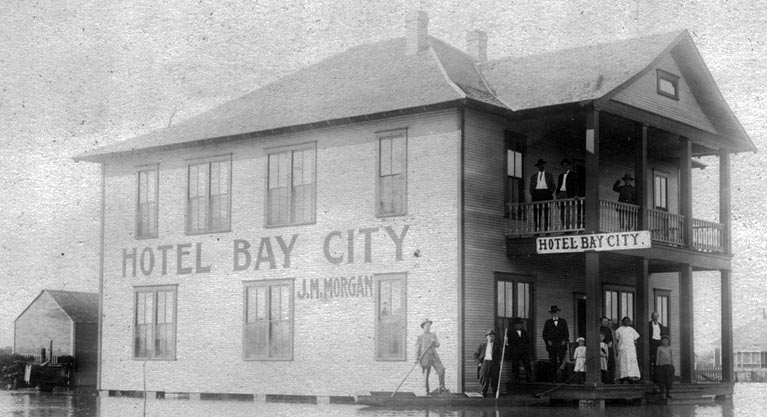
Hotel Bay City During the 1913 Flood
J. M. Morgan, Proprietor
Location Unknown
|
|
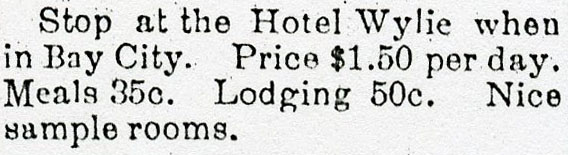
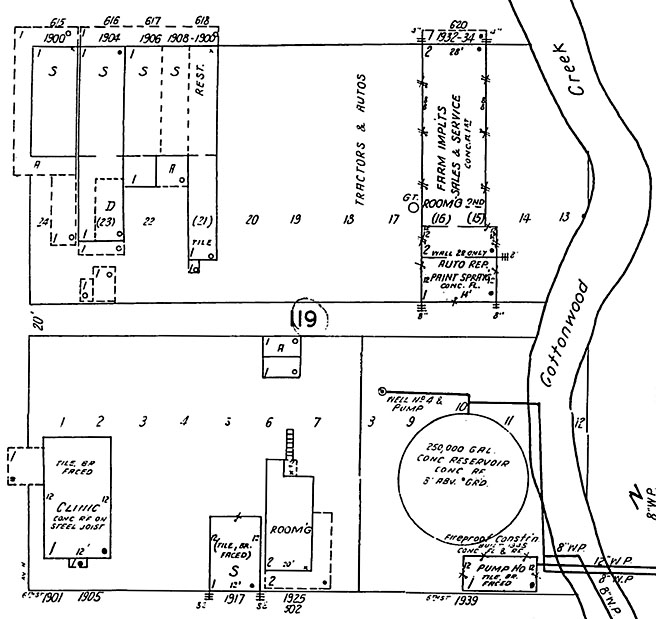
Hotel Wylie
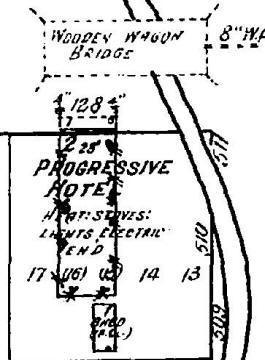
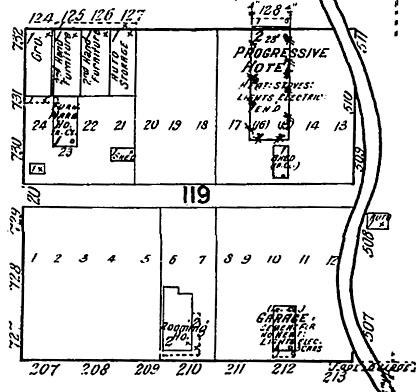
Hotel Wylie was located at 128 7th
Street on the north side Block 119 between Avenues H &
I, northeast of the site of the Odell Hotel-Stockton
House. A 1907 map indicates the site was used as Bay
City Iron Works and was Bay City Machine Shop in 1912.
The Hotel Wylie opened in November of 1913 and on a 1917
map it was labeled the Progressive Hotel.
F. G. Cobb opened an implement
business in the building and in December, 1936 sold the
business to A. R. Matthes who operated on the site as
A. R. Matthews
Implement Company.
Insurance maps in 1942 and 1947
indicated that the second floor was still used for
rooming. |
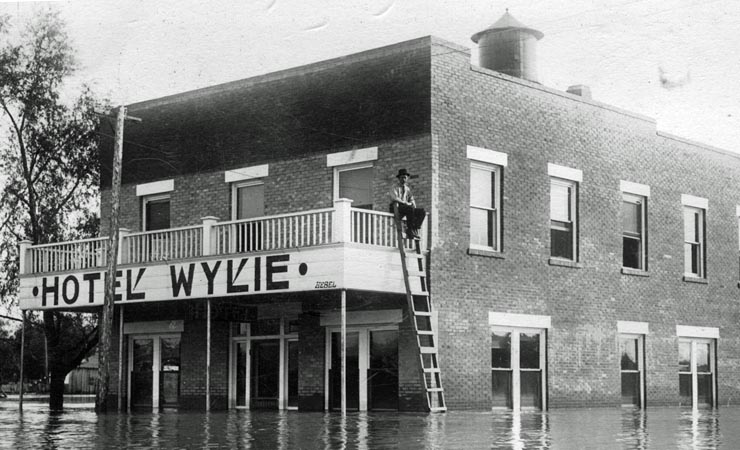
Hotel Wylie During 1913 Flood
Phone Number 143 in 1906 |
Hotel Wylie Open For Business
The new brick hotel building recently completed
for C. L. J. Sisk has been leased to Mr. and Mrs. J. T. [R.?] Wylie of
Palacios and is now open for the public's patronage.
The hotel will be known as "Hotel Wylie." The
lessees have moved to the city and are highly recommended as
citizens as well as efficient and capable hotel managers.
The Tribune, on behalf of our citizenship, extend
to these excellent people a most cordial welcome and trust that
their residence here will prove pleasant and profitable.
Matagorda County Tribune, November 21,
1913
|
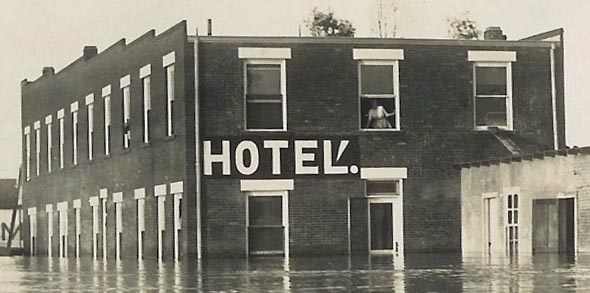
Back of Hotel Wylie During 1913 Flood
|
The flood of 1913 opened the front
door of Hotel Wylie and let Cottonwood creek right into
the foyer, as pictured here in original photograph taken
for Mr. John Sutherland. Built by Mr. C. L. J. Sisk, the
building while used as a hotel went through some more or
less hectic experiences, not the least hectic being this
flood. It should be noted, however, that since 1922 the
levee protection afforded Bay City has ended all such
flood danger. Purchased by Mr. John Sutherland shortly
after 1913, the first floor of the hotel became an
automobile show room and garage. The second floor
continues to be living quarters to this day. F. G. Cobb
owned the building before A. R. Matthes and installed in
the first floor the farm equipment business that Mr. and
Mrs. Matthes have operated since 1936.
Matagorda County Tribune, August 23, 1945 |
|
|
Death of Mrs. Elizabeth Smith
Mrs.
Elizabeth Smith died at 7:30 o’clock a. m. Thursday, the
11th inst., at the home of her daughter, Mrs.
J. R. Wylie at the Wylie house in Bay City, at the age
of 84 years and 2 months. The remains were brought to
Palacios in the afternoon yesterday, the train making a
special run for that purpose, and taken to the city
cemetery immediately after the arrival by the train,
where funeral services were held by Rev. Israel, pastor
of the Baptist church, of which…had been a
devoted…member for more than sixty years. After the
services the body was laid away in its final resting
place.
The
deceased was born in Tennessee, Oct. 11, 1929. In early
childhood she removed to Missouri with her parents, in
which state she was married to Mr. Smith in 1848. To
this union thirteen children were born, seven of whom
survive the mother—three sons and four daughters. They
are Mr. C. E. Smith of Palacios; J. J. Smith, residing
on Caney; T. P. Smith, of Goliad county; Mrs. J. R.
Wylie and Miss Sallie Smith, recently removed from
Palacios to Bay City; Mrs. J. A. Partain, of Palacios
and Mrs. Addie Coble, who lives in West Texas.
The
family moved from Missouri to Matagorda county in 1890,
locating near Ashby, where Mr. Smith died some seventeen
years ago. Four years ago the family moved to Palacios
where they made their home until a few months ago when
the Wylie family moved to Bay City to engage in the
hotel business. Mrs. Smith is also survived by one
brother and a sister and many grand-children and
great-grandchildren.
Mrs.
Smith, who has always been in good health, was taken ill
after the removal to Bay City, and the situation of the
family during the existing flood, was a matter of deep
concern to their many Palacios friends. The water is
several feet deep on the first floor of their hotel, the
family taking refuge on the second floor. The conditions
and situation are particularly trying, in which they
have the sincere sympathy of a host of Palacios friends,
who regret that they were powerless to be of active
assistance to them in this great ordeal.
Palacios Beacon, December 12, 1913
|
Matagorda County News and Midcoast
Farmer - April 24, 1914
|
| |
Progressive Hotel |
|
| |
7th Street |
|
Avenue
H |
 |
Avenue
I |
| |
6th Street
|
|
|
|
Miss Sallie Smith
Miss Sallie Smith,
daughter of James E. and Elizabeth J. Smith was born in Missouri,
December 10, 1858. In June 1866 she and her parents came to Ferris,
Ellis County, Texas, where at the age of eleven years she came to
know Christ as her Saviour and united with the Baptist Church.
The devout home life
of her parents as well as her own thorough consecration combined to
make her religious life her main business from the time of her
conversion. At the early age of nine, symptoms of paralysis were
apparent and in May 1899 a chair became necessary for the rest of
her life. She did not suffer much until her later years and was a
busy woman propelling her chair from room to room doing many
household tasks. Study, especially the Bible, was her delight from
an early age.
In 1889, with her
parents, she moved to a farm in Matagorda County near Deming’s
Bridge Church to which she was united. At that time there were three
other religious centers and Baptist Churches, Wharton, Edna and old
Matagorda besides Deming’s Bridge Church. Largely owing to the
devotion and consecration of the Smith family the Church at that
place maintained a very active life and was seldom without a pastor
and regularly had a revival in the summer of the old fashioned
pioneer type when the cattle men furnished beeves and their chuck
wagon outfits for free meals for all who came. The religious fervor
and sacrifices of early Christians puts to shame our present system
in many respects.
Miss Sallie’s chair
was loaded in the wagon along with the whole family and as she rode
along she dropped messages and scripture verses she had written
during the week. They were found by many who afterward came to
Church and some confessed they were saved by her messages.
Her child like faith
made it easy and a great pleasure for her to teach the children, so
on those preaching Sundays to which the families brought their
dinners she gathered the children about the wagon in which was her
chair and conducted a sunbeam band.
In 1906 Miss Sallie
and her mother came to Palacios and assisted her sister, Mrs. Wiley,
acting as clerk of the Wiley Hotel. Her Church membership was
transferred to the First Baptist Church, Palacios.
Of her life here,
and its high type of Christian activity, everyone knows and words
are inadequate to describe it, only Eternity will reveal its worth
to the community. Of the many nurse-girls who have cared for her in
the long years of her invalidism only one was a Christian when
employed, yet every one coming under her influence accepted her
Saviour.
For a number of
years after the Wiley Hotel closed, she conducted a kindergarten and
the children seldom left her school without a thorough foundation of
Bible Knowledge which made accepting Christ an easy step.
The B. Y. P. U.
Encampments were annual sources of joy to Miss Sallie. Many people
throughout the state will miss her chair and her friendly smile.
In talking of the
Encampment this year, she assured her friends that she hoped to
attend the heavenly meeting before that. The last years were ones of
great suffering and she anticipated her release with much longing
and joy.
We were made poorer
and Heaven became dearer when she went to be with her Heavenly
Father, Thursday morning, April 12, 1934.
She is survived by
two sisters, Mrs. J. A. Partain, Sr., of Palacios, and Mrs. M. Fiori
of San Antonio, a number of nephews and nieces and other relatives
and a host of friends.
Funeral services
were held from the First Baptist Church, Palacios, conducted by Rev.
George D. McClelland, and assisted by Rev. G. F. Gillespie,
Interment was made in Palacios Cemetery, under the direction of the
Palacios Funeral Home.
Music was furnished
by a double-mixed quartette, from the First Baptist Church composed
of Mesdames Harper, Halliday, Appleton and Feather and Messrs.
Burton, Nelson, Stadig and Forehand. They sang “Someday, It Won’t Be
Long,” “When They Ring Those Golden Bells,” “Face to Face,” and
“Rock of Ages.” Mrs. M. K. Feather accompanied on piano.
Pall bearers:
Messrs. J. A. Partain, John Richards, and John C. Richards of
Palacios; Rev. Elmer Dunlap, Gonzales; Mr. Forest Partain, Houston,
and M. C. Starup, Danevang.
Palacios Beacon,
April 19, 1934
|
|
|

|
Rice Hotel During the 1913 Flood
|
|
|
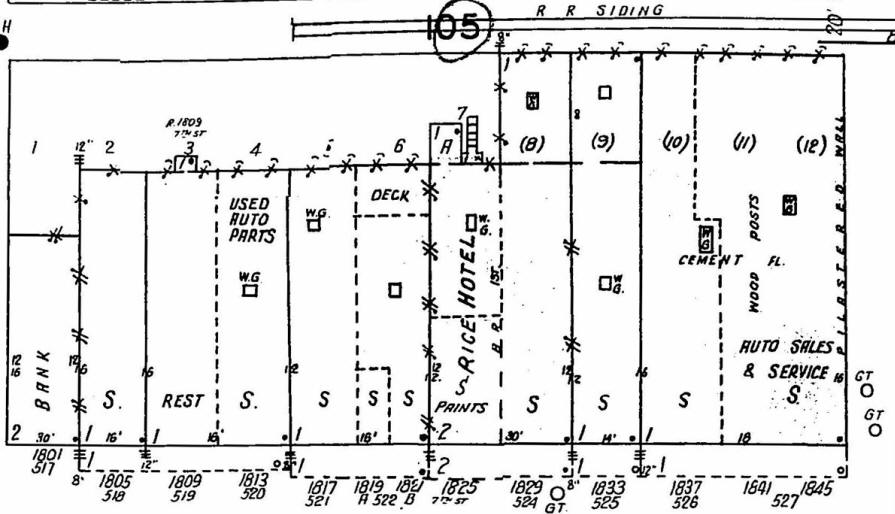
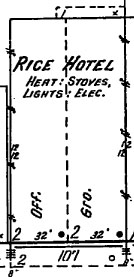
1800 Block
of 7th Street
Between Avenues G & H
2013 Buildings
Wells Fargo & Bay City Office Supply
1912 |
|
Rice Hotel Just Before Demolition |
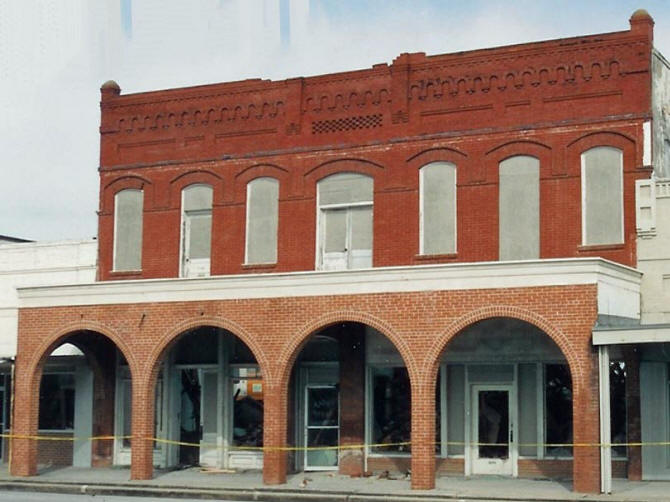
Gordon
Yates, listed as owner in the 1952 Southwestern
Bell Telephone directory
|
|
|
Mrs.
Odell's
Hotel
Meals 25¢
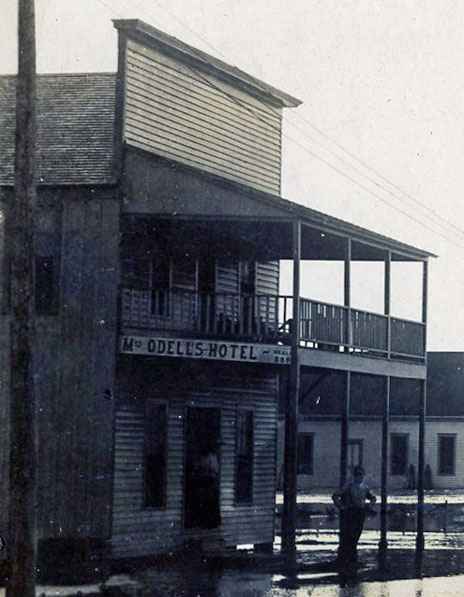 |
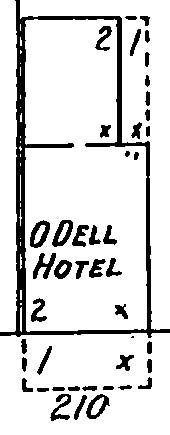
The hotel appeared on a 1907 map of
Bay City and was located on the south side of Block 119
between Avenues H and I. The address was first 210 6th
Street and later 502 5th when the street were
renumbered.
A 1912 map indicated the building was
vacant and dilapidated, but by 1917 it was again
operating as a rooming house. |
|
 |
|
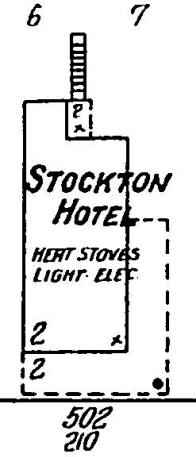
Stockton House
By 1913, the
O'Dell House was operating as the Stockton House.
The porch was extended around to the east side of
the building. In 1947 the address had become 1925
6th Street. The building was still being used as a
rooming house as late as 1947.
|
|
|

|
1913 Flood
|
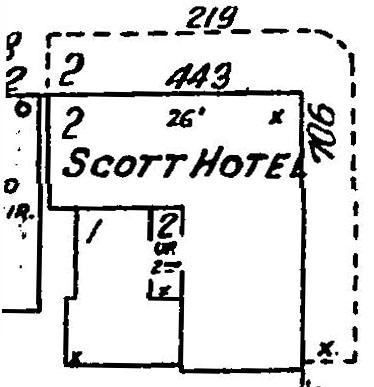
Scott Hotel
|
6th Street |
| |
|
Avenue
H |
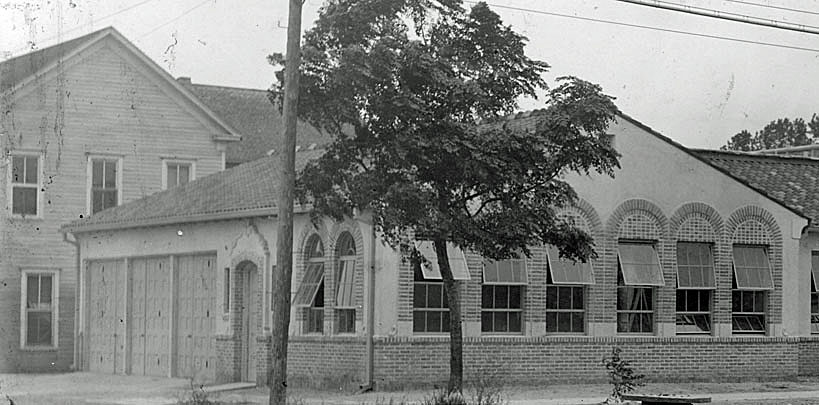
Scott Hotel at left of Bay City Fire
Station and City Hall
|
|
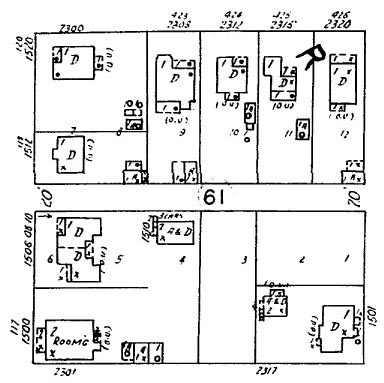
The Big House
1500 5th Street (1945
Southwestern Bell Telephone Company)
| 5
T
H
S
T
R
E
E
T |
<---------------- NORTH |
|
 |
|
^The Big House Hotel
|
AVENUE D
|
|
|
Photos courtesy of Matagorda
County Museum |