|
Courthouse |
Jackson County Courthouse 115 W. Main Edna, Texas 77957 Monday - Friday 8 - 5 |
County Clerk 115 W. Main, Room 101 Edna, TX 77957 Phone: 361-782-3563 Fax: 361-782-3132 jcclerk@co.jackson.tx.us Hours: Monday - Friday 8 - 5 |
|
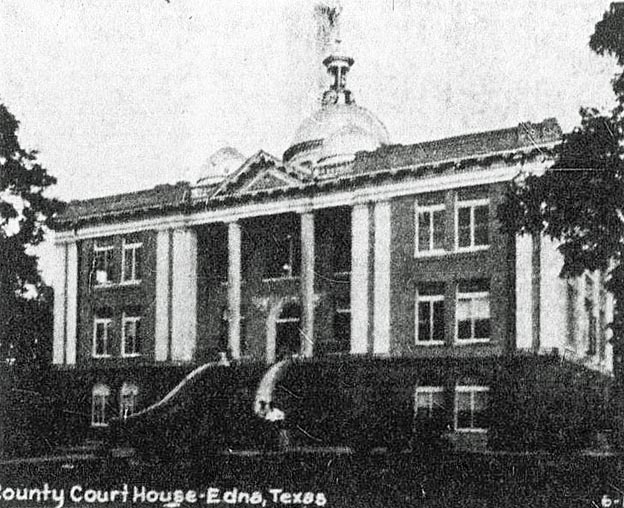
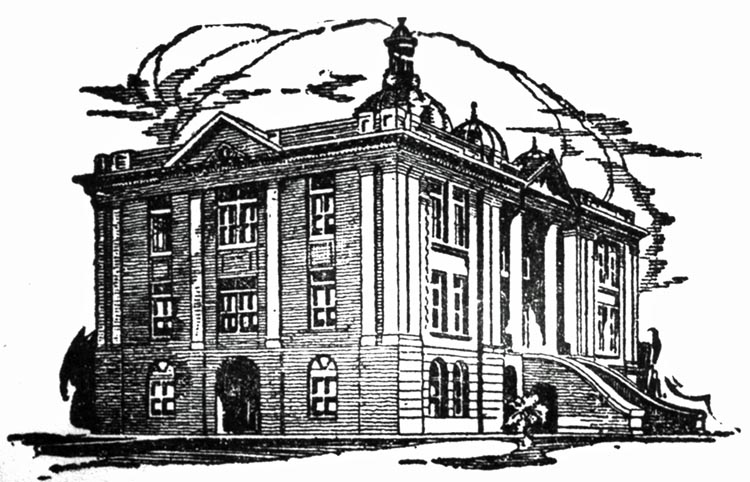
Edna, Texas, December 18.--Jackson county is to have a new court house. In the election at this place yesterday to vote on whether or not the county should issue bonds to build a new $50,000 court house, the issue carried by about 200 majority, and the people are rejoicing over the result of the election. Jackson county had the misfortune of losing its court house by fire about five years ago and since that time has been without one.
Houston Post, December 19, 1904 |
|
|
|
|
|
|
|
|
|
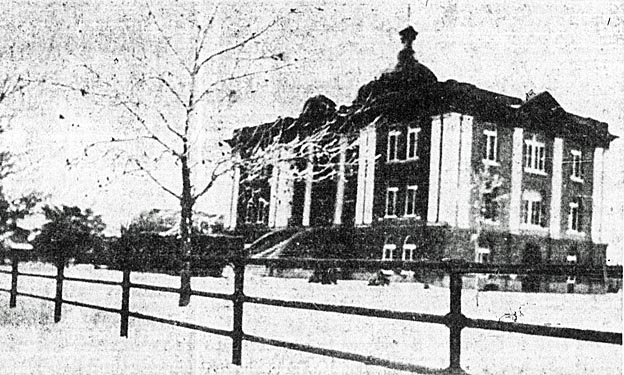
A sleet storm on December 19, 1924, gave the staid old
courthouse this mantle of white. It sleeted for 18 hours and
then remained on the ground for two weeks longer. Everyone had a
good time, of course, but only one by, Dolly Petrick, was able
to skate on the ice. He skated on the courthouse lawn. Note the
fence around the square. |
|
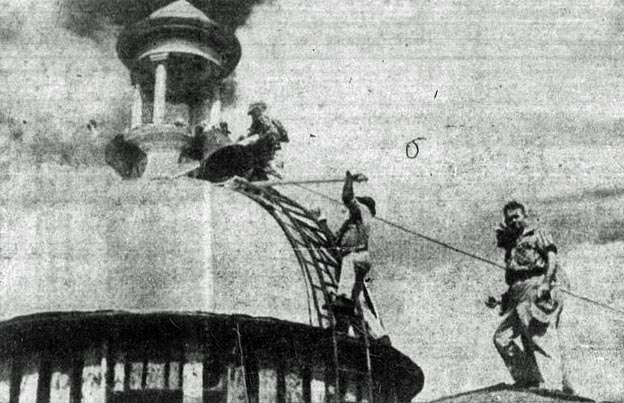
Courthouse Bell Rings At Falfurrias FALFURRIAS The First Methodist Church here now has a fine, half-ton bell to ring Sundays and therein lies a story of a tale of two cities with some good neighborliness thrown in. About four years ago the Methodists began using their attractive Austin stone sanctuary but there was no bell. Some people, in fact, got the notion that the opening left for later installation of the bell was simply part of the architecture, the Rev. Leo F. Ross, pastor, said. But on a Sunday this month the bell was dedicated and put into use although some adjustments must yet be made. Vital Role A vital role in securing the bell was played by K. B. “Swede” Rosene. He is a Presbyterian, incidentally. The story is that Rosene holds the plumbing contract for the new Jackson County Courthouse at Edna and while there noticed the tarnished bell from the old courthouse. He thought of the Methodist Church back here and notified one of its laymen, Jens Nielsen. Shortly afterward the bell was purchased for $200. A day later, Ross said, bell collectors were trying to get the bell for as much as $1,000. The bell, described by Ross as being of the same design as the famed Liberty Bell though weighing only half as much, is described as containing about $400 worth of bronze and silver. It was cast in 1906 by Baltimore's McShane Bell Foundry for the courthouse at Edna. M. S. Calhoun and Otis Gold man were responsible for transporting the heavy bell to the church site here. Plenty of Polishing Sledge hammers were needed to free the clapper, which strikes the side of the bell to furnish the sound, and plenty of polishing was required. A historical sidelight came while Ross was in front of the church shortly after the bell arrived. H. B. DeVille, a Falfurrias resident, passed by and noticed the bell. He learned that it was from the Edna courthouse and recalled that as a boy there, in about 1909, he heard the bell. Ross learned that the bell was rigged to a clock which timed a hammer to strike the bell every half hour.
Now the bell is a memorial to R. C. Jobe, a church member who
died recently. Donations are being accepted and a bronze plaque
in this connection will be put in the sanctuary. |
 |
|
Information from Edna
Herald Souvenir Courthouse and Oil Edition, October 7, 1954 |
|
June 19, 1952 - Campaign for new courthouse launched publicly in The Herald. Meetings of Jackson County C. of C. Courthouse Committee, the late Dr. R. E. Lee, chairman, held regularly. Earl Frels later became the chairman at the death of Dr. Lee. July 28, 1952 - Architect advisory committee named by Commissioners' Court. Oct. 2, 1952 - Petitions circulated for courthouse bond election. Oct. 9, 1952 – Courthouse bond election ordered for Nov. 4, 1952. Oct. 13, 1952 - Architect F. Perry Johnston retained. Nov. 4, 1952 - People of county voted, 2,233 to 766, for a new courthouse. April 20, 1953 - Contract on courthouse let to J. B. Hughes of Brownsville. May 1, 1953 - Actual construction on courthouse begins.
May 30, 1954: New courthouse occupied. |
|
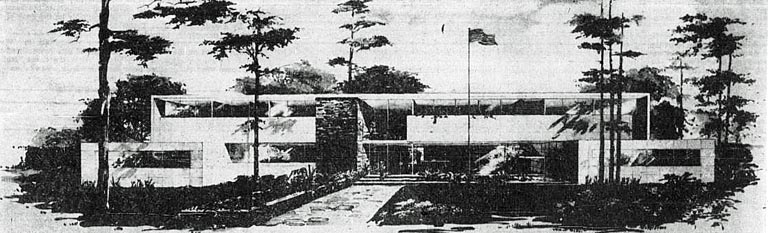
This architect’s drawing of the new Jackson County courthouse
shows the modern lines of the $500,000 structure. F. Perry
Johnson of Houston was the designer. A few changes were made in
the final plans, but essentially the drawing shown here is that
of the new structure. Principle changes noted here are the
elimination of windows in the first-floor wings on either side
of the front. These are now solid brick walls. A solid wall also
hides the steps that can be barely seen at the right of the
flagpole on the ground floor. |
|
"You are going to have the show place of Highway 59 between Houston and Corpus Christi." That's what contractors who bid on the new Jackson County courthouse said at the time of the bid opening over a year ago. Today, with the modern $500,000 structure completed and occupied and ready for dedication, everyone who sees it attests to this prophecy. It's truly one of the most modern and functional courthouses in the state. Designed by F. Perry Johnston of Houston and constructed by J. B. Hughes of Brownsville, the two-story edifice was voted by the people on November 4, 1952. The bond issue called for $410,000, the estimated cost of the building alone. Funds for fixtures and other incidentals were to come from an accumulated permanent improvement fund saved by the county over the years that had amounted to around $95,000. The people, thanks to a campaign waged by the Jackson County Chamber of Commerce Courthouse Committee and The Edna Herald, voted for the bond issue, 2,233 to 766. This astounding in view of the fact some two years before a similar bond election was defeated by three or four to one. The contract price was $377,000, but with the fixtures, architect's fees and landscaping and other incidentals the complete cost will run around a half million dollars. The building was about a year in the making. The building is functional in that there are no frills and extras with every available foot of space utilized. All offices have ample space with most of them having space for expansion as the county business grows. This is quite unlike the old courthouse, which had grown too small many years ago. In fact, the floor areas of the new building is more than double that of the old. There is no jail in the new structure, as some courthouses have, but there is a hold-over cell adjoining the sheriff's department. A narrow stairs leads from this cell to the district courtroom. The most used offices in the courthouse--the county clerk's and the county tax assessor and collector's offices--are on the ground floor of the two-story building. Other offices on the first floor include the sheriffs department, Public Welfare, county health nurse, the public library and county school superintendent and the justice of the peace. The ladies' lounge and men's rest rooms, both for negro and white, also are on the first floors, just off the main lobby. The air-conditioning equipment room is also on the first floor. The building is cooled by 95 tons of air-conditioning equipment. A separate air-condition machine cools the large district courtroom, since this room is not used daily. Offices on the second floor, in addition to the district courtroom, include the smaller county courtroom and commissioners' office, the county judge, the county attorney, a private conference room (later to probably be used as a county library), county auditor and county treasurer, reception rooms for them all, a large storage room for the tax assessor and collector, the district clerk two jury rooms and a private office for the district judge. Rest rooms also are available on this floor. One of the jury rooms has showers and clothes closets for jurors who must remain in session over night. An elevator leads to the second floor. It is an automatic elevator, even opening and closing the doors automatically. Stairs with aluminum rails are on either end of the building. Raised aluminum letters mark each office door, and a directory is located along the ledge-stone wall in the main lobby. Two large bulletin boards also may be found in the lobby. There are two ice water fountains in the building, one on each floor, and electric clocks are available in many of the larger rooms. A huge aluminum dial clock also is on the front of the building. The building is fire proof, except for the mahogany doors. The brick is pink Roman, and the stone work is architectural stone. There is ample ledge-stone work, especially on the pylon in front of the building. A ten-foot concrete sidewalk leads to the main entrance and five foot walks go to the two side entrances. A six-foot walk has been constructed on three sides of the building. A four-foot walk is located in the rear and leads to a large concrete parking apron.
The benches are located on concrete slabs to avoid damage to the
carpet grass. Similar slabs are around each parking meter for
the convenience of parkers. |
|
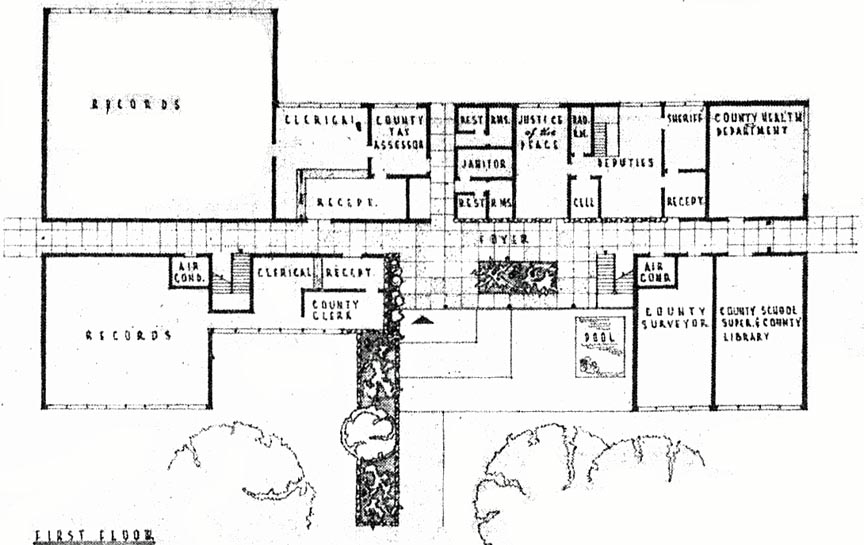
First floor, as shown in the original drawings, appeared like
this. Those who have visited the new courthouse can note some
changes from these original plans. The records room at the top
left is not that large. The justice of the peace room is down
with the library and the county surveyor is upstairs. There is
no reflection pool (it was eliminated because of danger).
Otherwise, this floor plan is about as it really is. |
|
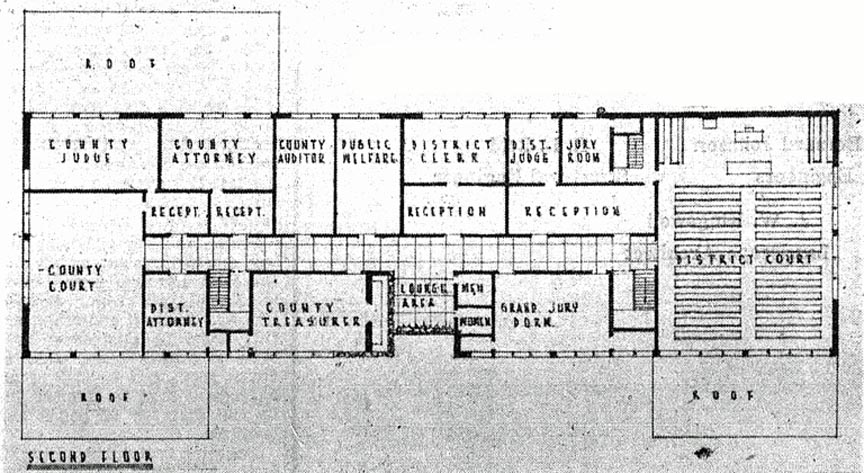
Second floor, shown in this original drawing, also has some
changes. There is a county law library (now being used as a
conference room) where a part of the county attorney’s office is
shown. The county auditor is across the corridor next to the
county treasurer and about where the district attorney’s office
is located. The public welfare space is a storage space for the
tax assessor and the district judge and jury room are reversed.
Otherwise, the plan also is fairly accurate. |
|
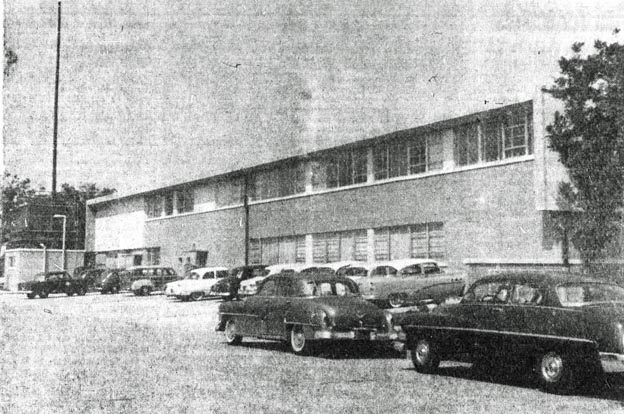
The rear view of the courthouse shows the large parking apron
that will take care of some 55 autos. The air-conditioning tower
is at the far left. Beneath it are storage quarters for janitor
supplies. The pole above it is the police radio tower. (Herald
photo by Evans) |
|
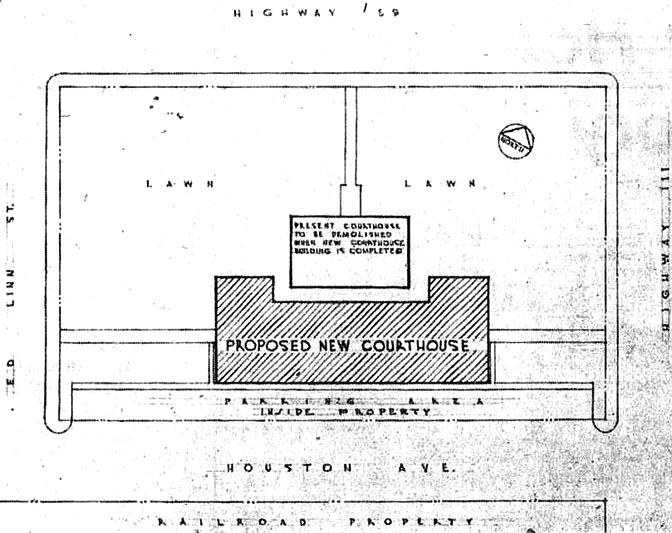
A comparison in size is shown by this drawing of the site of the
old and the new courthouses. This drawing was made by the
architect several months ago. The only thing changed was the
parking space in the rear of the new building. It was confined
indirectly back of the building and not the entire length of the
block. |
|
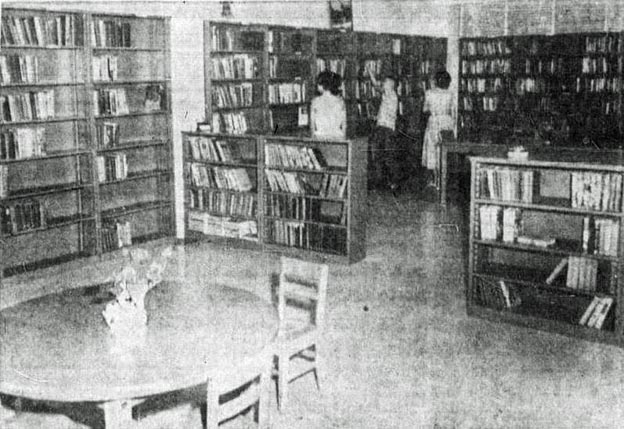
A visit to the library of the new Jackson County Courthouse is
shown in this photo. It’s really not the county’s library, even
though the county furnished quarters for it. The library is
sponsored by the Eleanor Brackenridge Literary Club of the
county. It’s a public library and the general public is invited
to make use of its facilities. (Photo by Nelson) |
|
|
 Floyd Afton Reeves at the Jackson County Jail 1920s Courtesy of John A. Reeves |
|
|
|
|
 |
 |
|
Copyright 2018-
Present by Carol Sue Gibbs |
|
| Created Apr 26, 2018 |
Updated Apr 26, 2018 |