Ciaccio
Family
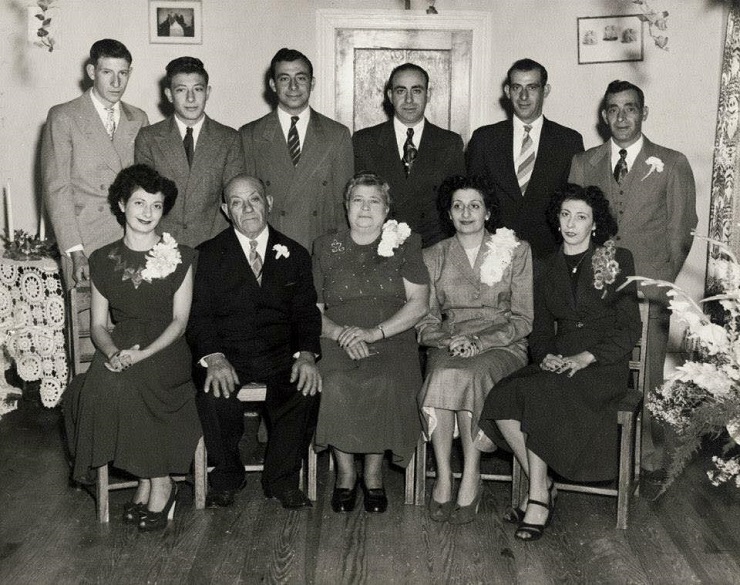
Back
row:
Sam Ciaccio, Bonnie Ciaccio, Nick Ciaccio,
John B. Ciaccio, Philip Ciaccio, George
Ciaccio
Seated: Georgia Ciaccio Schmidt, Joseph
Ciaccio, Lena Siragusa Ciaccio,
Josephine Ciaccio Hutchman, Carmen
Ciaccio Hood
granddaughter of John B. Ciaccio
Denison Herald
August 9,
1992
Telling Our
Stories
Italian
Heritage from Sicily to Denison
by Nick F.
Ciaccio
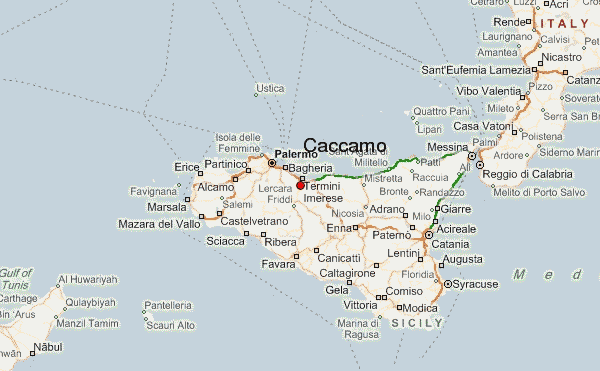
Both my parents came to America from
Caccamo, Sicily, near Palermo, Italy.
Papa came first
and settled in Kansas City, Kansas.
Mama was a small child when she came
with her parents, who also went to Kansas
City. Papa was working for the Union
Pacific railroad on the section gang from
Kansas to Denison, Texas. Grandpa also
found employment with the Union Pacific.
They worked together for many years
and Grandpa really liked Papa. It was
customary for parents to select the spouses
for their children.
There were
some requirements:
1. to
be gainfully employed for at least one year,
and
2. to
believe once wed to was "til death do us
part and for better or worse."
Needless to
say, Papa had been with the Union Pacific
for several years, and apparently he met the
second requirement well. They were
married nearly sixty years and raised nine
children, six boys and three girls.
Grandpa and
family moved to Denison, but Papa's
intention was to earn enough money to return
to Italy. The grandparents, however,
had a different opinion. Their
daughter was not to go. After a few
choice words and some tears, the
grandparents won.
Papa and Mama
then moved to Denison. They settled in
the northeast part known as "Dago Hill."
Many of their relatives and friends,
whose surnames included Latona, Bennitti,
Siragusa, Weda, Pace, LaBella, Savano,
Pistolo, Natasi, Isolano, Gagliano, Faso,
and Giarraputo,
were already settled there. I was the
first to be born in Texas. Three
brothers and two sisters had been born in
Kansas.
I remember as
a small boy the big "family dinners."
Grown-ups would tell of life in the
old co untry. Conversation was in
Italian. We young ones understood but
would respond in English. I guess we
were trying to teach each other the language
we knew best. Papa told of arriving in
America. They docked at New York and
were kept for a time on Ellis Island.
Their papers had to be processed and
also they had to have a physical.
Anyone with an eye problem or other
disease was sent back to the old country.
Some would jump ship in order to stay
in America. He said the trip over the
ocean was rough. He would wrap his
head in a sheet and lay on the floor to keep
from becoming seasick, and that still did
not help much.
Many Italians
from Sicily were attracted to Texas because
of the opportunity to buy and farm their own
land. They contributed much to the
agricultural development of the state.
Some of them worked on the railroad,
in construction, in the ice cream business
or candy making, but most made their living
from the land. The soil was very
precious to these people.
Papa and Mama's intentions were no
different. They bought 130 acres of
land east of Denison. We moved into a
four room house that was vacated by a black
family - the previous tenants. We had
very few farm implements - a turn plow, a
double shovel, a home-made harrow, one horse
and one mule. There was very little
flat land on the farm, mostly hills and
gullies. The terrain was much the same
shape as the land Papa left behind in
Sicily. We had a few cows and pigs,
but our main source of income was truck
farming. Papa and the older boys did
the heavy work, while the older girls and
younger boys picked greens, okra, beans,
onions, etc. Work was every day with
cows and pigs to feel and the milking twice
a day. We sold milk for five cents a
quart. In the winter time with snow on
the ground, Papa would cut a tow sack in
half and wrap it over our shoes. The
path to the milk barn was covered with what
resembled giant bear tracks.
Mama made her own yeast for the bread and
pasta for cooking. She made jellies
from the wild grapes and plums gathered
along the Red River. The mustang
grapes were excellent for homemade wine,
which our friends called "Dago Red."
Bread was baked in an outside "furno"
(oven) that Papa had built from stone
gathered from the farm. You could
smell bread baking for blocks away, and we
always had visitors about the time bread was
ready. They knew there would be a loaf
for them to take home.
Each house had a cellar underneath that was
perfect for storing canned good and fresh
produce. Also there was a small,
separate wine room, which was off limits to
younger members of the family. Washing
clothes was done by using a scrub board and
#3 washtub. Drying was on a makeshift
clothesline and the nearest fence. We
cooked and heated with wood. We cut
wood from the nearest forest and on land we
also rented. All we had for
woodcutting was a crosscut saw and a double
bit ax. We sold firewood for five
dollars a cord (delivered).
In 1936 we decided to build a new house.
The old one was just too small because
we had three new additions to the family and
we had grown quite a bit. Building had
to be accomplished in our spare time.
Farm work and tending livestock came
first. Until this day I don't know how
we managed the building, as we had no spare
time. One neighbor was a carpenter,
and with his help Papa, we boys, and some
neighbors built the house. The outside
was of stone taken from the farm land.
Papa had that idea from the old
country, because in Italy almost every
building is stone or brick.
Most of the Italians who settled in Texas
brought with them a religious custom, the
Feast of St. Joseph, celebrated on March 19.
St. Joseph is the patron saint of
Italy, particularly of Sicily. Dishes
for the feast had to be prepared from fish,
pasta, eggs, and vegetables. Since the
Feast is during Lent, no meat is allowed.
Fancy cakes and breads were decorated
by the women, who worked for days preparing
food. Some breads were in the shape of
saws, hammers and other carpentry tools
since St. Joseph was a carpenter.
When World War II started, we four older
boys went into the military service.
Mama prayed a lot and promised to make
an altar if all her sons could come home
safely. Fortunately, we all returned.
Papa and we boys erected an altar at
one end of the long room. It was
decorated with white satin. For its
dedication all kinds of bread and dishes
were prepared, and our neighbors and friends
joined us on this occasion. We all
gave thanks to our dear Lord. After
the feast, the remaining food was given to
the needy.
Papa and Mama are now gone, as are my three
older brothers. We still have the farm
but it is no longer a truck farm.
There's a few cows and horses, but it
is mostly for memories and recreation for
the younger generation.
I believe we need to give thanks to
Christopher Columbus for his contribution to
this country. Many ethnic groups have
migrated to this great land of opportunity,
and each one has made a special
contribution. As I have grown older, I
realize what a debt of gratitude we owe to
all immigrants that came to this country,
not knowing what a challenge they had to
meet. Leaving their families must have
been a trying experience. But with
faith, hope and love they strove for a
better life in an unknown land. From
our ancestors we should learn a great lesson
of determination and perserverance and pass
it on to the next generation.
Together we truly have America, a government
for the people and by the people. I am
honored to be a citizen of these United
States of America and am equally proud of my
Italian heritage. I firmly believe we
learn from each other and, as the saying
goes, "Life is not measured by the years we
live, but by the deeds that we do and the
love that we give."
|