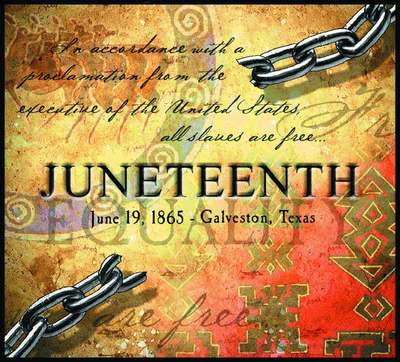
On June 19
("Juneteenth"),
1865, Union general
Gordon Granger read
the Emancipation
Proclamation in
Galveston, thus
belatedly bringing
about the freeing of
250,000 slaves in
Texas. The tidings
of freedom reached
slaves gradually as
individual
plantation owners
read the
proclamation to
their bondsmen over
the months following
the end of the war.
The news elicited an
array of personal
celebrations, some
of which have been
described in The
Slave Narratives of
Texas (1974). The
first broader
celebrations of
Juneteenth were used
as political rallies
and to teach freed
African American
about their voting
rights. Within a
short time, however,
Juneteenth was
marked by
festivities
throughout the
state, some of which
were organized by
official Juneteenth
committees.
The day
has been celebrated
through formal
thanksgiving
ceremonies at which
the hymn "Lift Every
Voice" furnished the
opening. In
addition, public
entertainment,
picnics, and family
reunions have often
featured dramatic
readings, pageants,
parades, barbecues,
and ball games.
Blues festivals have
also shaped the
Juneteenth
remembrance. In
Limestone County,
celebrants gather
for a three-day
reunion organized by
the Nineteenth of
June Organization.
Some of the early
emancipation
festivities were
relegated by city
authorities to a
town's outskirts; in
time, however, black
groups collected
funds to purchase
tracts of land for
their celebrations,
including
Juneteenth. A common
name for these sites
was Emancipation
Park. In Houston,
for instance, a deed
for a ten-acre site
was signed in 1872,
and in Austin the
Travis County
Emancipation
Celebration
Association acquired
land for its
Emancipation Park in
the early 1900s; the
Juneteenth event was
later moved to
Rosewood Park. In
Limestone County the
Nineteenth of June
Association acquired
thirty acres, which
has since been
reduced to twenty
acres by the rising
of Lake Mexia.
Particular
celebrations of
Juneteenth have had
unique beginnings or
aspects. In the
state capital
Juneteenth was first
celebrated in 1867
under the direction
of the Freedmen's
Bureau and became
part of the calendar
of public events by
1872. Juneteenth in
Limestone County has
gathered "thousands"
to be with families
and friends. At one
time 30,000 blacks
gathered at Booker
T. Washington Park,
known more popularly
as Comanche
Crossing, for the
event. One of the
most important parts
of the Limestone
celebration is the
recollection of
family history, both
under slavery and
since. Another of
the state's
memorable
celebrations of
Juneteenth occurred
in Brenham, where
large, racially
mixed crowds witness
the annual promenade
through town. In
Beeville, black,
white, and brown
residents have also
joined together to
commemorate the day
with barbecue,
picnics, and other
festivities.
Juneteenth
declined in
popularity in the
early 1960s, when
the civil-rights
movement, with its
push for
integration,
diminished interest
in the event. In the
1970s African
Americans' renewed
interest in
celebrating their
cultural heritage
led to the
revitalization of
the holiday
throughout the
state. At the end of
the decade
Representative Al
Edwards, a Democrat
from Houston,
introduced a bill
calling for
Juneteenth to become
a state holiday. The
legislature passed
the act in 1979, and
Governor William P.
Clements, Jr.,
signed it into law.
The first
state-sponsored
Juneteenth
celebration took
place in 1980.
Juneteenth
has also had an
impact outside the
state. Black
Texans who moved
to Louisiana and
Oklahoma have
taken the
celebration with
them. In 1991 the
Anacostia Museum
of the Smithsonian
Institution
sponsored
"Juneteenth '91,
Freedom
Revisited,"
featuring public
speeches,
African-American
arts and crafts,
and other cultural
programs. There,
as in Texas, the
state of its
origin, Juneteenth
has provided the
public the
opportunity to
recall the
milestone in human
rights the day
represents for
African Americans.
BIBLIOGRAPHY:
Randolph B.
Campbell, "The End
of Slavery in Texas:
A Research Note,"
Southwestern
Historical Quarterly
88 (July 1984).
Doris Hollis
Pemberton,
Juneteenth at
Comanche Crossing
(Austin: Eakin
Press, 1983).
Vertical Files,
Barker Texas History
Center, University
of Texas at Austin.
William H. Wiggins,
Jr., O Freedom!
Afro-American
Emancipation
Celebrations
(Knoxville:
University of
Tennessee Press,
1987). David A.
Williams, The
Emancipation
Proclamation of 1863
and the Emancipation
Proclamation, Texas
Style (June 19,
1865) (Austin:
Williams Independent
Research
Enterprises, 1979).
Teresa
Palomo Acosta
Recommended
citation:
"JUNETEENTH."
The Handbook of
Texas Online.
U.S.
President Joe Biden
on Thursday, June
17, 2021, signed
into law an act
designating June 19
as Juneteenth
National
Independence Day,
making it a federal
holiday.
Major General Gordon
Granger rode into
Galveston, Texas on
June 19, 1865 to
spread the news of
the Emancipation
Proclamation
outlawing slavery -
law President
Lincoln had signed
more than 2 years
earlier.
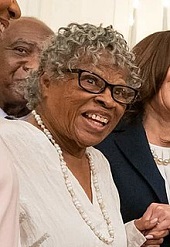
Ms. Opal
Lee worked for
decades to make
Juneteenth an
official holiday
after joining
Tarrant County's
Black Historical and
Genealogical
Society. She
started with a
walking campaign in
cities along the
route from her home
in Ft. Worth, Texas
to Washington D.C.
She stopped at
cities where she had
been invited to
speak and walk 2.5
miles to symbolize
the 2.5 years it
took for enslaved
people in Texas to
learn they were
free. She has
become known as the
"Grandmother of
Juneteenth".
Her paternal
great-grandmother
had been born in
bondage in Louisiana
|