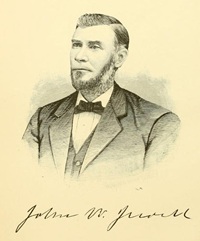
EWELL, John Woodman
John Woodman Jewell, son of Milton and Nancy (Colley) Jewell,
was born at Bow Lake, Stratford, N. H., July 26, 1831. His
paternal grandfather, Simeon, was born in Brentwood, N. H., July
20, 1776; married Jane French (born in Salisbury, Mass., Oct.
28, 1766, died at Sanbornton, N. H., Jan. 11, 1838) at
Deerfield, N. H., May 19, 1796, and soon afterward settled in
Northfield, N. H., as a farmer. After some years' residence
there he moved to Sanbornton, where he died at about the age of
sixty-six years, Sept. 10, 1832. He left four children, — John,
Milton, Betsey, and Samuel F., — and was known and prized for
his probity and quiet, unassuming honesty and rectitude. His
son, Milton, was born in Northfield, July 2, 1803. When about
eighteen, Milton was apprenticed to learn the business of
tanning and currying, after acquiring which he worked for a few
years in Deerfield at his trade. In 1828 he came to Strafford,
located at Bow Lake, and established a tannery there, with which
he coupled the manufacturing of boots and shoes. He prospered in
business until 1832, when the large dam of the Cocheco
Manufacturing Company, at the outlet of Bow Lake, gave way, and
his property was almost entirely ruined by the flood of escaping
water. After this event he only followed his trade in a small
way, but continued doing something until 1865, when, his health
growing very poor, he closed his business, and June 4, 1869,
passed away, leaving to his descendants the record of an
untarnished name. He married, Dec. 24, 1830, Nancy, daughter of
Richard and Sarah Colley, of Madbury. She was born May 3, 1808,
and died in Barrington, April 7, 1880. Their nine children were
John W., Hannah E. (died young), Mary J. (Mrs. Wingate T.
Preston, of Barrington), Asa W. (superintendent of water for
Cocheco Manufacturing Company, at Dover), Charles M. (deceased),
Cyrena T. (deceased), Enoch T. (deceased), Betsey A. (deceased),
and Samuel F., of Barrington. Mr. Jewell was an unyielding
Democrat. Both he and his wife were for years valued members of
the Free-Will Baptist Church, and he was universally known as
one of the most benevolent of men, and an accommodating
neighbor. His honesty was so rigid as to make him almost unjust
to himself. Pleasant and social in his intercourse with all, he
was highly esteemed.
John W. Jewell early learned to labor. When but five years old he was tied in a chair and set to drive a horse to grind bark in his father's tan-yard, and from that day onward he has never shrank from earnest discharge of such of life's laborious duties as have fallen to his lot. He early and thoroughly learned his father's trade. When he was eighteen, his father consenting, he commenced working for himself on a farm. After a short time he was taken ill, and returned home. The next spring he expended the money he had then earned in attending Gilmanton Academy. Then for three successive summers he worked in a steam saw-mill, teaching school during the winter, and in the spring and fall attending Strafford Seminary (now Austin Academy) and Gilmanton Academy. In 1853 he went to Newmarket as "second hand" in the cloth-room of the Newmarket Manufacturing Company, but soon went to Manchester, whence in a very short period of time he returned to Newmarket, and spent one year as clerk for S. A. & B. F. Haley, merchants; then, at the urgent request of Hon. B. W. Jenness, the leading business man of Stratford, he entered his employ, and remained with him until 1864, when Mr. Jenness removed to Ohio, and Mr. Jewell purchased his stock of goods at Bow Lake, and has been since, and now is, the leading merchant of the town.
He has been successful and popular. His counsel has been valued and sought in every important matter in town for years, and his cautious and at the same time progressive advice has been of public and private benefit. He is one of the standard-bearers of the Democracy of this section, and has often been honored by political trust. He has been moderator, superintendent of schools, and selectman. He represented Strafford in the State Legislature of 1862, and was sheriff of Strafford County from 1874 to 1876. He was placed in nomination in 1878 by the Democratic Senatorial Convention as its candidate for State senator, and received by far the largest number of votes cast, but failed of an election, as he had not a majority, but a plurality, — a third ticket (Greenback) drawing sufficient votes to defeat him. For ten years he was postmaster under Pierce, Buchanan, and Johnson, and for a number of years has been a member of the Democratic State Committee.
He married, Oct. 9, 1853, Sarah Folsom Gale, daughter of Bartholomew Gale, of Upper Gilmanton, now Belmont. They have three children, — Sarah A. (born Aug. 21, 1856; married Rev. W. W. Browne, of Evansville, Wis., now pastor of Freewill Baptist Church at Gonic, N. H.), John Herbert (born Sept. 10, 1859; now partner with his father in merchandising under the firm-title of J. W. Jewell & Son), and Mertie Folsom (born Sept. 10, 1859).
Mr. Jewell has ever been active in all matters for the improvement and advancement of his town and county, and is, in the best sense of the word, a "self-made man." Commencing life without a dollar, he is to-day in ample circumstances, the result of his business energy and thrift, and is one of the largest tax-payers in town. He occupies a very prominent position in social, political, and business circles, and is probably more extensively acquainted and known by a wider range of people than any other resident of Strafford. He is one of his native town's best representatives, is a member of United Order of Golden Cross, director in Northwood Mutual Benefit Association, and president of Bow Lake Building Association. To Mr. Jewell are the people of Bow Lake largely indebted for the shoe manufactory just completed, which, beyond doubt, will prove one of the most important industries of the future here. Through his efforts entirely have the Boston and Northern Telephone Company extended their lines to Bow Lake.
Contributed 2025 Aug 11 by Norma Hass, extracted from 1882 History of Rockingham and Strafford Counties, New Hampshire by D. Hamilton Hurd, pages 713-714.
-------------------------------------------------------------------------------------------------------------------------------------SULLIVAN, John
Judge Wm. D. Knapp. in his excellent but brief history of Somersworth, says: "In 1737 the parish voted sixty pounds for a schoolmaster; voted that Mr. John Sullivan be the schoolmaster for the ensuing year; vote that John Sullivan sweep and take care of ye meeting-house & to have thirty shillings."
Judge Knapp then adds: "John Sullivan came from Limerick,
Ireland, in 1723; landed at York, Me.; was a teacher in Berwick;
married Margery Brown in 1735. and soon after purchased 70 acres
of land in Berwick, where he resided more than sixty years. He
died in May, 1796, in his 105th year."'
Judge Knapp's statement is erroneous in some points, viz. : John
Sullivan married Margery Brown, who came over in the same ship
with him and landed at York in the winter of 1723; he was a man
of thirty-two years; she was a girl of nine years; he paid the
captain of the ship for her passage across the Atlantic; she
"served her time" as a house maid from 1723 to 1735 in one of
the best families in Old York; they were married in 1735, when
he was forty-four years old and she was twenty-one, just "out of
her time"; they commenced housekeeping at Summersworth soon
after they were married, as we know by legal documents he drew
up for others and signed his name "John Sullivan of
Summersworth." And next, in 1737, the parish of Summersworth
hired him as its schoolmaster; he continued such until April,
1752, a period of fifteen years, when, at a meeting of the
parish April 6, "voted Mr. Joseph Tate twenty-three pounds old
tenor, to keep Parish School one month." A notice of Master Tate
will be given later.
In August, 1753, John Sullivan bought his farm in Berwick of Mr.
Samuel Lord; he built a house on it, on the hill, and removed
his family from the Summersworth village to it in 1754; he
resided there until his death in June, 1796, in the 105th year
of his age. So he lived in Berwick forty-two years only, instead
of "more than sixty years," as Judge Knapp states. There is no
record that Master Sullivan ever bought land at any other town
or place. His remarkably brilliant family of children were all
born in the parish of Summersworth, viz.: Benjamin, in 1736;
Daniel, in 1738; (Gen.) John, in 1740; (Gov.) James, in 1744;
Mary, 1752; Ebeneder, 1753. These are the facts, and yet the
cyclopedias and biographical dictionaries keep right on
repeating the old error, that his children were born in Berwick,
Me. The error, probably, originally started by some writer who
knew that he lived in Berwick many of the last years of his life
and therefore took it for granted all of his married life was
passed there, hence that his children were born there. It seems
this is the proper time and place to correct this error of many
years' endurance, and establish for the parish of Summersworth
the illustrious honor which belongs to that little village, now
known as Rollinsford Junction. No more illustrious family was
ever born in New Hampshire; and no greater schoolmaster has ever
lived in the province or state than was Master John Sullivan.
The parish of Summersworth in Dover, as has been stated, hired Master Sullivan to keep school in 1737; but that was not the first school he kept in the town. He arrived at York, Me., from Limerick, Ireland, in the winter of 1723. His first work was on the McIntire farm in that town to earn money to pay for his passage. The reader will better understand this part of his career by letting him tell his own story. In his old age, when he and his wife were calling at a neighbor's house, they got to talking about his younger days, and he told the following story, which was recorded by the person who heard it. Master Sullivan said in the presence of his wife:
"I sailed from Limerick, Ireland, for New England in 1723; owing to stress of weather the vessel was obliged to land at York, Me. (it had intended to land at Newburyport, Mass.). On the voyage my attention was called to a pretty girl of nine or ten years, Margery Brown, who afterwards became my wife. As my mother had absolutely refused to furnish me with the means for paying transportation, and I had not means otherwise, I was obliged to enter into an agreement with the captain to earn the money for my passage.
"After I landed at York, for a while I lived on the Mclntire farm in Scotland Parish. Unaccustomed to farm labor, and growing weary of manual occupation, I applied to Rev. Dr. Moody, pastor of the parish, for assistance. I made my letter written in seven languages, so that he might see I was a scholar. He became interested in my behalf, and being conversant with my ability to teach he loaned me the money with which to pay the captain the amount I owed for my passage. Thus set free from the Mclntires, I was assisted to open a school and earn money to repay Dr. Moody."
You will notice he does not say where he opened his school; but
there is evidence concerning this point in his career. It was in
the winter of 1723 that he worked on the Mclntire farm. Winter
on a farm then was cutting lumber in the forest; cutting
firewood in the dooryard; and feeding and caring for the stock
in the barn. That was what the son of aristocratic Irish parents
was set to do, and from which Dr. Moody freed him. The minister
of the First Church in Dover, at Cochecho, was the Rev. Jonathan
Cushing; Mr. Cushing and Dr. Moody were close friends. Mr.
Cushing was influential in school affairs, as well as in many
other ways in Dover; so it is not difficult to see why the
following appears in the Dover town records:
At a meeting of the Selectmen in Dover the 20th of May, 1723,
ordered that two schoolmasters be Procured for the Town of Dover
for the year ensuing, and that their sallery exceed not £30
Payment a piece and to attend the Directtions of the Selectmen
for the servis of the town in eque'll Proportion. Test. Thomas
Tebets, Towne Clerk.
At the same time Mr. Sullifund exseps to sarve the Town above sd as Scoolemaster three months sertin and begins his servis ye 21st Day of May 1723, and also ye sd Sullefund Promised the Selectmen that if he left them soonner he would give them a month notis to Provide themselves with another, and the Selectmen was also to give him a month notis if they Disliked him. Test. Thomas Tebets, Towne Clerk.
The above also shows where John Sullivan began keeping school. There were to be two teachers, "for the serivs of the Towne in Equi'll Proportion." That means one schoolmaster was for Dover Neck, at the meeting house; the other at Cochecho, where the Rev. Mr. Cushing lived, and the presumption is fair that Master Sullivan was located near Pine Hill where the meeting house was and Parson Cushing lived. There is no record in regard to the matter, but I have no doubt he kept on teaching here in Dover until he got married and had a call to become schoolmaster in the parish of Summersworth in Dover, in 1737. After he bought his farm in Berwick and settled there in 1754, he became schoolmaster there, and kept on teaching more or less until he was much passed four score years of age. He was sixty-three years old when he settled in Berwick, and he was a noted schoolmaster there for a score of years. There is not the slightest evidence that he taught school in Berwick before 1754. He taught school in Old Dover thirty years, and in Berwick twenty years. All the Dover men who took such a prominent part in the Revolution had been his pupils.
Of course Master Sullivan did not keep school every month in the year; he did many other things. He was an expert at drawing up legal papers, deeds, wills, etc. He raised his own vegetables, corn, beans, etc., for the household, and was always ready to lend a hand at whatever needed to be done in the Parish of Summersworth. He had private pupils at his house.
Contributed 2025 Aug 11 by Norma Hass, extracted from 1914 History of Strafford County, New Hampshire, and Representative Citizens by John Scales, pages 235-238.